Showing posts with label ambiguity. Show all posts

Saturday, February 16, 2013

The Master (Paul Thomas Anderson)

The master and the mastered.

Many have been said regarding "The Master's" conspicuous allusions to L. Ron Hubbard and his church of Scientology, especially in how 'The Cause', the fictional religious group in the film, uncannily mirrors the said religion's intricate (but ultimately questionable) teachings. But after my first viewing of the film, I can really say that "The Master" is so much more than a quasi-satirical take on a controversial religion. More importantly, it is notable to mention that the film, amid its weird psychoanalytic vibe, is a piece brewing with enthralling character dynamics that are as involving as they are alienating, realized to utmost perfection by Joaquin Phoenix, Philip Seymour Hoffman and Amy Adams in what may be the best acting ensemble of 2012.
     
Fresh from his mock acting piece (chronicled in the Casey Affleck-directed film "I'm Still Here") which involves a Zach Galifianakis-like beard and some hip-hop music, Joaquin Phoenix, in one of 2012's best performances bar no role specifications, returns with a vengeance as the disturbed naval veteran Freddie Quell. A quintessential image of a wasted wanderer, Freddie does not know what to do or where to go next after a suggestively traumatic experience during the Second World War. But unexpectedly, one night after randomly boarding a yacht, he meets Lancaster Dodd, the multi-faceted leader of 'The Cause', who has developed an instant liking to Freddie's personality and, more specifically, to his paint thinner-infused booze. Slowly, they develop an erratic and openly psychoanalytic relationship that has also made an instant believer out of Freddie, even when Lancaster, as even what his own son has hypothesized, is merely making up the numerous doctrines of his religion as he goes along.
     
By fully imposing this complexly well-weaved relationship all throughout the film, Paul Thomas Anderson was able to make up for "The Master's" lack of narrative drive, and in that aspect, he has succeeded. But truth be told, "The Master" is no "There Will Be Blood", or does it even come close to being something akin to it. With quite a lack of thematic cohesion and a sense of narrative direction, "The Master", after a promising first half, falters both in power and energy in the second half, which leaves me very disappointed to say the least, especially considering the fact that this is my most anticipated film of 2012. Just like Joaquin Phoenix's character in the film, Paul Thomas Anderson appears to be quite lost, and it reflects in the film as it goes along, with both positive and negative repercussions.
     
In a way, being thematically directionless as a filmmaker adds to the overall mood and visual language of a film, and with "The Master", PTA's seemingly aimless psychological and science fiction-like philosophical jabbering is a great plus. But on the other hand, it's also the very same aspect that has squeezed out the film's strengths dry, until it reaches a conclusion that's characterized with a sort of hastened optimism.
     
For the record, he has never been this abstract since "Punch-Drunk Love", but also for the record, he has never been this optimistic, character development-wise, since, well, "Boogie Nights". But thanks to the film's stoic and sometimes emotionless imagery and its mercurial musical scoring that range from the relaxing to the downright unsettling, "The Master" was able to achieve a thoroughly frightening psychological undercurrent despite the fact that the film, after all, is heading towards a quite reassuring finale. Ultimately, the film, at least from where I see it, is all about the mystifying but deeply harmonizing relationship between man and religion. Unexpectedly, "The Master" has turned out to be more than just a brooding character study of a man lost between the harshness of his own reality and the emotional retreat that the so-called 'opiate of the masses' can offer; it is, after all, a quite comforting film that confronts religious cynicism and looks at it straight in the eye with the confidence of a newly reformed man.
     
In a way, "The Master" is a subtle criticism to those who criticize the truth to a particular religion, and for a seemingly cynical filmmaker like Paul Thomas Anderson, it is a truly welcoming sight. Now, I may sound stupid, but "The Master", with its insightful look at the interconnectedness of religion, psychology and sexuality, seems to remind me of a specific, Mormon-centric "South Park" episode entitled, well, "All About Mormons". In it, a kind-hearted Mormon boy named Gary, after hearing so much crap from Stan and his inquisitive statements regarding the veracity of Mormonism, suddenly manned up and delivered a most profound litany that is both a response to Stan and an address to us all: "Look, maybe us Mormons do believe in crazy stories that make absolutely no sense, and maybe Joseph Smith did make it all up, but I have a great life, and a great family, and I have the Book of Mormon to thank for that."
      
That quote, for me, is the essence of "The Master", specifically in the context of Freddie's emotional and psychological development. Yes, perhaps, my analysis of the film may be a tad too optimistic for some, but that's how I have made out the film. After sifting through much of my thoughts while writing this review, I still do think that I have arrived at a very justifiable conclusion. "The Master", in many ways, is a celebratory probe into the ever-changing nature of the human person. The only catch is that it doesn't look and feel like one.

FINAL RATING
Photobucket

Thursday, September 13, 2012

Stalker (Andrei Tarkovsky)

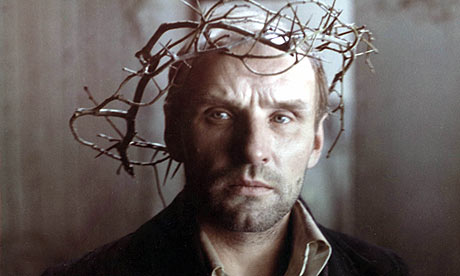
Crown.

For the record, this is the first time that I have watched an Andrei Tarkovsky film and I must say that it was quite a spellbinding first encounter. Both confusing and enthralling at the same time, "Stalker" is a timeless meditation on beliefs that contradict what's empirically perceived and is also a deep exploration of intellectual apprehension. Part-fantasy, part-science fiction and, in some ways, a quasi-religious discourse, this film is unique not just because of the otherworldly concepts that has established the film's visual texture but also because of the density of what it speaks of. 
     
Although painfully slow in its pacing, "Stalker" is never boring because of the quite stunning ideas that it presents. The film, about two tormented intellectuals and how they are guided by the titular character towards the 'Zone' (a place that is said to have the ability to grant wishes), is an adventure of immense consequences. It is a soul-searching trek towards a proverbial 'end of a rainbow' yet it is also a melancholic journey made infinitely more compelling by the characters' constant polemics. 
     
At times, I even found the conversations and arguments between the three characters to be even more fascinating than what their mission awaits them. This, I think, is the thing that makes auteurs like Tarkovsky very, very exceptional. Aside from their command of the visuals, they are also in control of which language their films would speak. And in "Stalker's" case, Tarkovsky mainly chose the language of metaphysics to further the film's profound abstraction. 
     
With the film mainly concerned about the unanswerable inquiries about the meaning of life and the anxiety of both knowing and feeling too much (represented by the two intellectuals, one a writer and the other a physicist), it was quite obvious at certain times that the characters' utterances are personal musings coming from Tarkovsky himself. At one point, the film has even discoursed about the unselfishness of art and the shallowness of technology (the writer character claimed that technology is nothing but an 'artificial limb' which makes people work less and eat more); with Tarkovsky the auteur at the helm, that particular statement is obviously all too personal that it seem out of place in a film that deals with monolithic ideas about life in the context of despair. But nonetheless, it's also all too refreshing. This is why true auteurs and no one else can best capture intimate artistry both at its most divine and at its most turbulent; they just know it all too well. 
     
Now if there's a term that would best describe the feat of creating this film, then I think it would be 'miraculous'. A convergence of imagery and content, "Stalker" is masterful not just because of the technical craftsmanship that comes with it or the weight of its ideas but because of the equal distribution of both and the patience of how they were balanced.  And then there are also the locations that have made the film even more special. With the 'Zone' seemingly taking on a life and character of its own as the film progresses, the way the place was visually presented is quite impressive because of how three-dimensional it was. With a naturally pervading sense of unpredictability, acute danger and, ultimately, of spiritual transcendence, the 'Zone' has been the strong backbone of the film. 
     
Shooting in ruins, dank tunnels and dark sewers, Tarkovsky and company has molded the reality (or unreality) of the 'Zone' in a way that's mystical yet also consistently dystopian. Also, there were some great performances in it too, particularly that of Aleksandr Kaydanovskiy as the 'stalker' himself. 
     
In some ways, the film's final minutes, at least for me, seems to be a subtle commentary regarding the irrationality of religion (with that enduring image of one of the characters wearing a crown of thorns on his head as if emulating Christ) and the outlandish belief towards both the unknown and the unseen. But despite of the film's flowing cynicism, "Stalker" still echoes hope even at its subtlest. Amid the film's overwhelming sense of intellectualism, it has at least succeeded to be emotionally eloquent. Though the film has left many questions in its wake, it offers closure on an emotional level. That, for me, is what's more important.

FINAL RATING
Photobucket 

Sunday, January 16, 2011

Kinatay (Brillante Mendoza)

Brillante's 'Inferno'.

Film Review Archive (date seen: November 7, 2010)

"Kinatay" is one of my 'quiet' must-see films not just because of the Cannes directorial prize it has garnered, but also because of Brillante Mendoza's experimental style of filmmaking, which I reckon to be a refreshing touch to an industry pestered with endless recyclable ideas for movies to pass as 'blockbusters'.

For the initial sequences, Brillante never bothered for sound editing, but instead used the seemingly nuisance-like sounds (the assorted voices of people, jeepneys) to his advantage, transforming it with true verite' ability into an element to breath character into the film as a whole.

But as it gradually enters the realm (the reality of violence and corruption) of the theme which it is pointing to the entire time, "Kinatay's" whole visual and sound texture also becomes different; its realistically colorful display of everyday life in the slums which suggests some hints of momentary gayness turns into a symbolic descent into the netherworld of crimes and profanities (not even bothering about geographical correctness) filled with darkness and aural ambiguities.


Yet Brillante Mendoza's extreme inclination to portray psychological forebodings is also the film's major weakness. Though this might not be a problem for experienced film watchers, this particular slow build-up betrayed its main theme that when the film finally got to where it wanted to be, the audience may already be exhausted and disinterested that they may just accept the violent display merely as a "shock value", when it could have been taken in as a more profound inquiry into the moral consequences of violence. In some ways, this film reminds me of the main exposition of Coppola's "Apocalypse Now", only this time, there's no Kurtz to kill, but a morality to waste based on a decision ultimately driven by the short-lived promises of monetary gain.

FINAL RATING
Photobucket

1001 Movies You Must See Before You Die

Ivan6655321's iCheckMovies.com Schneider 1001 movies widget