Showing posts with label period film. Show all posts

Wednesday, January 29, 2014

The Wolf of Wall Street (Martin Scorsese)

a.k.a. "The Douche of Debauchery Street"

From "The Great Ziegfeld" and "Citizen Kane" up to "Easy Rider" and "The People vs. Larry Flynt"; American cinema is definitely no stranger in tackling larger-than-life individuals taking on larger-than-life dreams and then subsequently disintegrating at the seams. It's a theme so common among American films that "The Wolf of Wall Street", the newest film by the great Martin Scorsese and was based on the novel of the same name by Jordan Belfort, seems awfully fresh and new yet so strangely familiar. After the great but very un-Scorsese-like "Hugo" (a film that felt like it was ghost-directed by Robert Zemeckis), fans will surely be delighted because, in many ways, this film once again showcases the Martin Scorsese we always knew, delirious and all, that has mysteriously went AWOL after 2006's "The Departed". 

Take note, though: "The Wolf of Wall Street" is not a colorful gangster film or even a cold period piece ala "Shutter Island". If Scorsese classics like "Goodfellas" and "Casino" were fly-on-the-wall looks at the hierarchical and systematic (not to mention bloody) operation of the Mafia, "The Wolf of Wall Street" is a chaotic depiction of the alternate lives stockbrokers lead once the Benjamins start to pile up more than they can handle. It is as dark in its comedy as it is disturbing in its debauchery, and though the film can be viewed mostly as a study of immorality and the evils of money, the film also has the trademark 'cautionary' feel that radiates from almost all of Scorsese's gangster features. Remember Harvey Keitel's quote from "Mean Streets"? "You don't make up for your sins in the church. You do it in the streets. You do it at home." This film forcefully begs to differ, for it suggests that you make up for them in luxury yachts and orgy rooms instead, while you snort the living hell out of everything that can be snorted.

Everything in the film, from the opening shot up until its sobering finale, screams 'Martin Scorsese' over and over again. But more specifically, it echoes "Casino" all too vividly, which makes the film nostalgic yet imbued with a 'been there, seen that' vibe, from the tracking shots to the strangely accommodating narration. Though on the up side, Scorsese himself should be more than commended for being able to handle a hard-hitting film with such smutty, hoop-de-doo imagery that perhaps only the combined forces of Sidney Lumet and Robert Altman in their heydays may dare to take on. And judging from its sprawling 3-hour running time, it is not too hard to infer that Martin Scorsese is, and I'm saying this with a devilish grin on my face, very much in love with the subject matter, which definitely validates some people's claims that the film glorifies excess. 

Well, perhaps it does, but it depends on who will see it. Frat boys, for instance, may go gaga about the more explicit scenes (add up their main man Jonah Hill's involvement) the same way how some '90s hip-hop artists have memorized by heart the lines from "Scarface" as if they are verses straight from the good book. The film is "Fear & Loathing in Las Vegas" all over again but without Hunter S. Thompson's aimless ramblings, and with a kind of resolution that will surely make you ponder if Gordon Gekko's "Greed is Good" speech in Oliver Stone's "Wall Street" has any truth behind it. The film is very familiar on what it really wants to be (a morality tale about money), but also occasionally sidesteps with one shock-inducing sequence after another, and I'm not even complaining. Though it can be said that the film may have one sex and drug-related scene too many, its explicitness never crossed the boundaries of necessity. Visually, the film surely has gone way overboard at times to the point of being exploitative, but, as redundant as this may sound, the film's pointlessness is the point, and Scorsese could not have pulled it off more confidently. 

The cast, which has made the hedonistic script effortlessly feel more comedic and its epic running time shorter than it actually is, is flat-out brilliant if a bit scenery-chewing at times. In addition to that, Leonardo DiCaprio also unleashes what may perhaps be his finest performance in years as Jordan Belfort, thanks in part to his great chemistry with Jonah Hill, and also to his peculiar energy. Matthew McConaughey also shines in a brief role as DiCaprio's mentor of sorts. I hope I'm not the only one to have noticed this, but damn he looks like an anorexic Patrick Bateman in this film.

"The Wolf of Wall Street", though stylish, flashy, and a tad too promiscuous for a mainstream film, is still a powerful feature that proves once more the fact that Scorsese is still far from losing his mojo. More than anything else, the film is obviously a stylistic replication of Scorsese's own film "Casino", but it nonetheless reverberates with a kind of sexual and moral audacity seen and felt more in brave art house features than in typical Oscar front-runners. After all is said and done, "The Wolf of Wall Street" is far from being one of Scorsese's very best, but it definitely sits atop the slew of films he has churned out in the last 10 years or so. This is definitely not the film you would want to watch if you're an idealistic businessman or an aspiring millionaire that wishes no one harm. Go watch Macaulay Culkin's "Richie Rich" instead.

FINAL RATING 
 photo 42.png

Saturday, May 11, 2013

The Grandmaster (Wong Kar-wai)

Master Yip.

Yip Man, whose life is a common favorite among filmmakers to interpret and is also perhaps the Asian cinematic equivalent of Abraham Lincoln, headlines yet another film about his chain-punching exploits. But this time, we've got a cinematic heavyweight at the helm in the form of Wong Kar-wai. Plus, we've got the Asian king of cool Tony Leung Chiu Wai as Yip Man himself. Despite the question of "The Grandmaster's" true necessity as a biopic (the 2008 Donnie Yen-starrer "Ip Man" may have already sufficed), the film has nonetheless sparked immediate interest among cinephiles because, why wouldn't it? It has Wong Kar-wai and Tony Leung Chiu Wai in it, not to mention that Zhang Ziyi (Zhang Ziyi!) is also part of it. It also has an amazing cinematography and an obvious promise for some solid, kick-ass martial arts action. Now who would not figuratively jizz all over such a project?
     
Set in Foshan a few years before the Japanese occupation (but then again, so was the Donnie Yen film), "The Grandmaster" chronicles, through Wong Kar-wai's trademark, quasi-poetic visual style, Ip Man's well-deserved rise to high esteem as a martial arts master and sudden fall as a wartime-stricken citizen. The film also fascinates by highlighting the fact that a brothel, named the "Golden Pavilion", has been the favorite haven among martial artists (and also the most preferred venue for their fisticuffs) during the time. Well, let's just say that it's kind of like the early 20th century equivalent of those modern, organic coffee shops and the masters themselves as the hipsters that inhabit them. Things indeed just recur. 
     
In a nutshell, well, the film is basically about this bunch of high-flying, philosophy-uttering bohemians who fight for some obsolete sense of pride, respect and discipline, even amidst a time of guns, bombs and widespread hunger. Surely, it was a fascinating thing to tackle, especially since the earlier "Ip Man" film is so much more focused on a bombastically illusory narrative (its title should have been "Ip Man vs. Japan") more than Yip Man's intensely spiritual personality. But still, "The Grandmaster" is, after all, supposed to be a martial arts film, and Tony Leung Chiu Wai, basically, is supposed to kick some ass. Heavy philosophizing, for me, should belong in other films. Hell, even his eventual student Bruce Lee, who also had his share of martial arts movies, would certainly agree. You don't mix forced dramatics, contrived verbal symbolism and uncalled-for romance with some good ol' bone-cracking action because, sooner or later, it would definitely overwhelm what the film is really destined to be. And alas, that's exactly what happened with "The Grandmaster". 
     
In some sense, the film has even lost itself halfway by not being about Yip Man anymore. Instead, it has problematically focused on what is an otherwise very sub-par revenge narrative instigated by what is otherwise a very forgettable character in the form of Zhang Ziyi's Gong Er. Now, that's two aspects right there that "The Grandmaster" has missed its mark on: first on being a true martial arts film, and second on being a memorable biopic.  
     
As for the imagery, well, you really wouldn't expect anything short of brilliant from Wong Kar-wai. Dream-like in its execution and peppered with Wong's fevered slow-motion shots, the film's visuals flow like an achingly beautiful lullaby. Suddenly, shades of Zhang Yimou's more reflective martial arts films come to mind. But then again, "The Grandmaster" is too weak and indecisive regarding what its narrative really wants to cover and whether its fight scenes were there to really matter that the film ultimately achieved only a third of its potential greatness. Sadly, the film is an 'almost' masterpiece. And with 'almost', I mean stuck in a gas station two miles away from its supposed destination. It really could have been so much more.

FINAL RATING 
 photo 352.png

Saturday, February 16, 2013

The Master (Paul Thomas Anderson)

The master and the mastered.

Many have been said regarding "The Master's" conspicuous allusions to L. Ron Hubbard and his church of Scientology, especially in how 'The Cause', the fictional religious group in the film, uncannily mirrors the said religion's intricate (but ultimately questionable) teachings. But after my first viewing of the film, I can really say that "The Master" is so much more than a quasi-satirical take on a controversial religion. More importantly, it is notable to mention that the film, amid its weird psychoanalytic vibe, is a piece brewing with enthralling character dynamics that are as involving as they are alienating, realized to utmost perfection by Joaquin Phoenix, Philip Seymour Hoffman and Amy Adams in what may be the best acting ensemble of 2012.
     
Fresh from his mock acting piece (chronicled in the Casey Affleck-directed film "I'm Still Here") which involves a Zach Galifianakis-like beard and some hip-hop music, Joaquin Phoenix, in one of 2012's best performances bar no role specifications, returns with a vengeance as the disturbed naval veteran Freddie Quell. A quintessential image of a wasted wanderer, Freddie does not know what to do or where to go next after a suggestively traumatic experience during the Second World War. But unexpectedly, one night after randomly boarding a yacht, he meets Lancaster Dodd, the multi-faceted leader of 'The Cause', who has developed an instant liking to Freddie's personality and, more specifically, to his paint thinner-infused booze. Slowly, they develop an erratic and openly psychoanalytic relationship that has also made an instant believer out of Freddie, even when Lancaster, as even what his own son has hypothesized, is merely making up the numerous doctrines of his religion as he goes along.
     
By fully imposing this complexly well-weaved relationship all throughout the film, Paul Thomas Anderson was able to make up for "The Master's" lack of narrative drive, and in that aspect, he has succeeded. But truth be told, "The Master" is no "There Will Be Blood", or does it even come close to being something akin to it. With quite a lack of thematic cohesion and a sense of narrative direction, "The Master", after a promising first half, falters both in power and energy in the second half, which leaves me very disappointed to say the least, especially considering the fact that this is my most anticipated film of 2012. Just like Joaquin Phoenix's character in the film, Paul Thomas Anderson appears to be quite lost, and it reflects in the film as it goes along, with both positive and negative repercussions.
     
In a way, being thematically directionless as a filmmaker adds to the overall mood and visual language of a film, and with "The Master", PTA's seemingly aimless psychological and science fiction-like philosophical jabbering is a great plus. But on the other hand, it's also the very same aspect that has squeezed out the film's strengths dry, until it reaches a conclusion that's characterized with a sort of hastened optimism.
     
For the record, he has never been this abstract since "Punch-Drunk Love", but also for the record, he has never been this optimistic, character development-wise, since, well, "Boogie Nights". But thanks to the film's stoic and sometimes emotionless imagery and its mercurial musical scoring that range from the relaxing to the downright unsettling, "The Master" was able to achieve a thoroughly frightening psychological undercurrent despite the fact that the film, after all, is heading towards a quite reassuring finale. Ultimately, the film, at least from where I see it, is all about the mystifying but deeply harmonizing relationship between man and religion. Unexpectedly, "The Master" has turned out to be more than just a brooding character study of a man lost between the harshness of his own reality and the emotional retreat that the so-called 'opiate of the masses' can offer; it is, after all, a quite comforting film that confronts religious cynicism and looks at it straight in the eye with the confidence of a newly reformed man.
     
In a way, "The Master" is a subtle criticism to those who criticize the truth to a particular religion, and for a seemingly cynical filmmaker like Paul Thomas Anderson, it is a truly welcoming sight. Now, I may sound stupid, but "The Master", with its insightful look at the interconnectedness of religion, psychology and sexuality, seems to remind me of a specific, Mormon-centric "South Park" episode entitled, well, "All About Mormons". In it, a kind-hearted Mormon boy named Gary, after hearing so much crap from Stan and his inquisitive statements regarding the veracity of Mormonism, suddenly manned up and delivered a most profound litany that is both a response to Stan and an address to us all: "Look, maybe us Mormons do believe in crazy stories that make absolutely no sense, and maybe Joseph Smith did make it all up, but I have a great life, and a great family, and I have the Book of Mormon to thank for that."
      
That quote, for me, is the essence of "The Master", specifically in the context of Freddie's emotional and psychological development. Yes, perhaps, my analysis of the film may be a tad too optimistic for some, but that's how I have made out the film. After sifting through much of my thoughts while writing this review, I still do think that I have arrived at a very justifiable conclusion. "The Master", in many ways, is a celebratory probe into the ever-changing nature of the human person. The only catch is that it doesn't look and feel like one.

FINAL RATING
Photobucket

Friday, January 18, 2013

Les Misérables (Tom Hooper)

Cosette.

Certainly the most visually stunning film of the year, "Les Misérables" is no doubt a musical picture of epic proportions that's passionately held together by numerous powerful performances. Running close to 3 hours, the film is indeed a cinematic dream come true for musical fans, but may also prove to be quite an extensive chore to watch for non-musical lovers. In a way, the song numbers may often tend to delay the film's otherwise smooth narrative progression, which is truly a proof of how musicals are more focused on prioritizing moods, emotions and internal turbulence rather than the stories themselves. As a song number ends and another one begins, I can't help but notice the audience's numerous laughs of disbelief as they uncomfortably twitch and readjust in their seats. "Les Misérables", despite its all-star cast and visual spectacle, is indeed not for everyone. But nonetheless, it's still powerful stuff, with Anne Hathaway and Hugh Jackman leading the way. 
     
Peter Greenaway, a visionary independent filmmaker, has once suggested that film adaptations (specifically Jane Austen's) are nothing but wastes of time. This statement may prove to be quite apt to this recent cinematic incarnation of "Les Misérables", but there's something in this Tom Hooper-directed version that is just quite transcendent to behold. One of them, quite naturally, is the performances, which were all elevated by a sense of both larger-than-life romanticism and subtle humanity. But the one who has really moved me close to tears is Anne Hathaway's performance as Fantine. Enhanced by the film's stylistic preference of capturing the song numbers in stark close-up shots (quite reminiscent of Carl Theodor Dreyer's "The Passion of Joan of Arc") rather than in flowing camera movements, Ms. Hathaway has delivered what may be the best performance of the year and the greatest of her career so far. Honestly, her rendition of "I Dreamed a Dream" is just so emotionally perfect and devastatingly heart-breaking that even at this very moment while writing this review, I'm still having some goose bumps. With echoes of Maria Falconetti in her performance, Anne Hathaway, despite her short screen time, has proven that although Jean Valjean's (Hugh Jackman) path to redemption is the real focus of "Les Misérables", it was her Fantine that is the anchoring soul of the film. I'm not exaggerating here or anything, but I do think that Anne Hathaway's "I Dreamed a Dream" scene is already worth the price of admission alone. 
     
But as expected, Hugh Jackman, whose resume boasts of a Tony award, is also pitch perfect in the role of Jean Valjean, who's just effortless in his embodiment of the character's rapid emotional transitions, usually from emotional fury to silent gentility and then back again. But let's not also forget Russell Crowe in the very complex role of Javert, who is very believable in his portrayal of the said character's adherence to both blind justice and pure conviction. Although his voice, as what other people complain about, quite lacks the power and range needed for such a crucial character, his facial expressions and imposing presence more than makes up for it. There's also the film's sleeper performance in the form of Samantha Barks' Eponine, who just shined in the role, especially in her "On My Own" number. On the other hand, Sacha Baron Cohen and Helena Bonham Carter, although in their usual element, never quite did it for me because, well, they're just too humorously ho-hum in their roles. 
     
Admittedly, "Les Misérables" is a film that's quite dated in its themes and very derivative in its revolutionary spirit. But nonetheless, it was still able to connect with me on a very nationalistic level specifically because of its numerous parallels with Jose Rizal's (Philippines' National Hero) "Noli Me Tangere" and "El Filibusterismo". As the film reaches its final crescendo and as the screen goes to black, it's as if I've watched an actual West End production, but this time with all of "Les Misérables'" 'sound and fury' magnified a hundredfold. "Les Misérables", an emotionally overwhelming musical film, is a textbook example of how stunning the marriage of stage and film can be when done right.

FINAL RATING
Photobucket

Thursday, December 27, 2012

Children of Paradise (Marcel Carné)

Baptiste and Garance.

The great Francois Truffaut has once stated that he would indeed give up all of his films to have directed "Children of Paradise" himself. If that's not a testament of the film's more than impressive whole, with its ability to impress and stir up healthy jealousy among other equally heralded filmmakers, then I don't know what else will be. The film, shot during the turbulent times of Nazi occupation in France (French Resistance members at the time even secretly worked in the film's production), is a miraculous achievement not just of cinema but of the entire realm of art. By merging the symphonic beauty of two of the greatest art forms the world has ever seen (theater and film), Marcel Carné, the film's director, has created an unforgettable screen masterpiece that is both aesthetically moving and emotionally evocative. 
     
Although it was cleverly marketed in America as France's cinematic answer to Victor Fleming's "Gone with the Wind", "Children of Paradise" is so much more than just a foreign substitute to an epic Hollywood picture. It is, by its own right, a stand-alone film that ambitiously treads the territories of both love and artistry, not to mention that it is also a visually stunning rendition of 19th century France. Populated by characters that seem to be molded after Charles Dickens' creations, "Children of Paradise", in a way, moves and unfolds like great literature (the film was even split into two distinct, very novel-like chapters). But unlike the lively pageantry of "Gone with the Wind", "Children of Paradise", even at the film's early moments, is already burdened by a running sense of melancholy, specifically when the camera first focuses its lens on the face of Baptiste (Jean-Louis Barrault), a great pantomime who will find himself slowly falling under the spell (and pain) of love. The object of his affection is Garance (Arletty), a stunning woman who sees love merely as a simple phenomenon and who, at first sight, was immediately magnetized by Baptiste's romantic peculiarities. 
     
But then, it's not only Baptiste who's smitten by Garance; on one side, there's Frédérick Lemaître (Pierre Brasseur), a flamboyant theater actor whose acts atop the stage bleed through life itself. On the other, there's also Lacenaire (Marcel Herrand), a part-time poet and full-time criminal whose great contempt of life can only be matched by his enormous pride. And finally, there's Count Édouard de Montray (Louis Salou), a rich man who baits Garance with his unequaled fortune so that she will not love any other man ever again. 
     
Together, these four characters engage in a slow dance of doom that finally justifies the melancholic undercurrent that runs through the film. But even though "Children of Paradise" plays like a tragedy, the film, for plenty of reasons, will surely put a smile in every cinephile's face mainly because of its visual and thematic perfection. And even though the film runs close to 3 hours, I honestly would have wanted 3 more. Hell, the film, with its highly eloquent and intuitive screenplay (by Jacques Prévert), could have been an audio book. But then again, it could have also been an enjoyable silent film, what with its pantomime fluidity and swift physical timing. 
     
Considered by many as one of the greatest films of all time, "Children of Paradise", again despite of it being a romantic tragedy, is a celebratory film that embraces and makes one with art even in the midst of a violent global conflict. "Children of Paradise", a flawless masterpiece of French cinema, will always stand the test of time not just as great art but also as a proof that cinema can never be crippled by war-time destruction, be forced underground by bombs and be shackled by fear. "Children of Paradise" powerfully persists.

FINAL RATING
Photobucket 

Tuesday, December 25, 2012

El Presidente (Mark Meily)

Aguinaldo.

After last year's surprisingly good period gangster film that is "Manila Kingpin: The Asiong Salonga Story", here is E.R. Ejercito again with an Emilio Aguinaldo biopic entitled "El Presidente", an infinitely trickier film to pull off, scope and exposition-wise.
     
If E.R.'s previous film focuses mainly on gangland altruism, "El Presidente" is all about patriotic resilience amidst imperialism, and it definitely shows on the film's abundant dose of sentimentalism. And if E.R. seems tailor-made for the role of Asiong Salonga (after all, he has already played Asiong in the '90s film "Asiong Salonga: Hari ng Tondo"), he seems feverishly out of place in this whole historical drama, especially when he's surrounded by character actors that are ten times more talented than him.
     
Now do not get me wrong, when I think of a more suitable and relatively bankable actor to play Aguinaldo, I can't really think of anyone save for Ejercito himself (as of the moment, that is). Except for his bulldog-ish cheeks, Ejercito nicely fits the title role specifically because of his relative mass appeal and sense of authority. But then, somebody has seemingly forgotten to remind him that "El Presidente" is, after all, a film and not a theatrical play.
     
With his repetitively oratorical hand gestures and monotonous line deliveries, despite of the stature of the person he's playing, E.R. is easily dwarfed by his co-actors in the film, specifically Cesar Montano, whose brief but strong turn as Andres Bonifacio is a mild cause for celebration. Except for his hair that's anachronistically gelled upwards, Cesar Montano's Bonifacio is so well-portrayed that I wouldn't bother for him to have more screen time than Aguinaldo himself. Granted, "El Presidente" is quite sophisticated with its cinematography and action sequences, but its whole narrative seems fairly derivative and very 'Philippine History 101' that the film's human aspect was left terribly wanting.
     
Complete with cursive texts beneath every establishing scene that continuously remind us that the film is more of a crash course on the history of pre-republic Philippines rather than a fairly humanizing story of a great man (this, of course, depends on who's seeing the film), "El Presidente" never quite connects on the emotional level. Instead, and this is quite saddening, it merely gives out the occasional 'wow' factor with its action set pieces, mammoth scope and nothing more. And although I also liked Baron Geisler's intense performance as a Spanish captain, the film's supporting cast was fairly uninspired and a tad too unconvincing; indeed, a bunch of artificially mustachioed lads sputtering things about independence and going slow-motion on simulated battles is not enough. Well, maybe that is the ultimate downside of a historical drama: the scope is almost always so big that the characters are rendered as nothing but glorified plot details.
     
In a way, "El Presidente" is "Jose Rizal's" (the film, not the man) campy and overly sentimental half-brother who gets into too much unjustified scuffles. If Cesar Montano's portrayal of Jose Rizal is one founded upon complexity, dedication and utter intensity, E.R. Ejercito's Emilio Aguinaldo is founded upon monotony, misplaced emotions and uncalled-for action star-ism. In one action scene when he has suddenly pulled out a very gangster-looking boot knife, I even expected E.R. to suddenly show his ever-wriggling tongue and shout "Ako si Boy Sputnik!" His performance is just so all over the place that at the end of the day, "El Presidente" has made me root more for Andres Bonifacio. Now I have this sudden craving to watch Richard Somes' Bonifacio biopic "Supremo".
     
But in all fairness, the film's final 15 minutes or so is quite powerful. In a way, it reminds me of the final moments of Bernardo Bertolucci's "The Last Emperor" in how both finely convey the elegy of time in the lives of the most powerful and seemingly immortal leaders. The appearance of Nora Aunor as Emilio Aguinaldo's second wife though, who was cast just so she can be put into the posters as a potential crowd-drawer, is a complete non-event. In my opinion, they could have put Lilia Cuntapay in the role and it wouldn't really even make a strand of difference.
     
"El Presidente", although admittedly a grand, sweeping production, is a very clunky film that offers little to nothing that our history text books have not taught us yet. Perhaps showing some of Aguinaldo's trivial humanity wouldn't hurt. And yes, "Manila Kingpin" is better.

FINAL RATING
Photobucket 

Wednesday, October 17, 2012

In the Mood for Love (Wong Kar-wai)

Mr. Chow and Mrs. Chan.

It is quite well-known that Wong Kar-wai's filmography is one of great cinematic essence, so as a long-time film fan, I am quite ashamed to say that this is the first film of his that I have ever seen. But what I have felt right at the very moment the film has started is one of immediate admiration. "In the Mood for Love", a film of quiet romantic power, is really not about love at its most denotative sense. Instead, like the later "Lost in Translation", it is a film of how romance transforms into something more than the usual hugs and kisses. Sometimes, it is not strictly eternal love that people look for but simple human connection, and in this film, it was displayed in a way that fully evokes the particular emptiness that asks for it and the gentle emotional force that attempts to fill it up. 
     
The film's premise, about two lost souls and their sudden romantic spark after finding out that their respective better halves are cheating on them, is a subtle observation about the pain of extramarital affairs. And with Wong Kar-wai's choice of not showing the two characters' cheating husband and wife's faces, the film takes on a more absolute form. They know that they wouldn't be together for a long time, but they are aware of the feelings that will permeate across time years after they part ways. And in this brief time that they share together, how comforting it is to feel that all of it shall last forever. 
     
But wait, how about their marriages? Isn't this a form of cheating as well? Well, maybe that is the case, but Wong Kar-wai highlights the fact (through precise cinematographic compositions and haunting musical score) that their romance is in no way a form of transgression; hell, it's not even romantic revenge per se. Instead, it is quite simply because of human impulse, of our tendencies to look for a hand to hold on to in our perennial struggle to find answers to our questions, and of our adherence to the concept of love no matter the emotional price we may subsequently pay. We are born to love, but hell, we are also born to be hurt; "In the Mood for Love" dwells somewhere in the middle. 
     
Stars Tony Leung Chiu-Wai (playing Mr. Chow) and Maggie Cheung (playing Mrs. Chan) are evidently perfect in their roles. In the film's earlier moments, their body language perfectly conveys their utter indifference to one another. But as the film progresses, especially at the moment when they both realize that the love they have found is something that cannot be cherished for a longer time (their husband and wife are merely on a business trip in Japan, presumably consummating their own secret love), their faces show something that suggests contemplative sadness. They hate to see each other go but they nonetheless accept it. They both hate to cut their romance short but they know that it is wrong to prolong it even more. They both know that they need each other but they just can't continue on doing so. And in one of the film's most powerful scenes, we see how they rehearse their final farewells and the subsequent pain that comes along with it. Saying goodbye is indeed a hard thing to do especially if the one you're uttering it to is the final person you'll ever wish to be on its receiving end. 
     
It is from this complex set-up that I was able to see through Wong Kar-wai's emotional maturity as a filmmaker. He is quite aware of the fact that human connection always arises from the most unexpected of situations and that love is a mercurial aspect of life that's easy to feel yet slides so easily from the palm of the hands. He is also quite articulate about the sheer transience of time and its role in reminding us that moments may fade but feelings just wouldn't. "In the Mood for Love", an artful amalgamation of style and substance, is a symphonic film about the unpredictability of love, the persistence of memory, and the gentle, bittersweet pain of harboring a beautiful secret. Welcome to my film-watching consciousness, Mr. Wong Kar-wai.


FINAL RATING 
Photobucket    

Friday, June 29, 2012

Tinker Tailor Soldier Spy (Tomas Alfredson)

Smile, Smiley.

In "Tinker Tailor Soldier Spy", the reality of Cold War espionage has never been as coldly depicted. It's a film that's really intended to be emotionally distant from its viewers so that it can properly highlight the alienating undertakings that Cold War master spies have undergone themselves for a great 30 years or so for the sake of information supremacy. 

One of them is George Smiley, played by the ever-chameleon-like Gary Oldman in one of his most uncanny performances in a non-villain role, a master spy who is forced out of retirement to seek out a mole buried deep within the Circus' (the jargon for British Intelligence) ranks. What follows is a tensely complex story of half-baked allegiances, harsh inner rank politics and, looking at the bigger historical picture, the futility of it all. 

Oldman, a great actor known for his nerve-racking energy on-screen, is successfully sublime and grounded with his portrayal of Smiley. Despite of the lack of human warmth in the whole film, Oldman is able enough to capture the essence of Smiley's anxious humanity without being either too brooding or self-reflective. Here is a character and a man who is motivated not by his family and forced to act not by the pressures of those around him in the service but by a seemingly obsolete code of samurai-like proportions. He is compelled to do so because he believes there's still an enormously unfinished chess puzzle of fates between him and Karla, the mysterious Soviet spymaster that is both deceptive and brutal. In a tense world whose morality and loyalty is turning ever grayer by the minute, Smiley still believes in a black and white.

But then, finding the mole is a very tricky mission. He needs to go through a lot of red tape to arrive at something. Among the ones that Smiley must monitor (as potential leakers) are Alleline (the underrated Toby Jones), the Circus chief, and Haydon (Colin Firth), a superior intelligence officer that's having an illicit affair with Smiley's wife. 

With such great actors effortlessly horsing around with their respective characters, one can easily see the success of this film as a great acting ensemble. Add up talented young actors Mark Strong and Tom Hardy in the mix as the Circus' globe-trotting pawns and we've got ourselves a hell of a film. Oh, and did I mention that John Hurt is also in it? 

But then again, with the film capitalizing on natural overall silence as if to truly simulate the quiet intrigue of genuine espionage, "Tinker Tailor Solider Spy" gets its sustaining power not just from the actors but from the very material itself. Adapted from John le Carre's novel, which I'm more than tempted in buying from our local bookstore so that I can read it first before watching this (but never did), the film has captured the nervous essence, with its pale-colored cinematography that heightens the disillusioning effect, of the reality of spying without much glitter but full of quiet power.

To be exact, I have never witnessed such an intriguing 'backstage pass' of a film ever since, well, maybe Scorsese's "Casino". "Tinker Tailor Soldier Spy" is a rare film that does not indulge on cheap thrills just so it can maintain some sort of energetic flair in its narrative. Instead, it is a film with a great fly on the wall perspective that is as compelling and as frightening as the characters that populate it and the locations that make it whole. Director Tomas Alfredson is very commendable for not going overboard on some of the characters or faltering in the story department. 

Now, if some may want to argue that "Tinker Tailor Soldier Spy" is as cold as a walk-in freezer and that it will make you want to leave the second you enter it, then the film has succeeded. Its goal is not to sensationalize or commodify the reality of Cold War espionage for the general public but to render it as a cinematic mood, and it's your choice to either accept it as it is or not. But judging from its box-office returns, it's quite obvious that the film has compelled rather than disgust, and for that, the film is utterly effective and, in some ways, vindicated. 

"Tinker Tailor Soldier Spy" may just be fiction, but in the end, it's a story worthy of being told. It makes me want to grab that gargantuan "Smiley Versus Karla" compilation in our nearby bookstore, and fast. James Bond's great antithesis has finally arrived.

FINAL RATING
Photobucket

Tuesday, May 15, 2012

A Dangerous Method (David Cronenberg)

Freud, Spielrein and Jung.

Here in "A Dangerous Method", David Cronenberg dips his fingers into the realm of Analytical Psychology. Directing this film with two of the founders of psychoanalysis, Carl Jung and Sigmund Freud, as the chief characters, Cronenberg, one of the most visually audacious filmmakers out there, is surprisingly mellow and at ease with reality here, add to the fact that "A Dangerous Method" is a historical period piece which follows a true story very closely.

But that does not mean that he won't play with some peculiar stuff here. Being a director of this film but at the same time also a keen observer of the entire psychological unraveling wrapped in its very debauched innards, Cronenberg covers various truly unspeakable things in the film but is utterly dignified while doing it as he navigates through every scene with a gentle demeanor. Of course, the fact that Jung and Freud, both blessed with the utter characteristics of the perfect gentleman, are the main players in this film has helped to make the film externally pristine as they walk through the equally elegant backdrops of Vienna and Zurich.

But, as they say, looks can be very deceiving.

With Carl Jung and Sigmund Freud being successfully played by great contemporary actors Michael Fassbender and Viggo Mortensen (who has made his third film now with David Cronenberg) just like two genuine intellectuals wasting their days through the dissections of the human mind, it can be said that the very 'psychiatric' subject matter of the whole film should have stayed where it should have been: in Psychology 101 classes. Though at some points that's particularly agreeable, especially when the film seemingly begins to be too 'lecture-y' in its tone, specifically when Jung and Freud start to talk in a language that is too abstract outside of their field, the film still has managed to be truly riveting at some points.

Some of those said 'points' can be traced back to Sabrina Spielrein, played by Keira Knightley who just might have been robbed of an Academy Award nomination, and the brief but penetrating presence of Otto Gross, played by Vincent Cassel who has now made his second film with Cronenberg following "Eastern Promises".

Sabina, a hysterical young woman aspiring to be a psychoanalyst who's under the analytic care of Carl Jung, may initially look as if she's a lost cause, but knowing how she became a professional child psychologist after the events in this film while also changing the lives and the very field of both Carl Jung and Sigmund Freud, the more that her utterances in this film increasingly become more and more fascinating as it goes.

While Otto Gross, the man responsible for goading Carl Jung's little 'experimentation' with the darker possibilities of sexual exploration via the deprived Sabina, is Jung's patient who believes that the thing we call 'maturity' is what he calls a mere 'parameter' that hinders people to achieve complete sexual fulfillment, among others.

Jung, initially introduced by the film as a seemingly stern man made almost invulnerable by the flaws of the mind, is surprisingly easily persuaded to try out Gross' view of sexuality. Cassel, a great French actor tailor-made for these kinds of edgy roles, is effortless as the subtly manipulative and magnetic Otto Gross as he delivers, in semi-cryptic utterances, his very own sets of sexual beliefs while greatly highlighting a tone of 'if you don't want to listen to me, it's okay' passivity.

Throughout the film, I can't really say if Fassbender and Mortensen, as great as they are as individual actors, both have made a truly cohesive chemistry in the film. Sure, their presences alone made this film worth the watch, but there's an underlying flaw that runs through the film's veins that speaks of forced character dynamics. Though some scenes between them gives the film its needed tension, especially in the scenes when they both exchange scathing yet formal letters as their professional and personal relationship dwindles into oblivion because of contradicting ideas and a terrible secret, I would have preferred if the film has been a bit longer. In that way, I believe the film could have developed the relationships better and also would have given way for more thematic exposition.

"Only the clash of destructive forces can create something new". At the time quite a revolutionary insight, Sabina, with those words, might have just also prophesized Carl Jung and Sigmund Freud's relationship. Cronenberg, now more than ever playing with words both conversational and philosophical in nature, has managed to throw into the air various intriguing ideas but was quite unsure of what he wants to do with all of it.

But in the end, I believe that the whole film, although it has dwelled within the deterioration of Jung and Freud's closeness both as a mentor to an heir and as a friend to a friend, comes down more strictly as Carl Jung's story viewed from the perspective of the grim reaper looking at the aftermath of a man who may have stumbled upon a great intellectual discovery but is internally destroyed by uncontrollable impulses and made weak by guilt as he drifts away in silently fractured contemplation, burdened by the visions of the apocalypse; of thousands of corpses bathing in the blood of Europe; of the First World War.
FINAL RATING
Photobucket

Friday, April 20, 2012

My Week with Marilyn (Simon Curtis)

Michelle Williams as Marilyn Monroe.

"My Week with Marilyn" is a textbook example of great performances trapped within the confines of an 'okay' movie. The film, mainly about the tension between Marilyn Monroe and Sir Laurence Olivier during the making of "The Prince and the Showgirl" and also about her brief (though harmless) liaison with an employee working on the said production named Colin Clark (whose memoirs this film has been based), lacks in storytelling urgency and may have been too mundanely directed (by Simon Curtis) that it has resulted on it being less fascinating than it should have actually been mainly because of the fact that it has relied more to its actors' strong performances (which, in ratio, is not particularly healthy for a film that seeks balance), specifically Michelle Williams' and Kenneth Branagh's, rather than the substance of the very material itself.

Not turning their roles into complete caricatures nor try-hard impersonations, both Michelle Williams, who deservedly got an Oscar nod for her incredibly vulnerable portrayal of cinema's greatest sex icon that is Marilyn Monroe, and Kenneth Branagh, who played the legendary film and theater actor Laurence Olivier, stayed true to what the film is humbly all about and did not act beyond the stature of the very topic itself.

"My Week with Marilyn", though it features movie icons (include Vivien Leigh there, played by Julia Ormond) in a light that bared their all too human side, is not really about their lives but more about the nuances of their fame. Hell, the film is not even mainly and solely about Marilyn Monroe either. Instead, the film shows the exploits of Colin Clark (well-played by Eddie Redmayne) when he worked as an employee in Laurence Olivier's production company and his subsequently unforgettable 'week' with Marilyn Monroe herself that is self-affirming yet heart-breaking and worth forgetting.

The said production outfit, at the time preparing for a film called "The Sleeping Prince" (later renamed as "The Prince and the Showgirl") starring Olivier and Marilyn Monroe, is a dream come true for Colin, who grew up constantly watching motion pictures with utmost delight. The film's production then started, and so is Colin's fueled enthusiasm as he navigates through dressing rooms and movie sets with starry-eyed curiosity and as if functioning on a trance. He indeed enjoys what he's doing so as far as existential clichés are concerned, he finally found the place where he truly belongs. But for Marilyn, in contrast with Colin's workplace 'high', seems to sleepwalk through the production, with her heart struggling to find the essence of her showgirl character, her emotions a mess, and her mind a confused car-wreck. As a result, shoots are delayed, casts are frustrated and Laurence Olivier (who's also the picture's director) surely is infuriated.

Branagh, playing Olivier in one of the most perfectly cast roles in quite a long while, which is an understatement, really, because the inevitability of him crossing paths with Olivier one way or another is but given (both Shakespeare graduates, on stage and film), seems to channel him in a way that is humorous, melancholic and on-the-edge all at the same time; indeed an aspect in his Olivier characterization that he has purely derived from his very own acting energy and his inclination in combining overwhelming emotions with quasi-theatrical gestures.

Michelle Williams, on the other hand, has fully erased all skeptical notions towards whether or not she can do justice to the Marilyn Monroe role. Once, I've even read many posts in an internet forum repeatedly stating that she was terribly miscast in the part and the likes of Scarlett Johansson, who's appropriately buxom just like Monroe, should have played her instead.

Well, to begin with, I beg to differ with that alternative choice. If by chance Monroe has been played by Johansson instead, who's a modern sex icon in her own right, it will probably distract from Monroe's almost mythical screen presence (As a result of countless comparisons between the two that may also conjure up futile arguments) which will ultimately ruin the film's very impact.

So Michelle Williams, although armed with the proper acting credentials (with her great, Oscar-nominated performance in "Blue Valentine" the previous year), still has insurmountable odds working against her. But still, she has succeeded with what she's tasked to do, which is indeed a very tall one, to say the least. Mixing seductive playfulness that has always been a Monroe trademark with the illicit sadness commonly identified with larger-than-life movie stars, Williams, in a rather stellar effort that has certainly paid off in a very exemplary way, has finely portrayed Marilyn Monroe both as a movie star and as a conflicted young woman (though I think she has succeeded with the latter more) lost in a haze of bright lights and disheveled by the burden of fame.

All in all, I have to say that "My Week with Marilyn" is a fairly forgettable venture towards a potentially otherwise territory. But with the help of the performances (with Dame Judi Dench, Dominic Cooper and even Emma Watson providing additional attractions) and the film's conscious commentary regarding the sad and empty lives that many famous people pitifully lead once the novelty of fame finally wears off, the film has been at least particularly memorable. But still, I felt that it all just came and go, with only the portrayals being the ones able enough to leave a relatively enduring mark.

FINAL RATING
Photobucket

Tuesday, March 20, 2012

Corazon: Ang Unang Aswang (Richard Somes)


What immediately caught my attention regarding "Corazon" was the fact that it dared to tell a wholly original story within the fairly drought-laden lands of the local horror genre. With that alone, I think that that's a considerably tall order to do, but surprisingly, "Corazon", although flawed, is effectively unique in reminding the said genre the unbounded strength of utter originality. Give major credit to director Richard Somes, the man behind the terrifyingly melodramatic "Yanggaw", who has infused this film with enough guts, dramatic bravado and twisted soul.

In his interview, Richard Somes stated that with "Corazon", he has created a sort of origin story that will back up the whole "Aswang" lore that he has lovingly used in his films. For that matter, with this film, I think that he has embraced and contradicted his statement at the same time; embraced because, as we can all see, "Corazon" is a well-weaved (if not too melodramatic) tale that can really pass us a potent origin tale. But on the other hand, it is a contradiction because, at the end of the film, he has realistically told the tale of 'how' it might have been but he never convincingly stated as to how this could pass as a real 'Aswang' story in the first place.

"Corazon", stripped off of all the folklorian associations, is more a dark psychological film rather than a red-blooded creature feature. With its narrative that immediately connects the whole film's nightmarish ordeal with the hellish Japanese occupation (the film is, after all, a post-Second World War period piece), the paranoia of social discrimination and the flaws of an unguided devotion towards an abstract God, it's quite easy to surmise, through those key ideas, that "Corazon" is more of a sociocultural exploration of the so-called "Aswang" mythos rather than a strictly supernatural one. "Corazon" is your type of "Aswang" film that treads not the 'garlic' surface of it all, but the darker recesses of human frustration and perversion that may 'realistically' lead to something akin to a monstrous metamorphosis.

In terms of the film's whole tone, "Corazon" is sadly less atmospheric than the earlier "Yanggaw", though both boast of beautiful cinematography. And also, "Corazon", with its veritable approach to the "Aswang" lore, is arguably more prone to unintentional comedy. For more supernaturally-oriented films of the same kind, kinetically fast-paced motions of the said creatures are, more or less, understandable. But in "Corazon", with the titular character, a shy young woman, suddenly going quick in his feet as he succumb into a form akin to a monstrous stalker (specifically of children) merely because of a psychological lapse, such rapid change in both behavior and physicality is, I'm afraid to say this, quite laughable in some ways (with the audience's half-serious reaction in the theater that I've watched it in as my witness). Narrative-wise, it is excusable because although how realistic the approach may be, in the end we are still talking about garlic-fearing monsters here. But in terms of character transformation, this treatment to Corazon, from a suppressed woman to a monstrous murdering specimen without even a hint of supernatural intervention, just isn't believable.

But then again, maybe this lack of believability may have rooted from the choice of actress, which completely opposes the back story of Corazon herself. Erich Gonzales, playing the role of Corazon, is beautifully enigmatic and emotionally fragile. But this enigma and fragility is, more or less, leaning more towards the perennially 'Maria Clara'-type, not the 'reformed former prostitute who catered to Japanese soldier' kind. On the other hand, Derek Ramsay's Manuel, Corazon's husband, is a bit one-dimensional (I think the scenes of him holding his knife outweigh those which he does not) but also had his fair share of good moments. While the whole community in the film, however, that which includes the characters played by Mon Confiado and Epi Quizon, was reduced into nothing but a cinematic stereotype whose basic traits include bullying the resident mental case (Tetchie Agbayani) and discoursing about plagues and overall doom by way of their contemplative old-timers.

In its entirety, "Corazon", with its subtitle "Ang Unang Aswang", supernaturally speaking, never really proved to be a convincing origin story or a prequel that can support the events that has transpired in such films as "Yanggaw" or the overall notion as to how these most feared creatures, at least here in the Philippines, came to be. What "Corazon" has done, instead of delivering the immediate epistemology of our local boogeymen, has tackled the so-called origins of 'Aswangs' through sociocultural eyes, with the very 'origin' itself leading not to the exposition of the supernatural creatures' 'humble' beginnings but to the creation of our most primal of fears towards the unexplainable.

Every peculiar sound in our tin roofs, every weird sound in the woods and every howling dog deep within the night, there's this unconscious instinct within us all that immediately associate them to these carnivorously supernatural creatures of the night. "Corazon" strongly suggests a fictitiously alternative reason as to why we do.

FINAL RATING
Photobucket

Sunday, November 6, 2011

The Serpent's Egg (Ingmar Bergman)

Liv Ullmann and David Carradine.

I am really not quite sure what really is "The Serpent's Egg" more weighing flaw: The whole alienating premise of the film or David Carradine's robotic performance. But basing my choice on my better judgment, I'm gearing more towards the latter.

Throughout this whole Ingmar Bergman-directed feature, aside from that final, pseudo-scientific revelation, the film really felt nothing but an aimless exercise in existential angst. With our disillusioned and hapless protagonist roaming the decaying streets of 1920's Berlin that is completely unaware of a governmental take-over being led by someone named Adolf Hitler, I think that the groundwork as to why he's slowly being consumed by despair was not properly established, resulting with us being left with a main character that is both underwhelming and emotionally plodding.

I just don't think that David Carradine, a cult actor known for roles such as "Caine" in "Kung Fu" (a bit unrelated but it's interesting to note that his character here is then named "Abel"; a sort of an unconscious biblical allusion) and later as "Bill" in Tarantino's "Kill Bill", fits these kinds of roles. He's just relatively too tough-looking to really make his character believable and empathetic. Even Liv Ullmann, an actress of great emotional depth, is a bit out of place playing a forgettable character.

But then, there's Sven Nykvist's calculated cinematography that constantly puts dread and bleakness even in the most joyous cabaret settings and at the same time, finds emptiness even in a crowd. This is particularly evident in the film's impressive and disturbingly ambiguous opening scene (that is, until the climactic final exposition) where Nykvist has shot a scene of people of different ages and walks of life descending a stair with deeply melancholic and exhausted faces in stark, grainy black and white.

At certain points, the film's flimsy hands seem to let go of my already fleeting attention, but there's no doubt about the uncannily fascinating impression that the climactic 'explanation' scene, pulled off rather brilliantly by Heinz Bennent who played an experimentation scientist who knows the core secret as to why people like Abel are slowly slipping off from sanity, has left me.

Yes, it does felt that that crucially revelatory sequence looked and sounded more like a scene that you may see from those 'mad scientist' movies rather than from 'art' films like this, but for it to prophetically foretell the Nazi revolution's supposed 'New Society' and at the same time highlighting and comparing its idealistic superiority to an old one founded by the goodness of man is truly unnerving and, in a way, very brave.

And considering that this is Ingmar Bergman's first and only Hollywood film, "The Serpent's Egg" should be remembered more as a testament of his unbounded audacity rather than as a disappointing speed bump in his otherwise flawless oeuvre.

FINAL RATING
Photobucket

Wednesday, September 7, 2011

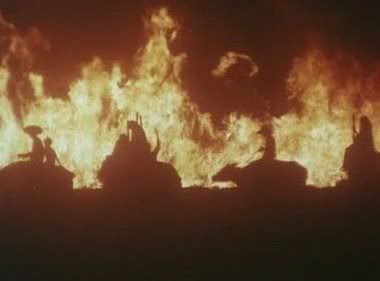
Oro, Plata, Mata (Peque Gallaga)

Ablaze.

A second viewing.


"Oro, Plata, Mata" can easily be accused of being too explicit and overly indulgent on Peque Gallaga's part, but it can't be doubted that this film puts forth a visually harrowing perspective that does not merely settle on pacifist commentaries or wartime tears. Sometimes, just like how Gallaga has presented his allegorical "Scorpio Nights", films must not wait in some dark corner in hopes that someone may clumsily pick them up out of curiosity. They must be assertive with their audience regarding whatever they want to show, and "Oro, Plata, Mata" succeeded to do just that, with the occasional 'shock' factor on the side.

Just like "Batch '81", which suddenly begins with a musical score that mirrors the sounds of a circus fun fair, this film also opened with a music that seems out of place. A mixture of harmlessness and sardonic sarcasm, the music plays as if it's poking fun of its mannered bourgeoisie characters, Bunuel-style. The film's opening credits greet us with assortment of characters moving in 'slow-motion' as they fix their hairs and smoke tobaccos. Going along with these scenes is this sinister feel that wraps them that seem to suggest that "Oro, Plata, Mata" is about decadence as it is about the entrails of war, if not more.

And as the film furthers its linear yet episodic narrative descent into the grave unknowns of war, it unfolds an unsettling portrait of how even the most mannered of people may easily concede to the angst-ridden sexual temptations that root out from living in ennui. But Gallaga, who shows his mastery of visual composition and a hint of exploitation (I believe that the film still would have worked even with two to three sex/nude scenes less), backed by Jose Javier Reyes' screenplay, extends the fact that the film's characters' emotional and carnal transformations weren't human deconstructions, but a simple case of skeletons in the closet. It's right with them all along.

Joel Torre, his first screen role, is remarkably effective as the frail Miguel, whose psychological metamorphosis from a mama's boy to a hardened killer is every bit believable. While an array of portrayals by Sandy Andolong, Lisa Lorena and Maneul Ojeda balances the film with subtlety, the film is made literally alive amid the film's more dragging moments by commanding performances from Lorli Villanueva and especially Mitch Valdez (credited as Maya Valdes in the film) as the calculating 'doktora', whose sexual promiscuity inspires the innocent Trining (Cherie Gil) to pursue and quench the thirsts of the flesh with Hermes (the vastly underrated Ronnie Lazaro), a Guerrilla rendered mute by the war.

There's no question about "Oro, Plata, Mata's" distinct influence across Philippine cinema. Whether it's the scope, the family-centered narrative or the violence, this film attracted 'greatness' for itself but does not brag about it. Never did I feel, all throughout its more than 3 hours of running time, that the film relished in self-importance. Self-indulgent, yes, there were specific scenes which were more a showcase of great cinematography and production design than sharp needles to stitch the whole film together. But still, "Oro, Plata, Mata" is nonetheless a lasting Filipino film that tackled the horrors, the deep wounds and the indelible scars of the Second World War unlike any other of its kind.

In the long run (quite literally for its length), it's never an overly pacifist film. Although there's this ambiguous 'diwata' character played by Kuh Ledesma that may subjectively symbolize the tarnished state of our 'Inang Bayan' (Mother Land) during the onset of war, the film is more about the isolated effect of violence and sexual immorality upon two families than it is a cinematic anti-war essay. Hell, we only see one Japanese soldier in the entirety of the film.

"Oro, Plata, Mata" is never concerned about the sentiments against foreign oppression that comes from islands away. With its blood-drenched message, the film is a brutal depiction of how at chaotic times, barbarism and decay gush out from nowhere else but within one's own backyard.

FINAL RATING
Photobucket

1001 Movies You Must See Before You Die

Ivan6655321's iCheckMovies.com Schneider 1001 movies widget