Showing posts with label World War II. Show all posts

Wednesday, September 7, 2011

Oro, Plata, Mata (Peque Gallaga)

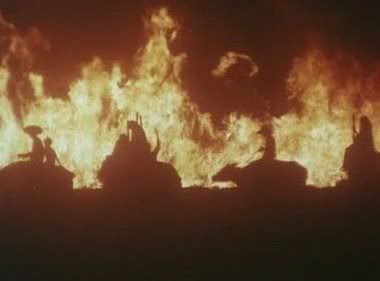
Ablaze.

A second viewing.


"Oro, Plata, Mata" can easily be accused of being too explicit and overly indulgent on Peque Gallaga's part, but it can't be doubted that this film puts forth a visually harrowing perspective that does not merely settle on pacifist commentaries or wartime tears. Sometimes, just like how Gallaga has presented his allegorical "Scorpio Nights", films must not wait in some dark corner in hopes that someone may clumsily pick them up out of curiosity. They must be assertive with their audience regarding whatever they want to show, and "Oro, Plata, Mata" succeeded to do just that, with the occasional 'shock' factor on the side.

Just like "Batch '81", which suddenly begins with a musical score that mirrors the sounds of a circus fun fair, this film also opened with a music that seems out of place. A mixture of harmlessness and sardonic sarcasm, the music plays as if it's poking fun of its mannered bourgeoisie characters, Bunuel-style. The film's opening credits greet us with assortment of characters moving in 'slow-motion' as they fix their hairs and smoke tobaccos. Going along with these scenes is this sinister feel that wraps them that seem to suggest that "Oro, Plata, Mata" is about decadence as it is about the entrails of war, if not more.

And as the film furthers its linear yet episodic narrative descent into the grave unknowns of war, it unfolds an unsettling portrait of how even the most mannered of people may easily concede to the angst-ridden sexual temptations that root out from living in ennui. But Gallaga, who shows his mastery of visual composition and a hint of exploitation (I believe that the film still would have worked even with two to three sex/nude scenes less), backed by Jose Javier Reyes' screenplay, extends the fact that the film's characters' emotional and carnal transformations weren't human deconstructions, but a simple case of skeletons in the closet. It's right with them all along.

Joel Torre, his first screen role, is remarkably effective as the frail Miguel, whose psychological metamorphosis from a mama's boy to a hardened killer is every bit believable. While an array of portrayals by Sandy Andolong, Lisa Lorena and Maneul Ojeda balances the film with subtlety, the film is made literally alive amid the film's more dragging moments by commanding performances from Lorli Villanueva and especially Mitch Valdez (credited as Maya Valdes in the film) as the calculating 'doktora', whose sexual promiscuity inspires the innocent Trining (Cherie Gil) to pursue and quench the thirsts of the flesh with Hermes (the vastly underrated Ronnie Lazaro), a Guerrilla rendered mute by the war.

There's no question about "Oro, Plata, Mata's" distinct influence across Philippine cinema. Whether it's the scope, the family-centered narrative or the violence, this film attracted 'greatness' for itself but does not brag about it. Never did I feel, all throughout its more than 3 hours of running time, that the film relished in self-importance. Self-indulgent, yes, there were specific scenes which were more a showcase of great cinematography and production design than sharp needles to stitch the whole film together. But still, "Oro, Plata, Mata" is nonetheless a lasting Filipino film that tackled the horrors, the deep wounds and the indelible scars of the Second World War unlike any other of its kind.

In the long run (quite literally for its length), it's never an overly pacifist film. Although there's this ambiguous 'diwata' character played by Kuh Ledesma that may subjectively symbolize the tarnished state of our 'Inang Bayan' (Mother Land) during the onset of war, the film is more about the isolated effect of violence and sexual immorality upon two families than it is a cinematic anti-war essay. Hell, we only see one Japanese soldier in the entirety of the film.

"Oro, Plata, Mata" is never concerned about the sentiments against foreign oppression that comes from islands away. With its blood-drenched message, the film is a brutal depiction of how at chaotic times, barbarism and decay gush out from nowhere else but within one's own backyard.

FINAL RATING
Photobucket

Friday, July 29, 2011

Captain America: The First Avenger (Joe Johnston)

Cap.

The most outstanding testament of how Marvel handles its core superheroes with utmost care in films, this is truly, without a doubt, the best Marvel movie that I have seen, or to be more exact, the finest 'Pre-Avengers' Avenger movie out there. It has certainly balanced the typical side humor present in almost all popcorn flicks with its action sequences that make it all the more explosive and entertaining. It's a war-torn celebration of patriotism and outlandish strength, and who would be better to represent such a film but the most obviously propagandistic superhero out there that is Captain America?

But a reminder to those who might be put off by the film's geographically-specialized protagonist, the film, directed by Joe Johnston like a true blockbuster filmmaker, is also quite conscious with its hero's stupendous status. Like a war-time satire, it highlights Cap's post-frailty but pre-hard hero masquerade as a symbolic mascot that parades around camp after camp and city after city to promote bravery and desire for clean-cut Allied victory. It partly worked because of Chris Evans' nuanced portrayal as a pretty boy figure that seemingly came out of the corners of the American Dream but whose outer motives is all but superficial. As told by the film's very fascinating look at Steve Rogers' literally 'small' beginning as a Brooklyn Boy U.S. draftee wannabe, his moral fiber is perfectly sound save for his physical built. But along came the scientific experiment and bam! Just like that, he's now muscular than ever and a genuine super soldier.

Now, based on the standards of common superhero origins, Steve Rogers' rise as a star-spangled super patriot is all too easy considering that Bruce Wayne got his parents killed before having enough inner strength to balance his conflict between being a hero and vigilante to become the legendary bat entity that he is. It can easily be said that Captain America's path towards being a superhero is relatively convenient compared to others, but with how the film has introduced his humble origins with a slightly sympathetic and sentimental view and then combining it with over-the-top occult and far-fetched science, do all superheroes really need to have some dark past to really carry out a great back story?

Strictly speaking, Captain America really is one of the few superheroes out there that really does not belong to an edgy reality. Although he existed in an era of widespread violence that is World War II, he's on a territory of his own. Some may say that his appeal is more inclined towards children more than it is for adults, but with his no-questions-asked fighting skills that the film has captured with its uniquely overblown (in a good way) Serial-style action sequences and a hardcore haze of Nazi foes, Cap balanced both demographic well enough. He's both a kid's dream idol and an adult's colorful nostalgia, and with "Captain America: The First Avenger", his myth as a Marvel character and as a most recognized figure of pop literature was finally materialized into the silver screen in a most overwhelming, and quite surreal, fashion.

With non-stop and knock-out (wow, two hyphenated rave adjectives in a sentence?) excitement and great performances by its array of actors, particularly Tommy Lee Jones in his Lee Marvin-like character, Dominic Cooper as Howard Stark and Stanley Tucci's bit performance as Dr. Erskine, it is a wonderful all-around cinematic experience.

But surprisingly, Hugo Weaving, considered the absolute go-to-guy for villainous roles (come on, he even voiced Megatron) and is also one hell of a versatile actor, is flatly one-dimensional in his role as Red Skull in a very 'James Bond villain' kind of way. But then of course, that might be intentional.

In countless alternate worlds where heroes and villains repeatedly play death-defying chess games of immense magnitudes with each other, Red Skull uses his mouth more than his hands. Words are not particularly useful when you got a boomerang shield heading into your face, you know.

"Captain America: The First Avenger" is like a grocer's errand boy who came late for your orders yet you find out that there's an extra something that he has put inside your grocery bags. We all know that a good Captain America film is long overdue, but as it finally came into our very midst, it exceeds the simplicity of the qualitative requirements of a decent movie. Instead, maintaining with the errand boy analogy, it 'delivered' with the silvery spark of a great action-adventure film. Sure, it's a given that Cap's 'Avengers' mates are extremely ecstatic about the film, but I instinctively know that elsewhere, Indiana Jones is also out there wearing a smile.

FINAL RATING
Photobucket

Monday, April 18, 2011

Tatlong Taong Walang Diyos (Mario O'Hara)

Chance.

Not so long ago, I finally came into a certain understanding that Filipino films will always be inclined into 'melodrama': The sappy music, intense displays of physical animation to accompany the drama, and of course, tears. It's a nauseating phenomenon in the Philippine movie industry when absolutely done the wrong way. But thank god there are films such as "Tatlong Taong Walang Diyos" to serve as timeless testaments to the magic that 'melodrama' can create and manifest within one's senses and emotions, from simple to complex, when done perfectly.

The film started with Hitler's rhyming, mouth-foaming speech regarding the strength of his socialist party. Being set in the times of the Second World War, the film unveils like how a history text book would for a student. But after this run-of-the-mill introduction, its story unfolds like how a poet affects to even the farthest of souls.

In plain sight, the film may look like your typical 'love caught by the tides of war' and a period vehicle for its star and producer, Nora Aunor. Granted, the love story arc is already established prior to the complications of the narrative, but I am deeply surprised and pleasured how complex the film really was.

At various points, "Tatlong Taong Walang Diyos" can be viewed as a metaphor for the ravages and ruins that the Philippines (The idea of the motherland may allude to Nora Aunor's (subtly powerful, as always) character Rosario and her initial abuse in the hands of Masugi, played by Christopher De Leon) have experienced during the Japanese Occupation and, on the opposite end, the potentially unconscious development of the Philippines' slow embrace towards the Japanese ways (how Rosario learned to love Masugi after she has been raped).

And pushing it further, Bembol Roco's character Crispin is the physical manifestation of the concept of a true 'Filipino' who, despite of the predicament that his real love (Rosario) has gone through, remained completely absent and consumed by fighting an abstract notion towards an illusory, national deliverance. The film may also relate to a slightly satiric approach to some Filipinos' extreme devotion to the perpetually clean-cut view of America and their intervention.

Mario O'Hara, a primed director and a memorable actor by his own right due to his performance in Brocka's "Tinimbang ka ngunit kulang", created this film with a certain honesty and a hint for something new. He dared not to mold a war film with old clays of sentiments and melancholy. He instead established a fresh foundation to the film, making the complexity of love and the ambiguity of Catholicism its true center and added up the hypnotically repugnant, yet may have been quite accurate, emotional weather of the time.

"Tatlong Taong Walang Diyos" never settled for a one-sided rally behind patriotism's usual sweet myth-making; director Mario O'Hara treated the Filipino people (that includes the Guerrillas) not as hopeful revolutionaries that can almost dwell on the pages of a legend, but as a confused crowd dipped into a mudflow of fever and hysteria: looking for even the slightest mistakes, violently ditching even the slightest idea of a socially unsanctioned love, and pointing fingers to even the slightest of flaws.

Nora's Rosario, on the other hand, served as their martyr; their miniature 'Joan of Arc' to make up for the futility of their distorted search for something meaningful. A senseless pervasion of mobocracy masquerading as a push for Philippines' well-being and disguised as a search for national identity.

The film covered so much, yet it came out as a simple tragedy of love. Deep analysis or surface viewing, either way, "Tatlong Taong Walang Diyos" is still a tremendous work of Philippine cinema. Where is film preservation when it's needed most? This film begs for a better print. Too bad it's too late.

FINAL RATING
Photobucket

Sunday, January 16, 2011

The Dirty Dozen (Robert Aldrich)

The 'Dozen', plus Lee Marvin's looming presence.

Film Review Archive (date seen: November 21, 2010)

An iconic and unforgettable war film, not because it has any sentimental message to send, but because of its sheer high-powered action, unforgettable characters, and a charismatic Lee Marvin as the tough Major Reisman. One can easily see its untainted influence across the years prior to its release, from modern 'ensemble' war films tackling different conflicts, to a masterful Tarantino homage in the form of "Inglourious Basterds".

Before watching the film, I've read the plot summary and saw derogatory adjectives such as 'losers' and 'lunkheads' on one side, with some atrocious descriptions like 'rapists' and 'murderers' on the other. I wondered, "how did Robert Aldrich pulled it off and squeezed out some form of heroism from these unlikable characters?" Then, while I watch the film, it occurred to me like a revelation, that all the negativity are all just paper-bound. Halfway through the film, the supposed 'death and hard labor-sentenced' criminals became even more likable than the actual military officers. Donald Sutherland is excellent in his precursor performance to his immortal Hawkeye in "MASH", Telly Savalas is great as Maggot, and Charles Bronson, arguably the king of cool next to Clint Eastwood, is, well, 'cool' as the German-speaking Wladislaw.

The developments, trainings, and comic reliefs proved to be very effective as a build-up to the literally shattering climax, with the team-affirming 'war game' as the film's best sequence. Though "The Dirty Dozen" is an action film urging audiences to cheer with the Major Reisman-led team, the final attack at the chateau, with the Germans trapped in the bomb shelter, proved to be an adequate slip-in commentary regarding the horrors of war.

FINAL RATING
Photobucket

The Guns of Navarone (J. Lee Thompson)

The bunch.

Film Review Archive (date seen: November 18, 2010)

I've grown up always hearing about this film, and how impeccably masculine it was. So, aside from the two female characters, it really is one of the iconic pictures to ever put a stamp on the "recruited men on a mission" sub-genre of war films. It appealed to me immensely how effective the opening narration is (seems like "Fargo"), making us believe, with that voice tailor-made for telling tall tales, how perilous the "Navarone" mission was, only then finding out that it's all a work of fiction courtesy of adventure novelist Alistair Maclean.

Though it's quite hard to view Gregory Peck as a British, he, aided by his personality, physical features and his pure cinematic presence, has ably passed as a believable leader of the bunch. As for the others, headed by Anthony Quinn and David Niven, they have created great chemistry among contradicting characters; an ingredient very much common for the sub-genre nowadays but was initially sparked by the influential Kurosawa classic "Seven Samurai".

There were some sequences that contained unsure, half-cooked editing, but with this film heading for an ending as anticipated and explosive (though not as morally puzzling) as the one in "The Bridge on the River Kwai", these slight blunders were easily eclipsed by the film's more exciting moments.

"The Guns of Navarone" is one of those blockbuster war films that has carried its sense of high adventure and action consistently while maintaining its grasp on 'morality' and a pacifist message that tells about how war can put it into 'ruins', like how their mission will wreak destruction on the eponymous weapon, and a parallel to the ancient remnants of its Greek backdrop.

FINAL RATING
Photobucket

Stalag 17 (Billy Wilder)

Spot the traitor.

Film Review Archive (date seen: October 7, 2010)

Perfectly balanced World War II film (or a POW film to be more specific) with the elements of comedy and drama contrasting and merging at the same time to great effect. On one hand, the whole humorous tone of the film is incredibly, almost single-handedly carried by the characters of Shapiro and Animal (Harvey Lembeck and Robert Strauss, respectively). While the complex tone of human spirit and survival against all odds flawlessly embodied by William Holden (in an Oscar-winning performance) as J.J. Sefton on the other.

In the expansive magnitude of films such as those of the war genre, it's very rare for a picture of this kind to play with the "whodunit" plot device. But the screenplay (based on a theatrical play) has brought the film into its revelatory climax without being very obvious of what (or who) it is pertaining to.

Besides its thrilling suspense and trivial comedy contained throughout as it heads into a surprise ending, "Stalag 17" also shows the side of soldiers unblemished even by captivity; that of their extreme devotion of preserving a much-admired "war hero"(Lt. Dunbar) from certain death.


But once they looked at J.J. Sefton with disdain and brow-raising judgments, both to his stance, his cigarette-trading antics and their hunch of him being a "stoolie", they never were aware that they're looking at yet another hero. He conforms with his captors, he's a loner in their ranks, but his ultimate gallantry's what really counts.

FINAL RATING
Photobucket

Saturday, January 15, 2011

Das Boot (Wolfgang Petersen)

Submerged claustrophobia.

Film Review Archive (date seen: September 18, 2010)

Claustrophobic and tense, "Das Boot" is an epic human study of survival set in the less-explored battlefields of the great second world war: the vast nothingness of the oceans. We know the stories of war zones: Stalingrad, Iwo Jima, Normandy. All has been said about those places: heroism, tragedy, casualties, you name it. But then there lies, beneath the watery abyss, the untold lives and existence of U-boat crews. The tension, anticipation, disappointments and camaraderie. Who would have surmised that a film out of these would be conceived? And even more so, the Germans, the much-dreaded stereotypical villains of the war genre, as chief protagonists? Director Wolfgang Petersen broke the boundaries of the genre and presented the said race not as ideological, ethnocentric monsters, but as vulnerable individuals that still cower on the face of imminent danger.

Jurgen Prochnow is unforgettable as the U-boat's captain, having the required experience and strength of character for such position, but still mentally encapsulated by endless insecurities and anxiety about the military hardware and capabilities of the Nazi regime. There were sequences of supreme technicalities always obligatory on the war genre but ultimately surpassing it and boasts not of the loud explosions and hard clashing of metals, but its brilliant foreshadowing of tension, its perfectly-balanced criss-cross between the narrow, sweaty confines of the U-boats' interior and the turbulent expanse of the perilous waters. Some complain about its long running time, but I think its the right approach to the film to thoroughly maintain the distress throughout the film, bombard audiences' senses with relentless suspense and create a credible bond and affection between the characters.

Adolf Hitler is on his podium, reciting reasons of the Aryan race's supremacy and yelling preposterous ideologies. But deep down the unforgiving bowels of the seas, lies the men to whom the world he promised; disillusioned, desperate, and hungry for home, they don't care about global conquest, they just need the 'silent run' and the 'surface'.


FINAL RATING
Photobucket

Downfall (Oliver Hirschbiegel)

A teary-eyed Hitler.

Epic mosaic of war-time Germany in the brink of Nazism's fall and can also be an ultimate film portrayal of extremist pride. I was quite surprised at how expansive the film has been in terms of parallel narratives, be it the brief story of a Hitler Youth's father or Traudl Junge's (played by Alexandra Maria Lara) observant but deeply emotional involvement with the life within the claustrophobic bunker. All of these pieces converge and circle around Adolf Hitler himself and his central deterioration from being a brain-washing, all-knowing tyrant/political rhetorician into a man grasping helplessly for desperate pride and twisted ideologies.

The Fuhrer to which the story focused its attention most of the time was brilliantly played by Bruno Ganz. Yes. Bruno Ganz. That sweet philosophically lovelorn angel in "Wings of Desire", now portraying the "worst ethnic cleanser the world has ever known". There has been numerous transmutations (even an alternate reality) of Hitler's cinematic persona, but after seeing "Downfall", with his undying ego and his stubborn final salvo for what he calls 'principle' perfectly portrayed by this film inside out, surface and within, no other cinematic evocation of Hitler and his life would be as definitive as this one.

"Downfall" never intended to entirely humanize Adolf Hitler (though I spotted some tears in his eyes). It merely gave a personification of a seemingly invincible prime ruler of the Aryan race and stripped him off of all the enigma and occultic intrigue. What we have is a Hitler stumbling and shouting his way into his defeat; a headfirst descent into ruins reciprocated by last-minute theatrics disguised as unswayed authority.

FINAL RATING
Photobucket

1001 Movies You Must See Before You Die

Ivan6655321's iCheckMovies.com Schneider 1001 movies widget