Showing posts with label Andrei Tarkovsky. Show all posts

Monday, April 8, 2013

Solaris (Andrei Tarkovsky)

Kelvin and Hari.

Considered by Andrei Tarkovsky to be the least favorite film that he has ever directed and is also lowly regarded by the source novel's author (Stanislaw Lem), "Solaris" is not quite the cinematic darling before than it was today. And if that is quite the case, that even the director himself is not that keen on singing praises about his own work, then who are we to like it more than the one who created it? But then I suddenly remember that I liked "The Virgin Spring" immensely: the film that Ingmar Bergman himself has also considered to be one of his weakest works. And damn, we all love "The Seventh Seal", a film that Bergman has labeled as nothing more than a 'lousy imitation' of Akira Kurosawa. Perhaps to really be a great artist, one must have an adequate dose of insecurity, because if one does not have any, then how can that artist properly discourse on the weakness of man (a most favorite topic to tackle among great filmmakers)? 
     
In this film's case, Tarkovsky himself, knowing that "Solaris" has not been powerful enough to transcend the science fiction genre, reflects what the film itself is all about: that man can never reach an ambiguous goal because it is something that he 'fears and doesn't want'; that man, whatever knowledge he may have, is but a minuscule detail in the whole thick of the universe, and that man, as he seeks intelligence, creates more confusion in the process. 
     
There has always been this preconceived notion that the vastness of space is indeed something that 'we can't fully understand'. But what if it's the one that wants to understand us? And what if it's just us who can't really comprehend ourselves? These are such questions raised by "Solaris", a masterful interstellar drama that tries to expound on the mysteries of the great beyond and, subsequently, of our very soul. What results is, bar none, one of the most emotionally articulate science fiction films ever conceived and also one of the most inquisitive.
     
The film's plot, perhaps the most linear and derivative of all Tarkovsky films, concerns a psychologist, named Kris Kelvin (Donatas Banionis), and his mission to find out what's really going on in a space station orbiting a mysterious oceanic planet. When he arrived, he found the crew emotionally disheveled, extremely worrisome and jumpy beyond belief. And to add to that, his already dead wife, Hari (Natalya Bondarchuk), has suddenly materialized back into life. What's really going on?
     
Tarkovsky, a filmmaker who we all know is careful not to be limited by the mechanics of a specific genre, makes it sure that expository dialogue and special effects are kept at a minimum. In addition, his pacing is as deliberate as it can be. After all, he never went to space to visually showboat, to tell a lightning-fast story or to discuss mere technology; he's there to philosophize about humanity. 
     
Just like his later, very companion-y "Stalker", "Solaris" also operates under its own set of cerebral, emotional and physical rules. It's also less concerned on explaining things just like how a magician is never inclined on revealing the secrets of his trade. Mysterious plot devices, such as the 'Annihilator', are mentioned but not fully expounded upon. Characters' inner landscapes are further explored but never explained why. There's also a recurring sense of futility in the characters' numerous philosophical clashes. In the end, something may have been ostensibly resolved, but surely at a bitter cost. 
     
Andrei Tarkovsky, however challenging his works may be, is in fact a subtly didactic and optimistic filmmaker. Deeply submerged in existential despair his films may sometimes be, Tarkovsky never forgets to insert the idea that man can be better off if only he can know his limitations; if only he can be less grandiose in his ambitions; if only he can be aware of the fact that man only needs man. 
     
"Solaris", aside from being a meditative psychological drama, is also a timeless parable on humility. We've always been deluded by the idea that we're not alone in this universe and that, ultimately, we can make first contact with whoever they are or whatever it is. But as what this film suggests, such intention to see and know too much negates the very essence of existence itself.

FINAL RATING
 photo 52.png

Monday, April 1, 2013

Zerkalo (Andrei Tarkovsky)

Aleksei.

Coming into Andrei Tarkovsky's "Zerkalo" with only "Stalker" in my 'already watched' list, I was caught by its stream-of-consciousness style with my tattered pants down. Well, I should have known, it is a Tarkovsky film after all. Indeed, "Zerkalo" is the kind of film that won't comfort you with its immediate meanings. Instead, what it will do is befuddle you with its visuals, floor you with its powerful, wisdom-infused poetry and, ultimately, help you reach your own personal epiphany. 
     
Although it is commonly viewed as one of Tarkovsky's most inaccessible films, I think I must beg to differ. Sure, it is a non-chronological, dream-like film, but it's not that hard to absorb. Sure, to comprehend it fully and come up with your own meaning, shot-per-shot, truly is a heavily analytical chore, but its essence, that of the lucid story of a man named Aleksei (a cinematic avatar of Andrei Tarkovsky himself) and his last-minute retreat to his fragmented memories, is not that hard to digest. In fact, with it being a most personal film by Tarkovsky, who are we to intervene with what he really means? Perhaps, "Zerkalo" has but a single, unifying definition, and perhaps it is only Tarkovsky who knows it deep inside, but the film, in all its lush visual glory, is very easy to associate with one's own experiences and with one's own life; if you had ever reflected upon your own existence, that is. 
     
In all fairness, "Zerkalo" can easily be accused of pretense, and maybe it is fair to say that it truly defies or even negates comprehension, and that, on a more esoteric note, we must first read about Russian history to really be at ease with the film. But, really, do you need textbook lessons when what's unraveling in front of you instantly connects on a personal level? I think not. Watch the film solely to decipher its meaning, and you may utterly be frustrated. But watch the film to purely reflect on its life-affirming visual poetry, and you will be rewarded a hundredfold.
     
After watching the film, there was a subtle lump in my throat, and my eyes seem to be on the verge of something. But was it tears? I do not know, and neither the sensation that I've felt at that very moment. Indeed, "Zerkalo" is unlike any film I've ever watched or experienced; it's also a film that can easily disprove certain things you thought you know about life. 
     
For starters, it's a film that's more than worthy of fervent celebration, and that Tarkovsky is worthy of praise not just as a filmmaker but also as a plaintive man who was able to look between the lines and present what may be the most honest reflection on war, the transience of time, and the briefness of life ever filmed, that of which can only be rivaled by Dalton Trumbo's earlier film "Johnny Got His Gun". Indeed, I was touched and I was affected, and the next thing I know, I was watching the film the second time in one night, and after wrapping up my second viewing, I was once again blown away, and I was also able to come up with my own sad interpretation of the whole film: That more than it is a film about a dying man's cerebral swan song, it is also about him coming to terms with a painful truth that has haunted him all his life: that he was, for a lack of a better term, an 'unwanted' child. 
     
The key scene to support my idea is the moment when Aleksei's mother (Margarita Terekhova) queasily walks away after seeing a sleeping little boy and then subsequently hearing the fact that the said boy's father and mother wants a little girl after all ("He put us up to a lot of trouble, little rascal," said the mother). In my view, she has walked away not just because she can't take in such an honest truth but also because she identifies herself with the same parental sentiment. Pay attention then at the final, heart-breaking scene (presumably a distant flashback) where she was asked by her husband if whether she likes a boy or a girl for a child. Unsure, anxious and on the verge of tears, she merely answered with an apprehensive smile. And then, we see her next as an old lady, walking through some dingy shrubberies with two children in tow, a boy (presumably Aleksei) and a girl. We see her walk hand-in-hand with the little girl, but we also see how obviously indifferent she is towards the boy, who merely trails behind. And as the camera pans slowly to the left (while zooming out) to show the path being tread by the old lady and the two children, we then see a mysterious man standing in the distance, staring intently at the three of them. 
     
Who is he supposed to be? In my perspective, it's the adult Aleksei, who can finally look at this particular scene of 'truth' (that his mother, after all, is apathetic towards his existence) without much hurt or hesitation anymore. The film, ultimately, is about a sort of emotional pain that can only be healed by confronting one's own memories, and by doing so, Aleksei has emotionally liberated himself. After all, the mirror that the film is pertaining to is in fact our most distant dreams and memories: two artifacts of the soul that we can stand in front of and look closely to so that we can examine what's wrong with ourselves, and the lives we have lived.   
     
"My purpose is to make films that will help people to live, even if they sometimes cause unhappiness," says Tarkovsky, who, in this film, has helped not just his audience but also himself. "Zerkalo" is heavy cinema, but just like any Tarkovsky films, the perceived heaviness of his films is most certainly followed by an unexpected episode of euphoria. I know, because I've felt it.

FINAL RATING
 photo 452-1.png 

Thursday, September 13, 2012

Stalker (Andrei Tarkovsky)

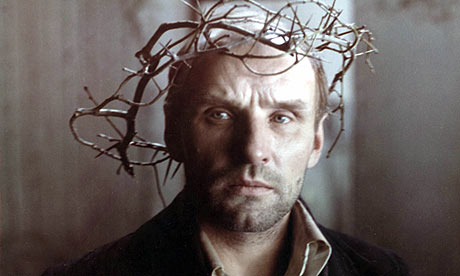
Crown.

For the record, this is the first time that I have watched an Andrei Tarkovsky film and I must say that it was quite a spellbinding first encounter. Both confusing and enthralling at the same time, "Stalker" is a timeless meditation on beliefs that contradict what's empirically perceived and is also a deep exploration of intellectual apprehension. Part-fantasy, part-science fiction and, in some ways, a quasi-religious discourse, this film is unique not just because of the otherworldly concepts that has established the film's visual texture but also because of the density of what it speaks of. 
     
Although painfully slow in its pacing, "Stalker" is never boring because of the quite stunning ideas that it presents. The film, about two tormented intellectuals and how they are guided by the titular character towards the 'Zone' (a place that is said to have the ability to grant wishes), is an adventure of immense consequences. It is a soul-searching trek towards a proverbial 'end of a rainbow' yet it is also a melancholic journey made infinitely more compelling by the characters' constant polemics. 
     
At times, I even found the conversations and arguments between the three characters to be even more fascinating than what their mission awaits them. This, I think, is the thing that makes auteurs like Tarkovsky very, very exceptional. Aside from their command of the visuals, they are also in control of which language their films would speak. And in "Stalker's" case, Tarkovsky mainly chose the language of metaphysics to further the film's profound abstraction. 
     
With the film mainly concerned about the unanswerable inquiries about the meaning of life and the anxiety of both knowing and feeling too much (represented by the two intellectuals, one a writer and the other a physicist), it was quite obvious at certain times that the characters' utterances are personal musings coming from Tarkovsky himself. At one point, the film has even discoursed about the unselfishness of art and the shallowness of technology (the writer character claimed that technology is nothing but an 'artificial limb' which makes people work less and eat more); with Tarkovsky the auteur at the helm, that particular statement is obviously all too personal that it seem out of place in a film that deals with monolithic ideas about life in the context of despair. But nonetheless, it's also all too refreshing. This is why true auteurs and no one else can best capture intimate artistry both at its most divine and at its most turbulent; they just know it all too well. 
     
Now if there's a term that would best describe the feat of creating this film, then I think it would be 'miraculous'. A convergence of imagery and content, "Stalker" is masterful not just because of the technical craftsmanship that comes with it or the weight of its ideas but because of the equal distribution of both and the patience of how they were balanced.  And then there are also the locations that have made the film even more special. With the 'Zone' seemingly taking on a life and character of its own as the film progresses, the way the place was visually presented is quite impressive because of how three-dimensional it was. With a naturally pervading sense of unpredictability, acute danger and, ultimately, of spiritual transcendence, the 'Zone' has been the strong backbone of the film. 
     
Shooting in ruins, dank tunnels and dark sewers, Tarkovsky and company has molded the reality (or unreality) of the 'Zone' in a way that's mystical yet also consistently dystopian. Also, there were some great performances in it too, particularly that of Aleksandr Kaydanovskiy as the 'stalker' himself. 
     
In some ways, the film's final minutes, at least for me, seems to be a subtle commentary regarding the irrationality of religion (with that enduring image of one of the characters wearing a crown of thorns on his head as if emulating Christ) and the outlandish belief towards both the unknown and the unseen. But despite of the film's flowing cynicism, "Stalker" still echoes hope even at its subtlest. Amid the film's overwhelming sense of intellectualism, it has at least succeeded to be emotionally eloquent. Though the film has left many questions in its wake, it offers closure on an emotional level. That, for me, is what's more important.

FINAL RATING
Photobucket 

1001 Movies You Must See Before You Die

Ivan6655321's iCheckMovies.com Schneider 1001 movies widget