Showing posts with label Brillante Mendoza. Show all posts

Sunday, May 19, 2013

Foster Child (Brillante Mendoza)

John-John.

By mastering a certain visual style that seems to have little to no regard on proper framing and composition and also distilling his films through perennially impoverished eyes, Brillante Mendoza has navigated through the local and international film scene alike (while nabbing some prestigious awards in the process) as some kind of master of derelict cinema. From the sex and filth of modern Filipino urbanites to the incidental violence that occurs in the far south, he has debunked the so-called mystique of social change by presenting unto us films that deal with seemingly insoluble societal problems. And by depriving his films of any melodramatic garbs (except maybe "Kaleldo"), he gives us new albeit pungent insights into the strains of modern Filipino existence. But here in "Foster Child", penned by regular collaborator Armando Lao, his concern is not much geared towards something broad and socially pervasive as in his later films but specifically on the beauty of 'foster care' and how it functions as a seemingly odd vocation.
     
Its story, quite simple enough, is about a mother of two named Thelma (the underrated Cherry Pie Picache in a most emotionally involving performance) and her government-sanctioned job as a foster parent. Taking care of a supposed Filipino-American kid named 'John-John', the film explores her everyday life as a surrogate mother to this poor, parentless little sap. Even her close acquaintances, namely a gay man and her very own employer (Eugene Domingo) are, in a way, parents in the most unnatural of circumstances. The first, being a homosexual, takes care of his lover's daughter from a previous marriage, while Thelma's employer, presumably a 24/7 kind of worker, is determined to be the best mother and wife that she can be despite a most passive husband. 
     
Although it's not overtly suggested, "Foster Child", a most emotionally sound film, hints at the fact that the lives of foster parents are, in many ways, enclosed in a painful cycle of loving and letting go. I know it by fact because our family has once taken care of a parentless baby for about 2 months, and the pain of finally giving the baby to its legal adopters is just quite hard to bear. Now, think of repeating this emotional rollercoaster again and again. This, for me, is at the heart of what "Foster Child" is trying to empathize with, and Brillante Mendoza succeeds in immersing us into this bittersweet world with little to no emotional artificialities. Best scene? The part where the camera lingers on a premature baby inside an incubator, and how it slowly tilts up to reveal Thelma's priceless body language and facial expression; she knows that only the likes of her can give meaning to this little boy's life, and as hard as it is to bear, hers is a motherly love that's on retail.         
     
The film, typical of Mendoza, has no concrete script. Instead, the film is comprised of scenes that are merely brought to life by clever improvisations and reactionary acting. Even the plot, as free-flowing as it is, seems to work purely by intuition. The cinematography, as shaky and as non-intrusively observant as it is, just goes to show how Brillante Mendoza has mastered the art of cul-de-sac filmmaking: that is, the style of shakily shooting films through narrow passes, concrete dead ends and shanty-jammed mazes. And by combining it with improvisational acting, "Foster Child" was able to achieve a purer and infinitely more spontaneous form of filmmaking not seen since the heydays of Brocka and Bernal. 
     
"Foster Child", aside from its individual merits as a film, is also a sign of things to come for Brillante the auteur. It's a film that's so painfully unseen by most people that many quickly dismiss Mendoza's body of work, often immediately after seeing his darker films like "Serbis" and "Kinatay" and nothing else, as socially exploitative hogwash. On the contrary, I think Brillante Mendoza may perhaps even be the most emotionally articulate director working today without even trying hard to do so, and it is in his more tender films like "Foster Child" where it truly and glowingly shows.

FINAL RATING
 photo 452-1.png

Wednesday, February 20, 2013

Thy Womb (Brillante Mendoza)

Love and marriage.

Although the most highly-honored Filipino film director of all time (he has won the Best Director award at the Cannes Film Festival back in 2009), Brillante Mendoza is without a doubt also the most divisive one. With a body of work that range from the sexually controversial "Serbis" to the shockingly violent "Kinatay", Mendoza is, in a way, an icon of cinematic polarization. Some see him as a maverick hack, but some (including yours truly) also see him as a most important filmmaker whose cinematic unpredictability and rough-edged approach to filmmaking exemplify what modern, eye-opening cinema should be. 
     
"Here is a film that forces me to apologize to Vincent Gallo for calling "The Brown Bunny" the worst film in the history of the Cannes Film Festival," says Roger Ebert, arguably the most famous film critic in the world, while pertaining to Mendoza's "Kinatay". In a way, the negative reception that his films often receive can fairly be attributed to his film's elliptical nature and explicit content. But his latest film "Thy Womb", an official Metro Manila Film Festival Entry and is also a return acting effort from Nora Aunor, may very well be a solid proof of how visually and thematically eloquent Brillante Mendoza really is as a filmmaker even without venturing into the world of violence and fornication. Well, to be exact, he has already exercised his prowess as an intrinsically fine filmmaker by way of his earlier films like "Kaleldo" and "Lola". But for the record, "Thy Womb" is his first film in a very long time that does not wear poverty as some kind of an exploitative mask. Instead, what it has truthfully donned is the entirety of a culture and a tradition, and I can't say that I was disappointed by how he has pulled it off. 
     
Set in a fishing village in Tawi-Tawi, "Thy Womb" is an inexorably rich and humanistic portrait of the island's humble beauty. On paper, it seems that Brillante Mendoza, a most rugged filmmaker, may just be, well, too visually 'rough' to handle a story that's set in a place of such delicate and picturesque beauty. On the contrary, his style proves to be just perfect, and so are the principal actors involved. Bembol Roco, for example, who for the past years has been merely relegated to villainous roles, is very, very believable as Bangas-An, a Badjao fisherman who, along with his infertile midwife of a spouse Shaleha (Nora Aunor), embarks on a search for a new bride who will hopefully bear their first child. Yes, you've heard that correctly, "Thy Womb" is a story of a couple searching for a fertile second wife. 
     
Often laborious but also, to a certain extent, quite humorous, their small adventure to find a second wife is marked with a hint of inevitability and such calm resolve that it's almost impossible not to feel awkward while witnessing how the couple's story unfolds. Now, compare that to its MMFF competition "One More Try"; an almost similar story, same dilemma (kind of), but two different emotional responses: silent acceptance from Nora Aunor's character; mouth-foaming diatribes from Angelica Panganiban's. That's cultural disparity right there. 
     
Nora Aunor, one of the greatest actresses of our time, plays the infertile wife with such hopefulness and acceptance (seen mainly through her ever-eloquent eyes) that, sometimes, watching her brave great lengths just to find her husband a new wife is a bit painful to sit through. Some may even brand her character as a full-fledged martyr by doing so, but we must also bear in mind that she is a devout Muslim, and what she is doing is not just according to her heart's content but also to her religion's. So with an objective camera lens to capture it all, Brillante Mendoza, armed with an uncharacteristically poetic visual sensibility, makes us feel the strains of such a situation without handing down any judgments. 
     
For a country of great religious divide like the Philippines, it's almost impossible to sanction acts in a univocal light, and "Thy Womb" just goes to show that an extramarital scandal in one religion can just be interpreted as nothing but pure tradition in another. And for Brillante Mendoza, a filmmaker whose works are characterized by images of great sociopolitical decay, it's refreshing to see that he has finally took on a story of great sociocultural relevance. "Thy Womb", despite its tendencies to beat around the bushes, is a lyrical film that resonates far beyond its geographic boundaries. Finally, Brillante Mendoza has graduated from poverty porn to do something entirely different but just as powerful. Well, hopefully at least.

FINAL RATING
Photobucket

Saturday, May 7, 2011

Lola (Brillante Mendoza)

Anita Linda as Lola Sepa.

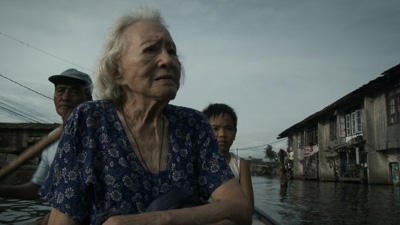
Just when I thought that Brillante Mendoza will not get out of his trend of sexual and disturbingly putrid depictions of the modern downsides of Philippine society, here he comes bringing "Lola", a painful, yet at times comic, observation of two striving grandmothers on opposite sides of a situation (one whose grandson is the victim and the other, the suspect) trying to cope up with the tragic trails, including financial shortcomings, brought forth by an uneasy crime. Anita Linda and Rustica Carpio, both past their physical primes, may have just given their more-than-impressive swan songs. Director Mendoza, who is not that much known on squeezing out pure performances from his actors/actresses (as his characters usually just blend in into the realistic palette of the surroundings), handled may be the two most astounding ones from aged performers.

In some ways, it's almost a miraculous feat on his part (and cinematographer Odyssey Flores) in terms of enhancing Anita Linda and Rustica Carpio's natural and honest evocation of suppressed sufferings and prolonged sacrifices as impoverished grandparents through a panoramic view of the present social state of those inflicted with destitution. But the real highlight is of course from the two brave, nagging, and at times, swindling heroines who will do just about anything not just to resolve their numerous woes, mostly involving money, but also to unconsciously prove their 'worth'. Throughout the film, as the camera follows them both, we see them express stern authority to younger people, ask for directions and assistance like one, and show extreme determination like middle-aged fellows.

They embody the three stages of life based on the entirety of their characteristics. Their bodies show the tweaks of aging, but when, as they say, push comes to shove, their minds does not.

But in one specific sequence that is arguably the most resonant in the film, our protagonists engage in a very subtle, open and realistic conversation about the simple realities of old age. Many times, I have overheard old people talking. No, they do not talk about transcendent and elegiac things such as existence and life affirmations. Instead, they talk about the most trivial of things such as aching bodies, rheumatism and efficascent oils.

Brillante Mendoza captured the sequence with lightness and sheer minimalism. Amid the laborious small journeys here and there, this scene is their break. They do not reflect upon paradoxical things about their hardships but merely talk with a sense of common likeness. Although being the opposites in a tragedy, they share the beauty of human 'connection'.

At times visually and thematically similar with Nagisa Oshima (based especially on his explicitly unrelenting "Serbis" and "Kinatay"), Brillante Mendoza departed from the comparison to simply tell a poignant story. And what makes "Lola" even more fascinating albeit at times being emotionally painful is its underlying tenderness that treats these aged heroines of life not as urban sufferers but as rare triumphants.

Mendoza has already channeled the polarizing alternatives of cinema, but with "Lola", he may have glanced on some of De Sica and Ozu's brushstrokes and created an absorbing and empathetic film about human struggles and tribulations. Anita Linda and Rustica Carpio's performances made it all the more affecting.

FINAL RATING
Photobucket

Tuesday, January 18, 2011

Serbis (Brillante Mendoza)

Familial reality amidst immorality.

Film Review Archive (date seen: December 12, 2010)

I have to say that Brillante Mendoza’s “Serbis” is slightly better than his more renowned (and at the same time, denounced) “Kinatay”. In some ways, “Serbis’” cinematography, acting, and subplots were the collective product of what could be Brillante’s personal vision of Philippine society and familial relations that has been distributed rationally to his other earlier films: “Tirador’s” biting humor, “Kaleldo’s” character interactions and mild sepia cinematography, the escalating darkness that his later film “Kinatay” has embarked on, and even “Masahista’s” literal sexuality.

The ensemble cast was also very impressive in their uncanny degree of suppressing any screen inhibitions, be it about showing their skin, or acting as a credible, functioning family while immersing themselves into the decaying backdrop of a filthy ‘bold’ theater. It was almost unbelievable for the whole cast to pull off such a film without going as far as the extremities Nagisa Oshima has reached and the cost of what cinematic taboo he had broken to show a sociopolitical allegory. Brillante Mendoza has also able to incorporate his usual fascination of religious traditions; imageries that might have been inserted just for the sake of it, or can also be visual antidotes to the sinful displays on his films.

Notable performances were by Gina Pareno as the theater-inhabiting family’s matriarch, and Julio Diaz as the awkwardly unknowing husband of Nayda (played by Jaclyn Jose). It’s just refreshing to see a film that has brought a pitiful place such as a decaying ‘bomba’ moviehouse into cinematic life (a place whose only common attribution is to “Imbestigador”), put it in the center of a neorealist drama, and let its pathetic and dissident inhabitants dwell on the establishment’s sleazy imperfections; an uncanny likeness to their own lives indeed.

FINAL RATING
Photobucket

Sunday, January 16, 2011

Kinatay (Brillante Mendoza)

Brillante's 'Inferno'.

Film Review Archive (date seen: November 7, 2010)

"Kinatay" is one of my 'quiet' must-see films not just because of the Cannes directorial prize it has garnered, but also because of Brillante Mendoza's experimental style of filmmaking, which I reckon to be a refreshing touch to an industry pestered with endless recyclable ideas for movies to pass as 'blockbusters'.

For the initial sequences, Brillante never bothered for sound editing, but instead used the seemingly nuisance-like sounds (the assorted voices of people, jeepneys) to his advantage, transforming it with true verite' ability into an element to breath character into the film as a whole.

But as it gradually enters the realm (the reality of violence and corruption) of the theme which it is pointing to the entire time, "Kinatay's" whole visual and sound texture also becomes different; its realistically colorful display of everyday life in the slums which suggests some hints of momentary gayness turns into a symbolic descent into the netherworld of crimes and profanities (not even bothering about geographical correctness) filled with darkness and aural ambiguities.


Yet Brillante Mendoza's extreme inclination to portray psychological forebodings is also the film's major weakness. Though this might not be a problem for experienced film watchers, this particular slow build-up betrayed its main theme that when the film finally got to where it wanted to be, the audience may already be exhausted and disinterested that they may just accept the violent display merely as a "shock value", when it could have been taken in as a more profound inquiry into the moral consequences of violence. In some ways, this film reminds me of the main exposition of Coppola's "Apocalypse Now", only this time, there's no Kurtz to kill, but a morality to waste based on a decision ultimately driven by the short-lived promises of monetary gain.

FINAL RATING
Photobucket

1001 Movies You Must See Before You Die

Ivan6655321's iCheckMovies.com Schneider 1001 movies widget