Showing posts with label Eugene Domingo. Show all posts

Sunday, May 19, 2013

Foster Child (Brillante Mendoza)

John-John.

By mastering a certain visual style that seems to have little to no regard on proper framing and composition and also distilling his films through perennially impoverished eyes, Brillante Mendoza has navigated through the local and international film scene alike (while nabbing some prestigious awards in the process) as some kind of master of derelict cinema. From the sex and filth of modern Filipino urbanites to the incidental violence that occurs in the far south, he has debunked the so-called mystique of social change by presenting unto us films that deal with seemingly insoluble societal problems. And by depriving his films of any melodramatic garbs (except maybe "Kaleldo"), he gives us new albeit pungent insights into the strains of modern Filipino existence. But here in "Foster Child", penned by regular collaborator Armando Lao, his concern is not much geared towards something broad and socially pervasive as in his later films but specifically on the beauty of 'foster care' and how it functions as a seemingly odd vocation.
     
Its story, quite simple enough, is about a mother of two named Thelma (the underrated Cherry Pie Picache in a most emotionally involving performance) and her government-sanctioned job as a foster parent. Taking care of a supposed Filipino-American kid named 'John-John', the film explores her everyday life as a surrogate mother to this poor, parentless little sap. Even her close acquaintances, namely a gay man and her very own employer (Eugene Domingo) are, in a way, parents in the most unnatural of circumstances. The first, being a homosexual, takes care of his lover's daughter from a previous marriage, while Thelma's employer, presumably a 24/7 kind of worker, is determined to be the best mother and wife that she can be despite a most passive husband. 
     
Although it's not overtly suggested, "Foster Child", a most emotionally sound film, hints at the fact that the lives of foster parents are, in many ways, enclosed in a painful cycle of loving and letting go. I know it by fact because our family has once taken care of a parentless baby for about 2 months, and the pain of finally giving the baby to its legal adopters is just quite hard to bear. Now, think of repeating this emotional rollercoaster again and again. This, for me, is at the heart of what "Foster Child" is trying to empathize with, and Brillante Mendoza succeeds in immersing us into this bittersweet world with little to no emotional artificialities. Best scene? The part where the camera lingers on a premature baby inside an incubator, and how it slowly tilts up to reveal Thelma's priceless body language and facial expression; she knows that only the likes of her can give meaning to this little boy's life, and as hard as it is to bear, hers is a motherly love that's on retail.         
     
The film, typical of Mendoza, has no concrete script. Instead, the film is comprised of scenes that are merely brought to life by clever improvisations and reactionary acting. Even the plot, as free-flowing as it is, seems to work purely by intuition. The cinematography, as shaky and as non-intrusively observant as it is, just goes to show how Brillante Mendoza has mastered the art of cul-de-sac filmmaking: that is, the style of shakily shooting films through narrow passes, concrete dead ends and shanty-jammed mazes. And by combining it with improvisational acting, "Foster Child" was able to achieve a purer and infinitely more spontaneous form of filmmaking not seen since the heydays of Brocka and Bernal. 
     
"Foster Child", aside from its individual merits as a film, is also a sign of things to come for Brillante the auteur. It's a film that's so painfully unseen by most people that many quickly dismiss Mendoza's body of work, often immediately after seeing his darker films like "Serbis" and "Kinatay" and nothing else, as socially exploitative hogwash. On the contrary, I think Brillante Mendoza may perhaps even be the most emotionally articulate director working today without even trying hard to do so, and it is in his more tender films like "Foster Child" where it truly and glowingly shows.

FINAL RATING
 photo 452-1.png

Friday, September 9, 2011

Zombadings 1: Patayin sa Shokot si Remington (Jade Castro)

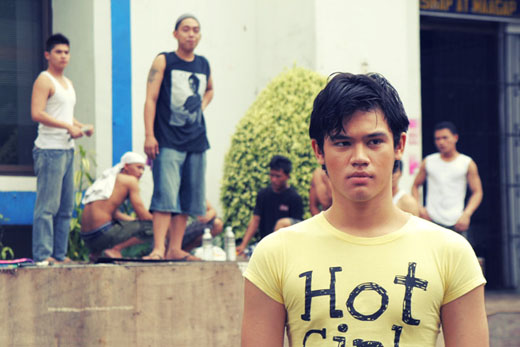
Mart Escudero as the cursed Remington.

I have to give props to this film for being able to carry out a fairly original horror-fantasy narrative, and extending a considerably offense-free humor regarding the homosexual sub-culture. But aside from that, I highly commend Mart Escudero for his great performance as the titular character (and also for the film's highly talented cast that are also good sports) that is condemned to undergo a 'fairy' metamorphosis and then to die of 'shokot' (a gay lingo for 'fright', for the uninitiated). Although an indie film (and we all know how some indie films take themselves too seriously), "Zombadings" wallows in its own exuberant B-movie cheesiness, filled with awkward editing, a stupendous murder MacGuffin (the 'gay-dar'), a quiet town (as always), and of course, hordes of cross-dressing zombies. But what makes it different at the very least is the fact that although we have seen endless amounts of comic homosexuality on film, I think this is quite the first time that I've seen a film that have dealt with homosexuals as if they're a generalized, cohesive and interdependent group.

With those mind-numbing 'gay-lingos', is it really their official language that spans borders of place, age and degrees of homosexuality? What if Remington, cursed by Roderick Paulate's character to be gay when he grows up, transformed into a discreet, shy-type one in the sense of how other complex 'bromance' genre films came to portray them? And why are gays in this film so, so sensitive? Is it really possible for a naïve kid's tease of 'bakla, bakla!' to inspire a spirit-summoning wrath? But again, questions like these aren't really particularly relevant let alone valid for this type of movie. Films like this is in a universe of their own; a homage-littered and film-recalling one at that.

As Remington slowly turns into a full-fledged, not so subtle 'bading', I can't help but compare Ogie Diaz's polar opposite transformation into a sultry Via Veloso in "Hiling". The setting of Lucban, Quezon (The great ‘Buddy's’, slightly seen in the plaza scenes) reminds me in some ways of Flavio's Sto. Sepulcro, while the zombies and the campy feel seems like a depleted, musical sequence-less combination of "The Happiness of the Katakuris" and a subliminal manifestation of Dr. Frank-N-Furter.

So, maybe that's what lacks in "Zombadings" that could have really perfected its self-mocking tone: A musical sequence. Granted, there's a colorful dance sequence for Remington (I love how ‘Remington’ sounds like a classically macho rifle yet suggests the contextually otherwise), but this film really begs for a dance ensemble. Like the one in the masterful yet obscure B-movie "Dead & Breakfast", "Zombadings" is the kind of film that is tailor-made for such. If musical sequences served as a deconstructive ingredient for the satiric "Ang Babae sa Septic Tank", a musical scene or two could have really 'constructed' this film's true, green-blooded (staying with the homosexual tone) feel as an 'eklavu'-filled nonsensical ride, and truly proud of it.

"Zombadings" is pure guilty pleasure, and even though it's an indie film (some people think that watching more indie and less mainstream films is a bloody good investment for their intellectual self-image), it is a surprisingly hollow, shallow and an inch-deep offering from our local film industry's alternative realm. But what really caught me off-guard regarding this film is the fact that when it looked like it will be another one of those films where gays are once again reluctantly placed into a comic freak show heap to be randomly stoned with malicious, bordering dehumanizing jokes, it's a revelation that it has portrayed the homosexual community as a productive, hard-working bunch. A breath of fresh air in its ultimate message and, considering that it was advertised as an unrelentingly nauseating take on the concept of flesh-eating zombies and stereotyped image of cross-dressing gays, quite innocuous in its overall execution.

With the mainstream generating endless concepts, be it comedy, drama, romance or combination of all three, to pass as cinematic escapism, this is our indie industry's take on the idea: Not truly unforgettable, not that great, sometimes even fleeting in its own right. But at least, it's head over heels fresher than its comparably big-budgeted half-brothers (or half-'sistahs', perhaps?).

FINAL RATING
Photobucket

Tuesday, August 9, 2011

Ang Babae sa Septic Tank (Marlon Rivera)

On the way to Mr. Smithberger.

It might initially appear that this latest Cinemalaya triumph is particularly a well-tread filmic practice of traditional Philippine neorealism. But as it unravels in a fashion only a knowingly self-conscious deconstructive film can do, what it appeared to be was a creative blend of fantastical quasi-realism and full-fledged, jargon-filled nuances between the independent film scene and the commercial movie industry highlighted and fueled by Eugene Domingo’s eagerly commanding “Being John Malkovich-like” parody of herself.

But do not be misled, although Ms. Domingo and her much-hyped (thanks to well-played news columns by gossip writers) ‘plunge’ into the titular brown hole is the highlight of the film from a moviegoer’s viewpoint, “Ang Babae sa Septic Tank” is essentially more about the film’s two visionary and free-spirited characters’ episodic adventures and whatnot. One a director (played by Kean Cipirano) and the other, a producer (JM De Guzman) who both display a certain raw energy typically steaming out from fresh grads, they are both struggling, amidst a cover of coffee-drinking comforts and ‘higher than anything else’ aspirations (they really much prefer Oscars than Cannes) to take a daringly unconventional independent film into fruition.

“Ang Babae sa Septic Tank”, directed by Marlon Rivera and written by Chris Martinez who clearly shows both his humorous outlook and comic disdain towards cinematic nuisances (such as product placements and the industry’s nauseating ‘diva’ culture), is not necessarily about the technicalities, logistics or the pressuring deadlines of making movies. Hell, there’s barely a scene involving movie crews, cameras and stuff. Unlike, say, Truffaut’s “Day for Night” which is purely about the ups and downs of such, this film is more about the endlessly playful landscapes of the mind going colorfully amok in the middle of a mind-boggling series of script conceptualizations and cerebral storyboarding. If countless ‘movies-within-movies’ dissect the fascinating days of principal photography, “Ang Babae sa Septic Tank” is inclined towards the fragility of pre-production.

The posters, the cast, the performances, even the overall treatment of the film within the film (which is entitled “Walang-wala”). These were taken into the open. Through a surprisingly muted character played by Cai Cortez, “Walang-wala” shifts through the different parallel realities of ‘what if’ movie scenarios via her daydreams and nap musings. For a film of immense creativity that caters its refreshingly postmodernist feel with exuberance and humor for a wider audience, using a non-speaking role as a medium to transcend the lucidly brittle “Walang-wala” film ideas is inexcusably lazy. But considering that the film is overwhelmed by endless modern Filipino vernaculars coming from Kean Cipriano and JM de Guzman’s mouths sugar-coated as loudly superfluous tirades and ‘two-cent’ dialogues and the parody Eugene Domingo sounding, acting and demanding like the real-life Kris Aquino, it’s a balancing tonic to see someone whose mouth is completely shut.

Normal to many independent films, “Ang Babae sa Septic Tank” is also filled with inspired performances from its cast, specifically Eugene Domingo as her alternative reality self, whose scene of her accepting the script from the two maverick filmmakers may have been mirroring her genuine real-life reaction in accepting this film. A true breath of fresh air for her considering the formulaic haze of mainstream movies that she has previously starred in. But the best performance in the film, which I never have foreseen even from the farthest of distance (maybe me being unaware of him helped) is the bit role of Arthur Poongbato, a satiric character that pokes fun of award-conscious indie directors, played effortlessly by Tad Tadioan.

But then again, “Ang Babae sa Septic Tank” is never a full-blown satire either nor a distinct celebration of the independent film spirit. Though the film can be a small-dosed mix of both, it’s mainly a subtly unnerving little film that highlights the forgotten urban plight of the impoverished that merely serve as harrowing textures of countless filmmakers’ attempt for superficial cinematic social commentaries.

"Majestic". One of them mouthed in ecstasy as they see the layered kingdom of make-shift carton houses and rusty tin-roofed shanties visually asking to be filmed. But what the film turned out to be, ultimately, is a tragicomic exposition of the characters’ internal realization that not everything adheres with their own cinematic vision and artistic conviction. As the film heads into a gob-smacking head-on collision course with reality, there’s this brooding clarity.

And as we see Eugene Domingo visually transform into the titular woman that could have easily been the scene that can elicit the silliest of laughter in the whole film, there’s this great sense that it is more profoundly symbolic than it is immediately graphic. It stared at cinematic apathy strong-eyed while inside a pungent hole of sobering truth.

The film ended with audience’s heartily fading laughter and tender smiles. For that sole reason, the integration of “Ang Babae sa Septic Tank” as a comedy vehicle into mainstream cinemas fully succeeded. But I hope the film left an impression that is much more than that.

FINAL RATING
Photobucket

1001 Movies You Must See Before You Die

Ivan6655321's iCheckMovies.com Schneider 1001 movies widget