Showing posts with label human drama. Show all posts

Wednesday, May 15, 2013

To the Wonder (Terrence Malick)

The love that loves us.

Infamously known for taking an awful lot of time between projects, Terrence Malick has uncharacteristically weaved a quick follow-up (a little more than a year) to his critical hit "The Tree of Life" in the form of "To the Wonder", a solemn rumination on how love affects the lives of those who search for it. Faster than a bullet train, many have immediately predicted the film's unanimous critical triumph. But sadly, what happened was quite the opposite, as "To the Wonder" finally proved that Terrence Malick, one of the more beloved art film directors today, can also truly divide. 
     
Met with mixed amounts of laughter, applause and boos during its Venice Film Festival premiere, saying that "To the Wonder" is polarizing is quite an understatement. Perhaps some have grown tired of Malick's loose-structured style, while some may have seen through the grave pretense of his themes. As for me, "To the Wonder" proved to be quite a transcendent experience. 
     
To state the fact, it's not, in any way, a 'movie' in the most intrinsic sense of the word. Dominantly, "To the Wonder" is more of a feature-length mood piece. And like a sweeter Alain Resnais, Terrence Malick, through the use of deeply pleading narrations and breathtaking yet fragmented imagery, explores love at its most trying and at its most pure. From a Parisian woman's (Olga Kurylenko) search for the meaning of her romance with an American man, played by Ben Affleck with a sort of detached silence, to a Spanish priest's (Javier Bardem) quest to make one with his spirituality, the film approaches the many forms of love with articulate questions and wandering thoughts that it has delivered through the profound nuances of the French and Spanish language. 
     
By doing so, the film takes on a more personal level. As the film continues on with its various reflections, the film becomes less and less about love in general and more and more like a silently thankful prayer. And just like "The Tree of Life", "To the Wonder" is a highly personal project for Terrence Malick, as he himself, from what I've read, is basically the Ben Affleck character in the film. So in many respects, "To the Wonder's" creation is basically a form of unhindered personal expression. For an artist like him, expressing whatever he feels through written words is certainly not enough.
     
Like a well-wrought diary entry, "To the Wonder" is Malick's remedy to his various emotional ellipses. And although the film is as ambiguous and baffling as the next artsy fartsy film, its emotional content, as far as I'm concerned, is as coherent as it can be. The film may be branded as an utter piece of pretentious art, but what it cannot be accused of is deluding the audience's emotions. Like a beautiful romantic symphony, "To the Wonder" is a film that you just can't help but stop and hum along with. 
     
Terrence Malick, unlike any directors of any kind out there, treats cinema as his personal poetry book, and I couldn't be more thankful about it. Ultimately, 'thankful' is the key word here. Lyrical, elegiac and also quite life-affirming even despite its perceived ambiguity, "To the Wonder" is a film that speaks more truth about love than some 30 romantic films combined. "To the love that loves us, thank you."

FINAL RATING
 photo 42.png

Wednesday, January 23, 2013

Beasts of the Southern Wild (Benh Zeitlin)

Hushpuppy.

As far as back as I can remember, there's always that one 'Sundance' film that gets a token Oscar nod for 'Best Picture' every year. But naturally, it usually does not have any chance of winning despite the fact that it is often far superior to half of its competition. For me, that's the Oscars subtly telling the independent film scene that "that's as far as you can go". Such is the case for "Beasts of the Southern Wild", a quasi-fantasy, coming-of-age film that really isn't (based on the stage play "Juicy and Delicious" by Lucy Alibar). 
     
With some sheds of "Pan's Labyrinth" in how it has seamlessly enjoined both fantasy and reality in a single continuum, the film is certainly quite refreshing and original. Being a film that's really quite hard to describe, just imagine this: What if a less cynical Werner Herzog and a less abstract Terrence Malick decide to team up and co-direct a children's film? Can you picture it? It's with a kind of profound narration and transcendental music, right? Yeah, that's pretty much how "Beasts of the Southern Wild" looks and feels like. 
     
For a film whose visuals rely heavily on images of poverty and semi-submerged squalor, "Beasts of the Southern Wilds" surprisingly lacks any embedded social messages. Instead, what the film has done is substitute a potentially pedestrian tackling of poverty with a completely unique exploration of innocence and pride that's finely fitted within an engrossing, quasi-magical atmosphere. 
     
Throughout the film, there's a relatively fascinating establishment of the return of the aurochs, an ancient group of giant wild boars that has lived millions of years ago, presumably for a kind of reckoning. But to first set the record straight, aurochs are actually direct ancestors of the modern cattle and not of wild boars, which is quite puzzling to me as to why the makers of the film did not fully rename the creature instead. But at this point, we do not care anymore because one, the film is utterly justified in this aspect because it is structured within a reality of its own, and two, because the film has a far more important angle to cover, and that is the roller coaster relationship between Hushpuppy (Quvenzhané Wallis) and his hot-headed father Wink (Dwight Henry). 
     
Together, both characters, thanks to Benh Zietlin's involving direction and both actors' heart-aching performances (Dwight Henry should have received an Oscar nod for Best Supporting Actor. Am I asking for too much?), dance in the rhythm of great dramatic chemistry without really trying hard to do so, all while the film's more fantastical nature unravels quite masterfully on the side. But then again, the very same 'fantasy elements' that have been laid down piece by piece with such care is the very same aspect that has quite disappointed me. For a person who has expected an equal distribution of both fantasy and reality, I ended up asking for more from the former. But if you come to think of it, the presence of the aurochs in the film is never intended to be quite literal just like how Aslan in the "Chronicles of Narnia" is. What it actually is, at least in my view, is a mountainously symbolic representation of Hushpuppy's ultimate 'test' before she can actually, as what the plot summary states, 'learn the way of courage and love', and it's quite effective because it gives the film a heightened sense of mythological resonance. 
     
"Beasts of the Southern Wild", an uncommon film of visual and thematic grace, is forged out of a unique cinematic spirit and genuine human warmth. The people of Baththub (that's what the film's water-surrounded town is called), although burdened by their difficult and relatively uncivilized way of life and are constantly being antagonized by welfare workers trying to get them out of there, is certainly a proud lot, and Hushpuppy, a girl that knows and feels more than the average kid, is slowly learning that pride, after all, is not that of a bad thing. While Wink, his father, has learned that crying is not a sign of emasculation but a vital proof of life. Indeed, the characters have learned something throughout the course of the film, and so have I.

FINAL RATING
Photobucket 

Thursday, January 3, 2013

Ikiru (Akira Kurosawa)

To live.

"This stomach belongs to the protagonist of our story," says a narrator, who's pertaining to an x-ray image of a stomach obviously ripe with cancerous complications. And so begins "Ikiru", a meditative film of quiet power that tackles mortality and life's purpose yet also dips its fingers on issues concerning the cons of bureaucracy. The film's protagonist is Kanji Watanabe, an old man who seems to be no more alive than a dysfunctional machine.
     
In many ways, films like "Scent of a Woman" and "About Schmidt" derive from "Ikiru's" main emotional drive, which is as timeless as it is life-affirming. As what the film suggests, maybe it is only in the face of death and mortal desperation will we muster change and find true significance; indeed, life is brief. In the words of the narrator in "Fight Club": "This is your life, and it's ending one minute at a time".
     
Takashi Shimura, who has previously played the woodcutter in "Rashomon" and who will later play, after this film, the noble Kambei in "Seven Samurai", plays Watanabe, a bureaucrat who, for the longest time, has led an uneventful life drained of all meaning or worth. Making his living by stamping insignificant papers for approval, he is as mechanized and emotionless as he can be. But in one ill-fated day, he is diagnosed with stomach cancer. According to the doctor, he has around six months to live. 
     
Devastated, Watanabe has never felt more strangely detached from the land of the living. His already hunched posture even becoming more contorted and his already fragmented articulation of words becoming even more so, Watanabe, as maybe what Kurosawa has intended, is the defining image of a modern man who has nothing to say about his life other than the painful fact that he has merely 'lived'. 
     
Going home, Watanabe then pitifully tries to tell his son about his terminal illness but is discouraged by the latter's coldness. Finding no sense of belongingness either in his own home (with his son being mainly concerned not with his father's well-being but with his pension) or in his work, he suddenly had this craving to just lash out. Guided by a struggling novelist, Watanabe then tries to navigate the busy, booze-laden nightlife of '50s Japan to find out whether or not it can make up for his final days. As it turns out, it does not. 
    
After his bar-hopping misfire, he then gets closer to a young woman named Toyo, an office subordinate of his who has recently tendered her resignation in Watanabe's office in favor of working in a toy factory, and whose exuberant and pure love for life leaves Watanabe in utter awe and in disgruntled fascination.
     
Miki Odagiri, who plays Toyo, has this distinct kind of energy that finely balances out Takashi Shimura's seemingly stagnant and doomed presence. By often framing Shimura's Watanabe, hunched, blank-eyed and ever-brooding, in the foreground and Odagiri's Toyo in the not-so-distant background, Kurosawa was constantly able to highlight the two characters' contrasting traits, behaviors and overall existence within the spatial landscapes of the film.     
     
"…In other words, why are you so incredibly alive?" Watanabe blurts out to Toyo, who innocently mistakes his desperate need to understand his own existence as romantic advances. Toyo answered him that all she does is work and eat. She then gets a toy rabbit from her bag, one of the many products being made in the toy factory where she's employed; "Making them (the toy rabbits), I feel like I'm playing with every baby in Japan," Kimura then said. 
     
Seemingly refreshed from Toyo's all-too-naïve yet honest response, Watanabe then sets out to do something that may hopefully make him matter. In a stunning turn of events, Watanabe transforms from an old nobody to a defiant spirit reminiscent of Jimmy Stewart's Mr. Smith determined to will through the lethargic incompetency of the city hall officials so that he can convince them to turn a mosquito-laden cesspool into a children's park.     
     
Much like "Rashomon", we then get to see another epistemological discourse on Kurosawa's part, this time not about the truth (or the lack thereof) behind a mysterious murder but about the legacy of a man who everybody never expected to have left one. And by piecing together some fragmentary moments in Watanabe's life as witnessed by his co-workers, from his brave persistence to stand up for the children's park to his starry-eyed admiration of the sunset, we then finally arrive at what Watanabe is looking for all his life: meaning and self-worth. 
     
"Ikiru", which literally means "To Live", is a an affecting film that explores man's search for existential meaning not through philosophically sophisticated means that may alienate viewers but realistically through an old man's eyes who just want to be at peace with those around him and, more importantly, with himself. Despite of "Ikiru's" apparent and sometimes much too overwhelming commentary on political bureaucracy, I'd rather remember it as an honest and reflective film about mortality and the often undermined beauty of life; simple as that. This then reminds me of a quote by Monty Python's Michael Palin: "Don't talk about living, just live".

FINAL RATING
Photobucket

Sunday, December 30, 2012

Fanny and Alexander (Ingmar Bergman)

Lost.

Christopher Moore, a contemporary author of fantasy fiction, has once said that "children see magic because they look for it". This, for me, is the foundation and the root of all questions raised in "Fanny and Alexander", a complexly-themed masterpiece that is, sadly, also Ingmar Bergman's very last feature film. In hindsight, it may look as if "Fanny and Alexander" is merely about children's innocence and the power of imagination; two themes that are otherwise quite alien to Bergman himself. But seeing the film unfold in its three glorious hours, "Fanny and Alexander" came out to be so much more than that. In many ways, the film is also a complex extension of Bergman's provocative meditation on the non-intervening nature of God (see "Silence of God" trilogy) and his passive role in human existence. Personally, watching "Fanny and Alexander" is like finally putting the last pieces of a jigsaw puzzle in place. 
     
But Ingmar Bergman, ever the abstract filmmaker, is indeed not the kind that will bail you out with some clear-cut answers. For the record, "Fanny and Alexander" is littered with magic and the supernatural; two aspects of the film that can be taken either as truly literal or completely symbolic. Nonetheless, the film, on surface level a period family drama, wonderfully takes on a new texture and thematic dimension by utilizing some elements that defy physics or explanation. In addition, the film even flirts with the idea that magic may perhaps be the one and only substitute for the complete absence of God; an absurdist approach on Bergman's part but is also very compelling in how it slightly satirizes the extent of our adherence to the unexplainable. 
     
With no real story or narrative, "Fanny and Alexander's" first half is all about the everyday trivialities in the life of the Ekdahls, a well-to-do family of stage actors which, after a relatively happy Christmas eve, was struck by an unexpected tragedy, which suddenly finds Fanny (Pernilla Allwin) and her older brother Alexander (Bertil Guve) emotionally astray and fatherless. 
     
By way of Sven Nykvist's dreamy cinematography which has won him a well-deserved Oscar, the film was able to subtly depict both the difficulty of losing a father in the formative years of one's life and the silently mercurial nature of familial existence at the time (early 20th century Sweden) through its use of empty spaces, distant shots and anguished faces. 
     
After the burial of the titular characters' father, a bishop named Edvard Vergerus (Jan Malmsjö) then enters the scene. Extremely authoritative and ruthless, the bishop is Fanny and Alexander's, both of which were raised in a tender and carefree environment, worst nightmare realized. But just when they thought that things won't get any worse after the death of their father, Fanny and Alexander then find themselves under the wing of the bishop himself, who has decided to marry their newly-widowed mother (Ewa Fröling). 
     
From this point on, after much foreboding early on (with those moving statues and the apparitions of Alexander's father), the film slowly but surely abandons the first half's relatively realistic and lively portrayal of the Ekdahls in favor of a more metaphysical, abstract and gloomy second part. From the approach to the characterizations, it's quite easy to see the definite influence of "Fanny and Alexander" in all those stepmother/stepfather films that it has since predated, specifically Guillermo del Toro's "Pan's Labyrinth", what with its stepfather subplot and whole 'magical realm' aspect. 
     
But then, "Fanny and Alexander" is never a film that can easily be defined by classifications. It is, in fact, a challenge to our own grasp of cinematic reality. If an emotionally-focused drama like "Fanny and Alexander" suddenly goes all supernatural (which it did), what then can be our potential response as viewers? Well, it's much preferred to just keep mum and simply relish it; after all, this may just be magical realism's finest moment in cinema.  
     
But aside from being a stunning amalgamation of both fantasy and reality, "Fanny and Alexander" is also a conscious allegory about the importance of cinema in relation to our lives ("Outside is the big world, and sometimes the little world succeeds in reflecting the big one so that we understand it better") and is also a film that challenges our perception of the unknown, of the things we can't define and of certain life phenomena that we can't explain and articulate about. But more importantly, "Fanny and Alexander" beautifully pushes the limits of cinema unlike anything I've ever seen before.
     
As what the Ekdahls' matriarch (played by Gunn Wållgren) has said at the end of the film, "Everything can happen. Everything is possible and probable. Time and space do not exist. On a flimsy framework of reality, the imagination spins, weaving new patterns." From where I look at it, this is the subtle justification of the film's surprisingly magical nature; a justification that is quite directed to us, the viewers, who are neither children nor naïve and who never expected or anticipated magic but stumbles upon it anyway because of this film. How sad that Ingmar Bergman's great swan song has come too early. But nonetheless, we should still be thankful that a film like "Fanny and Alexander" has come at all. Now I'm more than eager to watch the five-hour version.

FINAL RATING
Photobucket 

Sunday, December 23, 2012

Nights of Cabiria (Federico Fellini)

Cabiria.

Aside from being a masterful surrealist, it is also very notable to state that Federico Fellini is also a morally powerful and spiritually transcendent filmmaker. This is, of course, very much evident here in "Nights of Cabiria", an unforgettable cinematic masterpiece that traverses the widely unseen and unheard (at the time) world of prostitution and the soulful humanity that bleeds through and through albeit the blind sexuality contained within it. 
     
Although it is much expected that the film shall highlight the more obscene aspect of what many consider as the 'oldest profession in the world' just like, say, Luis Bunuel's later film "Belle de Jour", "Nights of Cabiria" is surprisingly very mellow with the jobs' details and instead delves not on the inner workings of the affordable sex that they offer or on what motivates prostitutes to continue on doing what they're doing but on the reasons why they should not anymore. At the center of it all is the energetic yet at times very temperamental Cabiria (played by Giulietta Masina), a prostitute who can be the most romantically jaded one minute yet can also be the most hopelessly romantic in the next. With a face that still echoes her heartbreaking turn in Fellini's earlier film "La Strada", Giulietta Masina, with her sometimes tomboyish facial expressions and mime-like gestures reminiscent of silent film stars, is a beautiful embodiment of both melancholy and hope. 
     
With her consistently comical body language and a face that fluctuates between naughtiness and confusion, Cabiria is evidently a most complex character to pull off. But despite of that, Masina has done it as if without much effort. Yes, perhaps there are no scenes that show her participating in any simulated sexual congress. And yes, perhaps Giulietta Masina does not, in any way, physically resemble an actual prostitute, what with her small stature and relatively frail body frame. But with the help of her masterful evocation of Cabiria's romantic naivety and pure humanity, she has been most believable as one in much the same way Philip Seymour Hoffman is never a dead ringer for Truman Capote (Toby Jones relatively gets that distinction) yet he has made us believe that he actually is the "In Cold Blood" writer for close to 2 hours mainly because of how inspired his performance was. 
     
But then of course, Giulietta Masina's powerful performance wouldn't really be as penetrating if not for Nino Rota's stirring musical score, the film's often dream-like photography and Fellini's patient direction which has perfectly built-up the film until its heart-breaking yet hopeful finale. 
    
Just like Fellini's masterpiece "La Dolce Vita", "Nights of Cabiria" is a film that's highly dependent not on how or where the so-called 'carnival of life' will bring the main characters to but how he/she may figure in the playfulness and hysteria of it all. In one of the film's most resonant sequences, Cabiria, along with her co-workers, joined a small pilgrimage heading towards the Santuario della Madonna so that they can ask her for forgiveness and guide. Albeit her countless pleads for mercy and various promises to change her way of life, Cabiria never felt any better or different, and so do her co-workers. Although a filmmaker that largely incorporates religious symbolism into his films, Fellini seems always aware that religion will always be a mere spiritual opiate and nothing more; that fate solely depends on whatever life a person leads and not on some higher power; that some music and a smile, not some wooden idols and a haplessly fevered devotion to the great unknown, can make the world of difference. With "Nights of Cabiria", Federico Fellini has made us all believe that despair can merely be shrugged off by a more than hopeful countenance. 
     
For the longest time, cinema has often made us feel the utter fruitlessness of existence and how it is almost impossible to graduate from life pristine and unscathed. "Nights of Cabiria", perhaps the best film ever made that deals with the emotional and moral conflict buried deep within the heart of prostitution, is a precious piece of art that genuinely captures the elusive essence of hope amidst anguish rarely seen in today's cinema.

FINAL RATING
Photobucket

Monday, May 28, 2012

Biutiful (Alejandro González Iñárritu)

Uxbal.

After his emotionally powerful "Death Trilogy", Alejandro González Iñárritu has since left us to wonder what will be his next step. Enter "Biutful", an emotionally devastating and painful film that has, at least, shown what Iñárritu can do by relying purely on his own emotions as a filmmaker. 

With this film sorely missing Guillermo Arriaga's powerhouse screenplays which have made his three previous films infinitely more special than they already are, Alejandro González Iñárritu, impressively, has never faltered in handling the film's dramatic eloquence as he guides it seamlessly both in how its story will unfold and how its emotional investments will pay off. What's also very commendable is how Iñárritu was able to tell an encompassing tale even when the very film itself is only limited through an almost singular (which is Javier Bardem's Uxbal) point of view. 

If the films in the "Death Trilogy" were able to intimately portray mosaics of happenstance character interactions through multiple and overlapping subplots, "Biutiful's" approach is more simple but one that's still with a similar feel, with a lesser chance of having contrivances in its execution due to its more plain narrative structure. And by far, this may also be his most personal film. 

Being dedicated to his father, "Biutiful" is not just a film that merely tells a thoroughly fictional tale made special by the abundance of gritty realism. Behind every emotions, actions, and decisions, those of which determine the fate of everyone in the film, Iñárritu is seemingly backing all of them up piece by piece with a love poem, fully manifested in the film's numerous scenes of poignancy, for his father and to the very beauty of redemption and personal peace. So touching and emotionally provoking this figurative love poem really is that in the end of the film, what one may feel is both sadness and transcendence; two aspects that we surely can find in an Alejandro González Iñárritu film. 

The film tells the story of Uxbal (Javier Bardem), a weary man who, after being informed by a doctor that he is terminally ill, tries to fulfill his paternal role to his children to the fullest that he can, mend the emotional distance between him and his bipolar wife Maramba (Maricel Alvarez), and make his every actions matter as much as possible within the two-month time frame that he has left. What makes him even more on the edge, aside from the fact that he is dying, is his involvement in illegal dealings with two Chinese businessmen and his unusual gift of being able to talk to dead people. 

In a sense, "Biutiful" might be what Clint Eastwood's "Hereafter" wants to be in the sense of how the former has successfully injected the tender yet tormented nuance of the afterlife. And also, maybe, "Biutiful" is the perfect antidote to Rob Reiner's extremely romanticized and sweetened take on terminal illness in the form of "The Bucket List". But then, none of this would have been that possible if not because of the actors involved. 

With tour de force performances by Javier Bardem, who has never looked so emotionally vulnerable and physically weak on film, and Maricel Alvarez as his wife, scenes flow easier and more naturally that it has heightened the film's sense of brutal honesty regarding the usually painful fact of life of having so much to do with so short a time. But aside from this vibrantly existential vibe, "Biutiful" also tackles the more alarming issues of abusive blue-collar exploitation and illegal settlements on foreign lands, but not in the form of a subdued social commentary. Instead, they have been turned into subplots which make up not just the very soul of the story and of Uxbal himself but also a very potent and pungent portrayal of life's numerous social truths. 

Playing a playboy painter who leads a bohemian life in Woody Allen's "Vicky Cristina Barcelona", here in "Biutiful", Javier Bardem now portrays a man living on the, I'm clinging on a cliche here, edge of society desperately trying to be the best father, husband and person that he can be amid the surrounding poverty. Through these dichotomous performances in both films, Javier Bardem has exposed the extremes of Barcelona in terms of human existence, with the latter one shining forth within Iñárritu's masterful directorial hands. 

To be a bit personal, my affinity towards Alejandro González Iñárritu's films started with my initially perplexed reaction to his film "Babel" (the last film in his "Death Trilogy" but is, ironically, his first film that I have seen), with that slow pacing, raw performances and ethereal musical scoring by Gustavo Santaolalla. Then followed up by "Amores Perros", "21 Grams", and a further "Babel" rewatch, I think it's just apt to say that his films are the ones that have truly introduced me to the emotional complexity of cinema. And after seeing "Biutiful", a film with an intensely beating heart, I reminisce the trilogy, and again, I'm hearing the guitars.

FINAL RATING
Photobucket

Sunday, January 1, 2012

The Lives of Others (Florian Henckel von Donnersmarck)

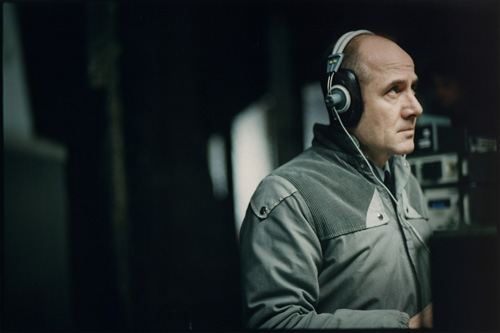
Intently listening.

A second viewing.

With Francis Ford Coppola's "The Conversation" being its closest cinematic kin, "The Lives of Others", one of the decade's best films and is also a stunning directorial debut by Florian Henckel von Donnersmarck, is also exceptional in its well-calculated thrills and is touchingly human in its very essence, which more or less separates it from the aforementioned paranoid classic. "The Lives of Others", with its beautiful emotional center that develops and permeates throughout the film, elevates itself from merely being a strongly-acted piece about the iron-fisted times of the German Democratic Republic into a genuinely transcendent piece about the beauty and mystery of human nature.

Set in 1980's East Germany during the times when German socialism is at an all-time high, privacy invasions through surveillances a commonality, and the destruction of the Berlin Wall nothing but an unrealized fantasy. Wiesler, played by the late Ulrich Muhe in a truly underrated performance that I think should be considered as one of the best in the last twenty years or so, is a seemingly cold surveillance expert and Stasi (German secret police) agent with principles that are well-intact, objective methods for investigations that are proven to be effective, and a solitary way of life. For many years, he has been a success in his field, capable of making suspected radicals squeal the names of associates and potential inciters of rebellion against the state confess to whatever they know. But despite of his strengths and an ability to thoroughly dissect, he struggles to connect.

"Stay a little while", says Wiesler as he futilely tries to convince a cheap prostitute to stay with him after they had a stiff sexual intercourse. Ironically, he is a man that technically controls the fate of those he interrogates and wiretaps but can't even guide his own. Here is a man whose existence has been rendered almost meaningless by his work but still oblivious of the fact.

Enter Dreyman (Sebastian Koch), a playwright, and Christa-Maria (Martina Gedeck), a stage actress: a couple that has been ordered to be put under surveillance technically because of radical suspicions but is really about Minister Hempf's (Thomas Thieme), a Stasi superior, ulterior intent to personally own Christa-Maria for his own sexual fulfillment.

Wiesler willingly signed up for the former but never for the latter; and to make his situation even more conflicted, Dreyman is slowly turning into the serious GDR critic that he was always suspected to be. And to make it even worse, Wiesler is silently being drawn into the couple's personal world plagued by emotional imperfections and forces they cannot control but nonetheless proved to fit Wiesler's concept of transcendent human connection. Furthermore, it's a world that Wiesler has never experienced before let alone felt. They represent his most hidden of hopes and the very truth of his own being.

But there's one personal challenge for him: He mustn't fly too close to the fire. Should he be the silently harsh Stasi agent that he always was? Or should he be a silent crusader for the sake of what's more righteous and more beautiful, at least for him?

From such a simple character as Wiesler, in a performance by Ulrich Muhe that is brilliantly understated and flawlessly complete, "The Lives of Others" has brilliantly embraced emotional importance and an unconditional faith in humanity more than the usual conundrums of a suspense-filled affair.

Director Florian Henckel von Donnersmarck once mentioned in an interview (and is also mentioned briefly in the film) that he was always fascinated of the fact that Vladimir Lenin, as it was told, can't seem to bring himself into finishing the Russian revolution every time he listens to Beethoven's 'Appasionata', his favorite musical piece of all time.

If the power of art can bring or manipulate people to such momentary departures from who they really are, how powerful can it really be? But is that really the case? What if art and beauty, in fact, brings people closer into what they really are? "The Lives of Others" sided with the potential idea that humans are innately good and that humanity, for whatever it has been all throughout history, always strives for an inner truth. The oblivious Wiesler unconsciously did, and unlike Lenin, his 'Appasionata' never stopped playing.

FINAL RATING
Photobucket

Thursday, November 24, 2011

Another Earth (Mike Cahill)

Earth 2.

It's a true breath of fresh air to really watch something like "Another Earth" especially in a time where science fiction films almost always equate to aliens, colorful spaceships and the expanse of the outer space. Although this film has small doses of each of the aforementioned sci-fi stereotypes, "Another Earth" is a whole lot different, highly inventive all on its own and, in the fashion of films like Duncan Jones' masterful "Moon", beautifully dramatic.

Unusually, the film is founded by two narrative extremes: One is its angle of human drama, which exemplifies simplicity in approach, and the other is its transcendental vision, which highlights the film's ambitious scope. With this kind of double content which may risk the equal depiction attention of both ends, balance is most important, and the film, for that matter, does not disappoint.

Mike Cahill, who directs his first cinematic film (his previous one, co-directed by Brit Marling, being a documentary), did what most fresh filmmakers must do, and it is to enter the film scene not with anxieties and insecurities of visions, but with utter confidence and a slight dash of flamboyance. Such ideas like this one here in "Another Earth" admittedly does take a lot of guts and unbounded devotion to really pull off and be successful in its execution. And of course, such far-reaching exercise of the imagination do need a 'more than adequate' budget, but the film nevertheless proved that it isn't always the case, and that often times than not, mind outweighs currency, vision exceeds the means and conceptual quality reigns over monetary quantity. Even just for that reason alone, "Another Earth" should be viewed as an ideal celebration of the creative affluence of the independent film spirit.

The performances in the film, although done by fairly unknown performers, were still able to convey the film's dramatic essence. Brit Marling (also the film's co-writer), who plays the film's main character Rhoda, is assured and effectively compact in her portrayal of a young woman and her guilt-ridden (because of her involvement in a tragic car accident) descent into a directionless existence. Although Marling's character is a fairly complex role to play with her constant transformation from being lost, finding herself, being lost and finding herself again, her performance captured Rhoda's lack of existential motivations early on in the film that it made her character simpler to empathize with.

William Mapother, playing John, is quietly affecting in his portrayal of the anguished musical composer/professor who lost his family in the said accident, is blank-eyed in his detachment from life, but whose connection with Rhoda, being unaware of her involvement in the accident, soon slowly brings him back into its tender symphony.

"Another Earth", although as what I've said earlier, purely relies on the counterbalancing of its main dual content (simplistic human drama and grandiose sci-fi vision), it's also significant in its subtle irony. What if in the aftermath of death there's more to life? What if in tragedy there's love? What if in the presence of a celestial wonder there's disillusionment? "Another Earth" can only contemplate the answers, but rest assured, it's inclined towards what's more hopeful.

FINAL RATING
Photobucket

1001 Movies You Must See Before You Die

Ivan6655321's iCheckMovies.com Schneider 1001 movies widget