Showing posts with label children. Show all posts

Sunday, December 30, 2012

Fanny and Alexander (Ingmar Bergman)

Lost.

Christopher Moore, a contemporary author of fantasy fiction, has once said that "children see magic because they look for it". This, for me, is the foundation and the root of all questions raised in "Fanny and Alexander", a complexly-themed masterpiece that is, sadly, also Ingmar Bergman's very last feature film. In hindsight, it may look as if "Fanny and Alexander" is merely about children's innocence and the power of imagination; two themes that are otherwise quite alien to Bergman himself. But seeing the film unfold in its three glorious hours, "Fanny and Alexander" came out to be so much more than that. In many ways, the film is also a complex extension of Bergman's provocative meditation on the non-intervening nature of God (see "Silence of God" trilogy) and his passive role in human existence. Personally, watching "Fanny and Alexander" is like finally putting the last pieces of a jigsaw puzzle in place. 
     
But Ingmar Bergman, ever the abstract filmmaker, is indeed not the kind that will bail you out with some clear-cut answers. For the record, "Fanny and Alexander" is littered with magic and the supernatural; two aspects of the film that can be taken either as truly literal or completely symbolic. Nonetheless, the film, on surface level a period family drama, wonderfully takes on a new texture and thematic dimension by utilizing some elements that defy physics or explanation. In addition, the film even flirts with the idea that magic may perhaps be the one and only substitute for the complete absence of God; an absurdist approach on Bergman's part but is also very compelling in how it slightly satirizes the extent of our adherence to the unexplainable. 
     
With no real story or narrative, "Fanny and Alexander's" first half is all about the everyday trivialities in the life of the Ekdahls, a well-to-do family of stage actors which, after a relatively happy Christmas eve, was struck by an unexpected tragedy, which suddenly finds Fanny (Pernilla Allwin) and her older brother Alexander (Bertil Guve) emotionally astray and fatherless. 
     
By way of Sven Nykvist's dreamy cinematography which has won him a well-deserved Oscar, the film was able to subtly depict both the difficulty of losing a father in the formative years of one's life and the silently mercurial nature of familial existence at the time (early 20th century Sweden) through its use of empty spaces, distant shots and anguished faces. 
     
After the burial of the titular characters' father, a bishop named Edvard Vergerus (Jan Malmsjö) then enters the scene. Extremely authoritative and ruthless, the bishop is Fanny and Alexander's, both of which were raised in a tender and carefree environment, worst nightmare realized. But just when they thought that things won't get any worse after the death of their father, Fanny and Alexander then find themselves under the wing of the bishop himself, who has decided to marry their newly-widowed mother (Ewa Fröling). 
     
From this point on, after much foreboding early on (with those moving statues and the apparitions of Alexander's father), the film slowly but surely abandons the first half's relatively realistic and lively portrayal of the Ekdahls in favor of a more metaphysical, abstract and gloomy second part. From the approach to the characterizations, it's quite easy to see the definite influence of "Fanny and Alexander" in all those stepmother/stepfather films that it has since predated, specifically Guillermo del Toro's "Pan's Labyrinth", what with its stepfather subplot and whole 'magical realm' aspect. 
     
But then, "Fanny and Alexander" is never a film that can easily be defined by classifications. It is, in fact, a challenge to our own grasp of cinematic reality. If an emotionally-focused drama like "Fanny and Alexander" suddenly goes all supernatural (which it did), what then can be our potential response as viewers? Well, it's much preferred to just keep mum and simply relish it; after all, this may just be magical realism's finest moment in cinema.  
     
But aside from being a stunning amalgamation of both fantasy and reality, "Fanny and Alexander" is also a conscious allegory about the importance of cinema in relation to our lives ("Outside is the big world, and sometimes the little world succeeds in reflecting the big one so that we understand it better") and is also a film that challenges our perception of the unknown, of the things we can't define and of certain life phenomena that we can't explain and articulate about. But more importantly, "Fanny and Alexander" beautifully pushes the limits of cinema unlike anything I've ever seen before.
     
As what the Ekdahls' matriarch (played by Gunn Wållgren) has said at the end of the film, "Everything can happen. Everything is possible and probable. Time and space do not exist. On a flimsy framework of reality, the imagination spins, weaving new patterns." From where I look at it, this is the subtle justification of the film's surprisingly magical nature; a justification that is quite directed to us, the viewers, who are neither children nor naïve and who never expected or anticipated magic but stumbles upon it anyway because of this film. How sad that Ingmar Bergman's great swan song has come too early. But nonetheless, we should still be thankful that a film like "Fanny and Alexander" has come at all. Now I'm more than eager to watch the five-hour version.

FINAL RATING
Photobucket 

Friday, July 15, 2011

Willy Wonka & the Chocolate Factory (Mel Stuart)

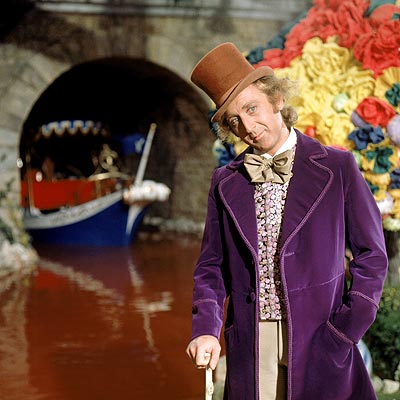
Gene Wilder as Willy Wonka.

Oh, If only I can turn back time. A review coming from a person that has first watched the 2005 Tim Burton adaptation way before this family classic, I got my perspectives the wrong way. I got the comparative order jumbled. When it should have been the later film being compared to the numerous strengths of the earlier one, I had it the other way around. But enough of that, let's move on.

Throughout the entire time I'm watching this film, I can't help but feel that the Willy Wonka character has virtually no backstory, let alone the exposition of his real reason why he closed his factory to the public save for Grandpa Joe's (played by Jack Albertson) unimaginative retelling of the said tale. But beyond Wonka's build-up in the film that may potentially treat his character merely as a golden ticket distributor, moderator and tour guide into the whole film and nothing more, Gene Wilder bursts into the scenery with impeccable style in the most literal sense.

As he first walks through a red carpet, with supporting cane and all, that stretches from his factory's double-doors up to the very external entrance gate, I immediately felt the enigma within him and his internalization of the Wonka role. And then he left the cane sticking into the ground and act as if he's falling, face first. But suddenly, he tumbles and regained his footing all in one motion with the honed finesse and energy of an effortless master acrobat. In that scene alone, I almost completely forgot about Johnny Depp's portrayal, and also from that point on, my ready-made comparison between the two actors immediately came into a halt. Gene Wilder, in the simplest of terms, owned Willy Wonka. He inhabited him and vice versa; shame that the said iconic character wasn't given enough story flesh to bulk him up a bit more in terms of his relative weight to the whole narrative fare. And it's more of a disappointment that the film was titled as "Willy Wonka & the Chocolate Factory" despite of the fact that it just doesn't feel like he's the center of the film.

Now, with that said, I can still fairly say that I have enjoyed the film as a whole, although I would have much preferred it if the two musical sequences before the factory scenes were removed as they just do not add anything to the film whatsoever. Yes, maybe the sense of melancholy and joy (Mrs. Bucket's song and the dance scene between Charlie and Grandpa Joe) are the specific emotions that were targeted to be conveyed in these scenes, but both could have been achieved with a more linear approach. And both songs aren't just that catchy at all.

But then, there's the production design. The tagline of the film is "Enter a world of pure imagination". If it tends to be more accurate, I think they should have added 'silly' somewhere in the middle of the sentence, but that's not an insult. Not at all. Unfolding the premises of Wonka's factory, the film has unveiled machines, mechanisms and devices that are laughable at best. But thinking about it all, I think the film completely distanced itself from the wondrous imagery of common fantasy and instead extended its hands and fully embraced its surreal, weird, bordering traumatic, but ultimately joyous and imaginatively quirky side. A beverage that makes a person who drinks it float up the air, a gum that simulates a three-course dinner, a flavored wall, and even a nightmarish boat ride. It is torn between the fantastically linear and the bizarre, but I think it chose to lean on the latter more.

And somewhere between the film's intent of appealing to the general audience and to connect with fantasy film admirers is an uncommon purpose to expose the darker, more desolate side of loneliness and eccentricity. Take note of Wonka's song number near the beginning of the factory scenes and his preacher-like blabbering during the boat ride scene. These key moments, beyond the unadulterated sense of fun, awe and hilarity, suggestively show his on and off, in and out flirt with lunacy. But the plot twist of sort in the end is the true depiction of Wonka's character's real intention, narrative-wise: that after all, he is the delivery boy of the film's moral lesson and the enforcer of the rewards to those who successfully align themselves with it.

Willy Wonka. The eccentric and the weird. His peculiarities, superficiality and unorthodox authority. Moved and touched by a gobstopper. Even in its ultimate emotional justification, the film is imbalanced at best. But the way it was executed and served in its colorful banquet of images and characters that includes a bunch of Oompa-Loompas that seem like Munchkin rejects, was quite effective. And also, it slightly pokes fun of media (the way it has covered Willy Wonka's 'Golden Ticket' craze), the virtue of fads and the conscious mass hysteria that roots out from the trivial promises of mass-consumed products. So, aside from being an exuberant adaptation of a beloved Roald Dahl classic, it's also quite loaded with what it has to say.

FINAL RATING
Photobucket

1001 Movies You Must See Before You Die

Ivan6655321's iCheckMovies.com Schneider 1001 movies widget