Showing posts with label classic. Show all posts

Thursday, December 27, 2012

Children of Paradise (Marcel Carné)

Baptiste and Garance.

The great Francois Truffaut has once stated that he would indeed give up all of his films to have directed "Children of Paradise" himself. If that's not a testament of the film's more than impressive whole, with its ability to impress and stir up healthy jealousy among other equally heralded filmmakers, then I don't know what else will be. The film, shot during the turbulent times of Nazi occupation in France (French Resistance members at the time even secretly worked in the film's production), is a miraculous achievement not just of cinema but of the entire realm of art. By merging the symphonic beauty of two of the greatest art forms the world has ever seen (theater and film), Marcel Carné, the film's director, has created an unforgettable screen masterpiece that is both aesthetically moving and emotionally evocative. 
     
Although it was cleverly marketed in America as France's cinematic answer to Victor Fleming's "Gone with the Wind", "Children of Paradise" is so much more than just a foreign substitute to an epic Hollywood picture. It is, by its own right, a stand-alone film that ambitiously treads the territories of both love and artistry, not to mention that it is also a visually stunning rendition of 19th century France. Populated by characters that seem to be molded after Charles Dickens' creations, "Children of Paradise", in a way, moves and unfolds like great literature (the film was even split into two distinct, very novel-like chapters). But unlike the lively pageantry of "Gone with the Wind", "Children of Paradise", even at the film's early moments, is already burdened by a running sense of melancholy, specifically when the camera first focuses its lens on the face of Baptiste (Jean-Louis Barrault), a great pantomime who will find himself slowly falling under the spell (and pain) of love. The object of his affection is Garance (Arletty), a stunning woman who sees love merely as a simple phenomenon and who, at first sight, was immediately magnetized by Baptiste's romantic peculiarities. 
     
But then, it's not only Baptiste who's smitten by Garance; on one side, there's Frédérick Lemaître (Pierre Brasseur), a flamboyant theater actor whose acts atop the stage bleed through life itself. On the other, there's also Lacenaire (Marcel Herrand), a part-time poet and full-time criminal whose great contempt of life can only be matched by his enormous pride. And finally, there's Count Édouard de Montray (Louis Salou), a rich man who baits Garance with his unequaled fortune so that she will not love any other man ever again. 
     
Together, these four characters engage in a slow dance of doom that finally justifies the melancholic undercurrent that runs through the film. But even though "Children of Paradise" plays like a tragedy, the film, for plenty of reasons, will surely put a smile in every cinephile's face mainly because of its visual and thematic perfection. And even though the film runs close to 3 hours, I honestly would have wanted 3 more. Hell, the film, with its highly eloquent and intuitive screenplay (by Jacques Prévert), could have been an audio book. But then again, it could have also been an enjoyable silent film, what with its pantomime fluidity and swift physical timing. 
     
Considered by many as one of the greatest films of all time, "Children of Paradise", again despite of it being a romantic tragedy, is a celebratory film that embraces and makes one with art even in the midst of a violent global conflict. "Children of Paradise", a flawless masterpiece of French cinema, will always stand the test of time not just as great art but also as a proof that cinema can never be crippled by war-time destruction, be forced underground by bombs and be shackled by fear. "Children of Paradise" powerfully persists.

FINAL RATING
Photobucket 

Sunday, June 10, 2012

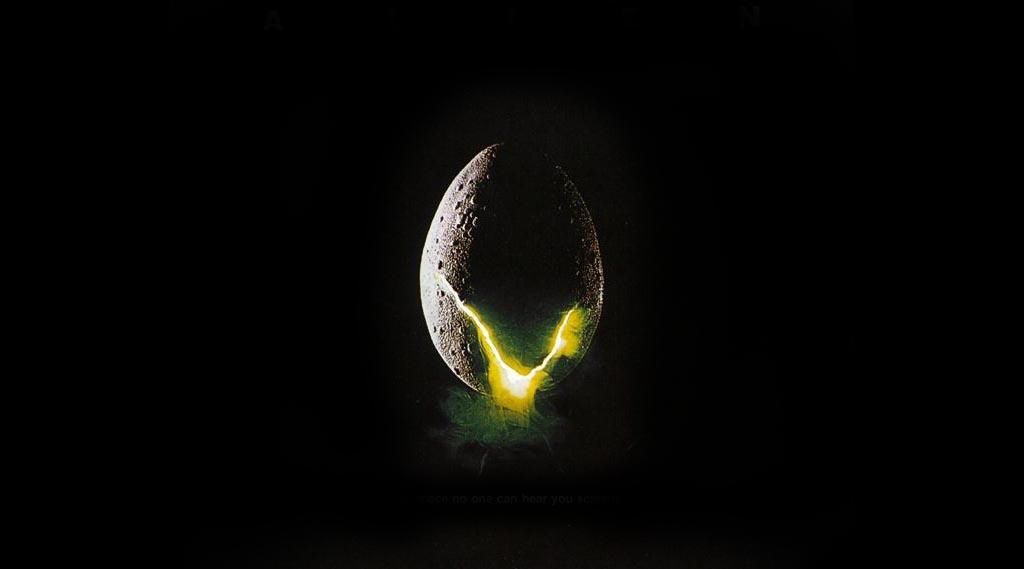
Alien (Ridley Scott)

Egg.

Not that I was truly compelled to rewatch "Alien" solely because of "Prometheus'" release, as viewing the former once more was already in the back of my mind even before the latter was even green lit. And watching it after more than 5 years, it was as if I'm seeing something new altogether. 

Perhaps my slight cluelessness brought about by the years of not watching this film is, in a way, a thing of envy for die-hard "Alien" fans and even a fantasy realized for most movie watchers. As a long-time film lover, I know that there's this ever-recurring yet far-fetched idea among compulsive cinephiles of being able to wipe their memories clean so that they can enjoy all of their favorite films once more without knowing what's going to happen next. 

I, for one, would love to watch "Predator" again without any 'action hero' bias towards Arnold Schwarzenegger so it will once again be a genuinely thrilling experience. 'Who will die next?' A simple question that is indeed one of the guilty pleasures in all of cinema and one of the meager delights of an avid suspense fan. Perhaps that's what I have felt while watching "Alien" once more, and it was indeed a wonderful high. 

Of course, one can't deny how well-made this film really is and how its simple premise has brought it to its legendary status that we all know of today, but I have never remembered it, more than half a decade ago, to have contained such exceptional performances. Sigourney Weaver's performance for instance, after watching it again, has been enhanced to a certain extent and was even more believable than I last remember it to be. 

Her transformation as Ellen Ripley, from a dead serious female crew of the Nostromo to a brave heroine by circumstance, is such a powerful slow-burner that her intense metamorphosis is still being repeatedly used as the model character arc for sole survivors in many films of the same kind even to this very day.

But although this 'zero to hero' arc has been used a year before "Alien" was released in the form of Jamie Lee Curties as Laurie Strode in "Halloween", Ellen Ripley is a hundred times more chilling in how she has responded to her situation mainly because the survival rate in space, paired with a murderously invulnerable Xenomorph, is relatively low compared to a suburban neighborhood hunted by a slow-ass, Captain Kirk mask-wearing Boogeyman. And also because, let's admit it, playing this little survival game in space is infinitely more intensely terrifying to behold. 

But the "Alien" experience, as we all know, wouldn't be that unforgettable if not for Ridley Scott's exquisite direction, Dan O'Bannon's (rest in peace) simple but effective writing and H.R. Giger's iconic creature design. Taking one out of those three will surely render "Alien" quite deficient and lacking so it's fortunate that they have created a film so good that it has bred an expansive franchise and even cross-over films, much, of course, to the delight of fans who wanted more of it.

And then there's the rest of the cast, which consists of Harry Dean Stanton, Tom Skerritt, John Hurt, Ian Holm, Veronica Cartwright and Yaphet Kotto. If I am to look upon that particular line-up of actors without a further knowledge that this is indeed a science fiction film about a murderous alien in a spaceship, I would have mistaken this to be an elegant ensemble drama. 

Indeed the talent of "Alien's" cast has made O'Bannon's writing more natural on-screen, as they have truly provided it with human spontaneity that an otherworldly and literally alienating film like "Alien" crucially needs. Their performances were not legendary by any means, but their chemistry exudes a certain relational authenticity that it has been the strong, primary highlight of the film just second to the very arrival of the extraterrestrial slaughterer itself. 

Now, look at it again: The Nostromo's crew sitting around a white, futuristic table, eating futuristic foods while taking about home. Aside from the creature itself, isn't that what you'll remember most about "Alien"? 

But after all, what has really made "Alien" a legendary classic? Well, if you look at it, the story is too simple to even qualify as such, which plainly concerns the crew of a commercial spaceship named "Nostromo" and their unlucky encounter with a not so accommodating creature that serves as the antithesis of Spielberg's "E.T.". "Alien" does not even possess "2001: A Space Oddyssey's" mystical ambiguity or even "Planet of the Apes'" revolutionary utilization of a twist ending.

So what, then, has made "Alien" so special? I believe it is how the film exemplifies the greatness of having just the right amount of everything. It's a science fiction film that does not bite more than it can chew, it's a suspense movie without the usual overkill and it's a monster movie without the visual excesses. The performances do not dominate and even the creature lurks in the blackest darkness, teasing you with the terror that it entails rather than scaring you with its physical wholeness and its tails (Why? I want to make a rhyme, damn it!). "Alien" is a film that wants you to look at the vast emptiness of space not as a purely meditative speculator asking the 'whys', 'wheres' and 'hows' but as a cautious spectator asking the most perverse 'what ifs'. 

"In space, no one can hear you scream". Just reading that tagline alone is enough to send genuine shivers down your spine. Watching the film is even a taller order for your nerves to handle. Beware of its scares but be compelled by its greatness.

FINAL RATING
Photobucket

Thursday, October 20, 2011

Tinimbang Ka Ngunit Kulang (Lino Brocka)

Anguish.

Living in the modern Filipino film culture, one can't easily delve oneself deeper into it without even hearing about the film "Tinimbang Ka Ngunit Kulang" and marvel about how heavily metaphoric the title really is. And then, with an unconscious compulsion, you then become curious. What is the film really all about? I, for one, initially thought that this film, although undoubtedly one of the finer Filipino films, isn't clearly one of the all-time greats. That's me and my unflinching idiocy. I then rewatched it with the aforementioned question rerunning in my mind, and then some. And just like that, I was in utter awe.

"Tinimbang Ka Ngunit Kulang" may widely be considered as Lino Brocka's seminal masterpiece, but somewhere within the corners of my mind where "Maynila: Sa Mga Kuko ng Liwanag", "Bona" and this film are on a continual struggle for subjective supremacy, it might just be his best work.

Contrary to Brocka's trademark ambient sounds-enhanced, raw visuals-enforced neorealisitic approach to contemporary Filipino squalor that has been ever prevalent in his later films such as "Insiang", "Tinimbang Ka Ngunit Kulang" boasts of a powerful human drama set within the hypocritical social and religious milieu of a seemingly quiet rural town.

Part coming-of-age film and part cinematic indignation of inhuman judgments, the film succeeded to disturb, touch and shake viewers all at the same time with its potent ability to deliver both an encompassing social commentary and an observant exploration of an adolescent's moral journey from debilitating indifference to something mirroring righteous courage and humanity.

The teenager, named Junior, played by then-rookie actor Christopher De Leon (who won a FAMAS for his performance in the film) who surprisingly handled the role like a seasoned veteran, is caught at an early crossroad; in this existential standstill, he can't seem to find his own path. Should he follow his father's successful yet women's perfume-laden path (a serial womanizer, that is)? Must he pursue a romantic, but ultimately hollow and immature commitment, or does he have the fiber to embrace the lives of two sideshow social outcasts whose deeply felt relationship overpowers their physical and mental shortcomings?

In some ways, just as how Brocka applied it to his later film "Jaguar", "Tinimbang Ka Ngunit Kulang" is a film that deals with crucial choices. Even with the dream-like opening sequence alone which, in a very hallucinatory way, portrayed the emotional nightmare of an abortion, both in its procedure, the aftermath (this powerful scene prophetically answers some of the questions that were raised in the 1985 film "Hinugot sa Langit) and the psychological effect once the choice regarding it was finally made, though in the film's case, a one-sided one at that (Lolita Rodriguez's Kuala seems unwilling).

Today, mentioning the name Lolita Rodriguez is like unveiling a dignified marble statue of a true Filipino cinematic icon, and for that kind of automatic pop culture thinking, suffice it to say that it was duly in part of her legendary performance in this film as the town lunatic, Kuala. It's one of the best performances in all of Filipino cinema, and her detailed conveyance of staggering facial expressions and uncanny gestures brilliantly merged and crisscrossed both the overly animated movements of a dirty mental case and the uncommon emotional depths of a woman who just suffered too much and is begging, by way of her soul creeping silently through her eyes, for all of it to end.

Mario O'Hara's role as Berto the leper is just as tricky to pull off. Listening to some of his lines, the character may easily drift into one-dimensional nobility, but O'Hara kept it all together quite consistently and has able to display the visceral goodness of a man who has nothing left to lose but just enough time to love. Eddie Garcia also shined in his role as Junior's father, Cesar, a role he so conveniently and effortlessly played that the very polygamous core of the said character has since been iterated quite heftily in his action film roles (the 'Manoy' persona).

One of Brocka's real, unequaled strengths is his great execution of endings. The one here in "Tinimbang Ka Ngunit Kulang" is a great example. Playing with the facial expressions of both the extras and the chief actors while still maintaining the emotional strain of the ending's dramatic center, the film, although can easily be branded as a communal tragedy, is still hopeful despite of its wounded premises. And as Junior emerges from Kuala and Berto's hut, carrying a symbolic purity that is a product of two individuals that were subjected to inhumanity, there's a feeling of solitary safety, and at last an emphasis, as Junior looks upon the people's guilty faces, of what was really weighed and found terribly wanting: the town itself.

FINAL RATING
Photobucket

Thursday, October 13, 2011

One Flew Over the Cuckoo's Nest (Milos Forman)

Randle.

Even though I have watched "One Flew Over the Cuckoo's Nest" way back (I think I was in 4th year high school or something), seeing it for the second time after reading the Ken Kesey-written novel from which the film was based is like seeing it anew. With the similarly-titled book conveying an uncanny life and energy that easily stimulates both the raw senses and the imagination, this film adaptation bursts of the same raw vitality of the human spirit fully prevalent in the said literary work. It's as if this film isn't merely a cinematic translation of classic literature but more of a direct affirmation of the material's true underlying power.

Even in just the film's opening scene alone, as we see the car which carries our flawed hero R.P. McMurphy (Jack Nicholson in a performance that only 'he' can call his own) into the mental institution, there's this clear-cut inevitability of a living and breathing cinematic rendition, and how everything, although there were drastic liberties taken by director Milos Forman and company, really seems to fall into place and almost symphonic in a way. Never have I been more excited of seeing a book's setting, which in that case a mental hospital, being visually laid down into separate sets of narrative establishments, and never have I been more compelled to see characters, even clinically-crazy ones at that (which I have treated as my subconscious friends for more than 2 weeks while I read the book), slowly populate the composite spaces of the screen.

Considering that the film is that of a mercurial human drama, inappropriately as it may seem, I was extremely pumped up towards re-watching "One Flew Over the Cuckoo's Nest" in the same way as when I'm about to watch a nicely-hyped thriller feature. And as the film, with only slightly more than 2 hours in its sleeve to cover all of the novel's essence, comes to an end, I came to a conclusion which I deem to be very proper: As a mere adaptation, "One Flew Over the Cuckoo's Nest" had its issues, particularly the much discussed and polarizing change of the story's main point of view from Chief Bromden (played by Will Sampson) to McMurphy. But as a stand-alone film, it really is quite untouchable in its unwavering capacity to deliver a walloping emotional punch and an unforgettable humanization of a place commonly conceived to have forgotten about it. It is indeed one of the best films of the 70's, and the fact that it has swept all the major honors in the 48th Academy awards agrees with my rave assumption.

What really moves this film forward in terms of both pacing and characterization, aside from the brilliant dynamics of the relationship between Nicholson's defiant McMurphy and Louise Fletcher's great portrayal of a mechanically brutal Nurse Ratched (I wonder if she's an acquaintance of Miss Trunchbull, or Warden Norton perhaps), are the eager and resilient all-around performances by the film's sideshow supporting cast of Acutes and Chronics, specifically early roles by Danny DeVito, Christopher Lloyd and especially the underrated character actor Brad Dourif. Cinematographer Haskell Wexler (edit: I read in the IMDb trivia page that he was actually replaced by Bill Butler early in the production due to Wexler's creative dispute with producer Michael Douglas) finely contrasted the mental institution's structure, both its calm exterior shots and white-painted interiors which symbolically exudes the characters' pristine but insidious imprisonment within a so-called therapeutic environment with the suggestive spark plug-like 'chaos' about to explode at any given time.

Like Milos Forman's earlier "The Firemen's Ball", through the use of quick cuts and rapid verbal noises to highlight the escalation of tension and full-blown disorder, he has painted a fragile mental atmosphere merely held together by the Big Nurse's wide-eyed cold glances and authoritatively monotonous voice, but is forcefully being loosen up by McMurphy's knack for anarchic freewill.

But McMurphy is by no means an enduring hero of sorts. Unlike other inspiring, Oscar bait-y films that have since came out of the bowels of Hollywood, "One Flew Over the Cuckoo's Nest" is never meant to be a black and white struggle between the proverbial 'good' and 'evil', but as a timeless study of extreme authority clashing with non-conformity.

Chief Bromden, on the other hand, is our mediator, but at the same time, a conceptual representation of the 'unreliable' narrator (at least in the novel). And as what I've mentioned above, if the varied characters have been my friends for the past 2 weeks or so while I read the book, Bromden has been my bestest there is, and seeing him quite underdeveloped in the film is like reuniting with a good ol' friend of mine again after so many years but mysteriously does not seem to want to talk to me anymore.

But through that crucial flaw, a flaw so detrimental that it has given Ken Kesey enough reason not to watch the film until his dying days, "One Flew Over the Cuckoo's Nest" is still a masterful film that blurs the boundaries between comedy and drama, the bittersweet and the tragic.

"But I tried, didn't I? Goddamnit, at least I did that." Great, enduring words from McMurphy which speaks of great meaning regarding the characters' predicament as much as it does to filmmakers in general in the context of literary adaptations. There's a recurring trivia that Ken Kesey, seeing this film one time on TV without knowing that it is indeed "One Flew Over the Cuckoo's Nest", thought it was interesting (of course he immediately found out). Just as what I've said earlier, although in some ways a letdown as an adaptation, it brilliantly succeeds as a film which holds its own ground as a genuine classic of American cinema.

FINAL RATING
Photobucket

Wednesday, September 7, 2011

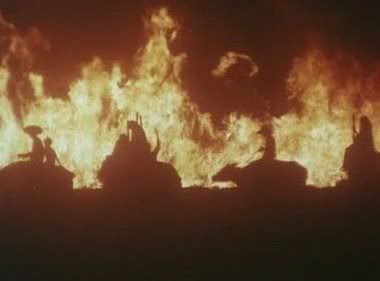
Oro, Plata, Mata (Peque Gallaga)

Ablaze.

A second viewing.


"Oro, Plata, Mata" can easily be accused of being too explicit and overly indulgent on Peque Gallaga's part, but it can't be doubted that this film puts forth a visually harrowing perspective that does not merely settle on pacifist commentaries or wartime tears. Sometimes, just like how Gallaga has presented his allegorical "Scorpio Nights", films must not wait in some dark corner in hopes that someone may clumsily pick them up out of curiosity. They must be assertive with their audience regarding whatever they want to show, and "Oro, Plata, Mata" succeeded to do just that, with the occasional 'shock' factor on the side.

Just like "Batch '81", which suddenly begins with a musical score that mirrors the sounds of a circus fun fair, this film also opened with a music that seems out of place. A mixture of harmlessness and sardonic sarcasm, the music plays as if it's poking fun of its mannered bourgeoisie characters, Bunuel-style. The film's opening credits greet us with assortment of characters moving in 'slow-motion' as they fix their hairs and smoke tobaccos. Going along with these scenes is this sinister feel that wraps them that seem to suggest that "Oro, Plata, Mata" is about decadence as it is about the entrails of war, if not more.

And as the film furthers its linear yet episodic narrative descent into the grave unknowns of war, it unfolds an unsettling portrait of how even the most mannered of people may easily concede to the angst-ridden sexual temptations that root out from living in ennui. But Gallaga, who shows his mastery of visual composition and a hint of exploitation (I believe that the film still would have worked even with two to three sex/nude scenes less), backed by Jose Javier Reyes' screenplay, extends the fact that the film's characters' emotional and carnal transformations weren't human deconstructions, but a simple case of skeletons in the closet. It's right with them all along.

Joel Torre, his first screen role, is remarkably effective as the frail Miguel, whose psychological metamorphosis from a mama's boy to a hardened killer is every bit believable. While an array of portrayals by Sandy Andolong, Lisa Lorena and Maneul Ojeda balances the film with subtlety, the film is made literally alive amid the film's more dragging moments by commanding performances from Lorli Villanueva and especially Mitch Valdez (credited as Maya Valdes in the film) as the calculating 'doktora', whose sexual promiscuity inspires the innocent Trining (Cherie Gil) to pursue and quench the thirsts of the flesh with Hermes (the vastly underrated Ronnie Lazaro), a Guerrilla rendered mute by the war.

There's no question about "Oro, Plata, Mata's" distinct influence across Philippine cinema. Whether it's the scope, the family-centered narrative or the violence, this film attracted 'greatness' for itself but does not brag about it. Never did I feel, all throughout its more than 3 hours of running time, that the film relished in self-importance. Self-indulgent, yes, there were specific scenes which were more a showcase of great cinematography and production design than sharp needles to stitch the whole film together. But still, "Oro, Plata, Mata" is nonetheless a lasting Filipino film that tackled the horrors, the deep wounds and the indelible scars of the Second World War unlike any other of its kind.

In the long run (quite literally for its length), it's never an overly pacifist film. Although there's this ambiguous 'diwata' character played by Kuh Ledesma that may subjectively symbolize the tarnished state of our 'Inang Bayan' (Mother Land) during the onset of war, the film is more about the isolated effect of violence and sexual immorality upon two families than it is a cinematic anti-war essay. Hell, we only see one Japanese soldier in the entirety of the film.

"Oro, Plata, Mata" is never concerned about the sentiments against foreign oppression that comes from islands away. With its blood-drenched message, the film is a brutal depiction of how at chaotic times, barbarism and decay gush out from nowhere else but within one's own backyard.

FINAL RATING
Photobucket

Friday, July 15, 2011

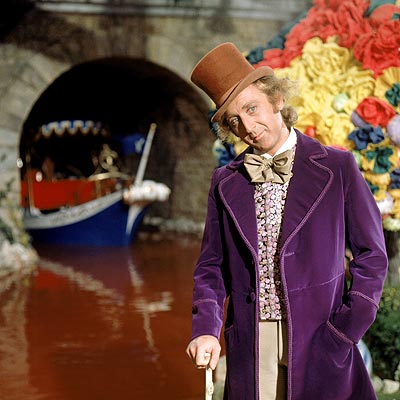
Willy Wonka & the Chocolate Factory (Mel Stuart)

Gene Wilder as Willy Wonka.

Oh, If only I can turn back time. A review coming from a person that has first watched the 2005 Tim Burton adaptation way before this family classic, I got my perspectives the wrong way. I got the comparative order jumbled. When it should have been the later film being compared to the numerous strengths of the earlier one, I had it the other way around. But enough of that, let's move on.

Throughout the entire time I'm watching this film, I can't help but feel that the Willy Wonka character has virtually no backstory, let alone the exposition of his real reason why he closed his factory to the public save for Grandpa Joe's (played by Jack Albertson) unimaginative retelling of the said tale. But beyond Wonka's build-up in the film that may potentially treat his character merely as a golden ticket distributor, moderator and tour guide into the whole film and nothing more, Gene Wilder bursts into the scenery with impeccable style in the most literal sense.

As he first walks through a red carpet, with supporting cane and all, that stretches from his factory's double-doors up to the very external entrance gate, I immediately felt the enigma within him and his internalization of the Wonka role. And then he left the cane sticking into the ground and act as if he's falling, face first. But suddenly, he tumbles and regained his footing all in one motion with the honed finesse and energy of an effortless master acrobat. In that scene alone, I almost completely forgot about Johnny Depp's portrayal, and also from that point on, my ready-made comparison between the two actors immediately came into a halt. Gene Wilder, in the simplest of terms, owned Willy Wonka. He inhabited him and vice versa; shame that the said iconic character wasn't given enough story flesh to bulk him up a bit more in terms of his relative weight to the whole narrative fare. And it's more of a disappointment that the film was titled as "Willy Wonka & the Chocolate Factory" despite of the fact that it just doesn't feel like he's the center of the film.

Now, with that said, I can still fairly say that I have enjoyed the film as a whole, although I would have much preferred it if the two musical sequences before the factory scenes were removed as they just do not add anything to the film whatsoever. Yes, maybe the sense of melancholy and joy (Mrs. Bucket's song and the dance scene between Charlie and Grandpa Joe) are the specific emotions that were targeted to be conveyed in these scenes, but both could have been achieved with a more linear approach. And both songs aren't just that catchy at all.

But then, there's the production design. The tagline of the film is "Enter a world of pure imagination". If it tends to be more accurate, I think they should have added 'silly' somewhere in the middle of the sentence, but that's not an insult. Not at all. Unfolding the premises of Wonka's factory, the film has unveiled machines, mechanisms and devices that are laughable at best. But thinking about it all, I think the film completely distanced itself from the wondrous imagery of common fantasy and instead extended its hands and fully embraced its surreal, weird, bordering traumatic, but ultimately joyous and imaginatively quirky side. A beverage that makes a person who drinks it float up the air, a gum that simulates a three-course dinner, a flavored wall, and even a nightmarish boat ride. It is torn between the fantastically linear and the bizarre, but I think it chose to lean on the latter more.

And somewhere between the film's intent of appealing to the general audience and to connect with fantasy film admirers is an uncommon purpose to expose the darker, more desolate side of loneliness and eccentricity. Take note of Wonka's song number near the beginning of the factory scenes and his preacher-like blabbering during the boat ride scene. These key moments, beyond the unadulterated sense of fun, awe and hilarity, suggestively show his on and off, in and out flirt with lunacy. But the plot twist of sort in the end is the true depiction of Wonka's character's real intention, narrative-wise: that after all, he is the delivery boy of the film's moral lesson and the enforcer of the rewards to those who successfully align themselves with it.

Willy Wonka. The eccentric and the weird. His peculiarities, superficiality and unorthodox authority. Moved and touched by a gobstopper. Even in its ultimate emotional justification, the film is imbalanced at best. But the way it was executed and served in its colorful banquet of images and characters that includes a bunch of Oompa-Loompas that seem like Munchkin rejects, was quite effective. And also, it slightly pokes fun of media (the way it has covered Willy Wonka's 'Golden Ticket' craze), the virtue of fads and the conscious mass hysteria that roots out from the trivial promises of mass-consumed products. So, aside from being an exuberant adaptation of a beloved Roald Dahl classic, it's also quite loaded with what it has to say.

FINAL RATING
Photobucket

Saturday, January 15, 2011

City After Dark (Ishmael Bernal)

A glimpse of death.

Film Review Archive (date seen: September 30, 2010)

Before our film industry has turned into the mainstream disappointment that it has been today, masters like Ishmael Bernal strengthened the industry's foundations, not by big-budget films that boasts of colorful, shallow nationalism, but supported its pillars with 'critical bravery'; exploring the themes, subjects, and immoralities in a time of modernistic bondage of expressive sovereignty (Marcos era).

I've always conditioned my mind that "Maynila: Sa mga Kuko ng Liwanag" is the best film to ever portray the eponymous capital of the Philippines. But witnessing this work for the first time, it has altered my perception of the Lino Brocka classic and at the same time "City After Dark", for me, has immediately entered the realms of being one of the "definitive" Filipino films with the highest artistic control.

But do not get me wrong, "Maynila: Sa Mga Kuko ng Liwanag" offered an unforgettably painful look of the city from the eyes of, putting it bluntly, an alienated 'promdi'. It's a film that steers raw emotions, and at times slips into complete melodrama. But "City After Dark" may have been the opposite; it explores apathy in the midst of moral decadence and hysteria without offering much mercy.


There are moments in the film where the characters asks each other artificial questions like "Do you really love me?", or "Will you really marry me?". They're not honest queries, but merely asked so to pass the time. And though same questions may have come from sincere hearts, it's beyond their grasp. Manila's too busy a city to provide secure answers.

FINAL RATING
Photobucket

Singin' in the Rain (Stanley Donen and Gene Kelly)

Gene Kelly is singin' in the rain.

Film Review Archive (date seen: September 14, 2010)

"Singin' in the Rain" might be the closest a film can get to a perfect musical. Some films of the kind, although impressive in its showcase of its extravagant production values, lacks the pure magic of telling a memorable story, drowning the project instead with countless song numbers to conceal the deficiency of the material itself, even so that some of them won Best Picture awards. Enter "Singin' in the Rain", a film that may look just like the others initially: style but no substance. But this film dared to remove the 'no', and succeeded.

The plot of the film may easily drift into some melodramatic musical numbers pertaining about the passing of old times and the silent era silenced forever by the emergence of the title card-less, full-fledged "talkies"; themes that can be effortlessly turned into a sad swan song of sorts for the said era. But with its mood and atmosphere departing from the typical treatment of the material, the film, directed by dance virtuoso Gene Kelly, along with Stanley Donen, flourished with almost uncontainable joy and genuine laughter, usually rooted out from the mishaps of transforming a silent film studio into a try-hard talkie producer. Add up Jean Hagen's unforgettable performance as Lina Lamont, a satiric attack for larger than life stars with smaller than penny brains, then you have a classic.

A concept that could have easily resulted into a tearful elegy about the transition of eras and the changing times always prevalent on the movie industry, but instead turned into a colorful celebration of film and music and of the successful passing of torch of two different cinematic deviations. Both proven by time as essential and significant to its (cinema) meteoric emergence as the prime medium commonly associated with "entertainment".


FINAL RATING
Photobucket

1001 Movies You Must See Before You Die

Ivan6655321's iCheckMovies.com Schneider 1001 movies widget