Showing posts with label New York. Show all posts

Sunday, January 12, 2014

Frances Ha (Noah Baumbach)

Girls just want to have fun.

It's one thing for a film to show life's heartaches in all its tearful, emotional glory, but it's altogether another for it to look at everything as if they're all but punchlines of a very funny story. The latter, I think, is always the more difficult one to pull off, and "Frances Ha" did just that without even figuratively letting out sweat. Throughout the film, there are hints about love and sex and relationship, but it's really more about the bumbling life of this girl named Frances, played with an entertaining kind of passive-aggressiveness by Greta Gerwig, and her bittersweet struggles through the 'black and white' metropolis of existence, all while these three crumble in front of her very eyes. 

Despite it being a story of a modern woman who we can pretentiously brand as some kind of a bird whose feather is just too bright for her own good, the film is unexpectedly brimming with so much naivety that you can excuse her foibles not just because it's cute and all but because we can understand her blunders. Frances may not necessarily be likable in the same way the characters portrayed by Katherine Heigl and Jennifer Aniston (then again, I'm not saying that you should like them in the first place) in all those junk chick-flicks out there are, but in her, I can sense someone real and breathing and very, very tangible. She's the kind of character who you can normally bump into on some busy avenue, share a brief smile with, and then be both on your way. 

As far as I'm concerned, Frances is as real as any modern female character can get, and it's very smart to show this honesty without reducing and locking her up within a basic 'girl meets boy' plot. "Frances Ha" is, for the record, a love story, but not between two very specific people but more with life itself, and how just wandering through it, sans responsibilities, will inevitably lead you into finding both what you really are and what you're not. And though I have this great urge to brand "Frances Ha" as a film about 'friendship' (between Frances and her best friend, Sophie), really, it's not. I even want to go out of my way and label the film as a comedy but it's really more concerned with the honest-to-goodness dramatic bummers of a twenty-something woman and not with some of her inconsequential quirks ala Wes Anderson. In retrospect, "Frances Ha" really is a film that's almost impossible to categorize simply because it works as some kind of a romance-drama-comedy genre hybrid without really being any of them because it's really just, all along, about this carefree woman who's merely being herself.     

As much as possible, I don't want to reference Woody Allen in my reviews of dramedy films because it's just too ho-hum to do so, but "Frances Ha", minus the almost disturbing dose of neurosis and cynicism, is perhaps what a Woody Allen film may look like if he's a little less world-weary, less redundantly psychoanalytical, and, yes, a tad less sexual. Directed by "The Squid and the Whale's" Noah Baumbach, the film is, just like the aforementioned 2005 indie sleeper, is virtually plotless and its cast not much acting but merely being themselves while saying trivial things that, when you think of it, actually matters. Case in point: The scene where Frances describes, half-drunk,what she really wants in a relationship. That's just pure movie magic right there. 

The script (co-written by Gerwig herself), in all its looseness, is very effective in impeccably highlighting Frances' aimless pursuit of dancing and, subsequently, happiness as a whole. Though some women may not like it if I declare Frances as 'what a modern woman should look and act like" (especially today where the archetypal 'empowered woman' is the 'in' thing this side of the glass ceiling), I think it is but right to brandish her with such a label because, hey, she's as imperfect as imperfect can be, and isn't modern living?

In "Frances Ha", there's no story but only Frances' life, there's no love but only her idealized concept of it, and there's no actual, concrete friendship but only her dreams of, one day, having such that would never go away. And her goal? To dance and choreograph. Perhaps she's too naive and awkward and a notch too 'undateable' to choreograph and orchestrate an entire production number let alone her very life as it happens, but Frances couldn't care less. Sometimes, at least for her, to want something without ever enacting upon it may just be enough because, sooner or later, it CAN just happen, all while she's having fun with herself and making fun of what she is and what she cannot be. As one of the staple sayings of this 'Tumblr' generation goes: "She saved everyone but couldn't save herself." But wait, Frances is not the martyr type, and no, she's really not keen on saving anyone, so read that quote again the other way around and you will pretty much have the idea of what Frances' "aimless goal" in life ultimately is. Shite. Freakin' oxymoron right there. 

Undateable.

FINAL RATING
 photo 42.png

Thursday, November 1, 2012

Escape from New York (John Carpenter)

Snake.

With "Escape from New York", director John Carpenter (alongside co-writer Nick Castle) offers us a frighteningly war-torn vision of 1998 where the eponymous city is nothing but a maximum security prison and the hope of mankind solely resting on the shoulders of an eye-patched criminal named Snake. Oh how screwed Carpenter's world is.  
     
As a seminal action film, the picture's visuals and simple yet compelling premise (adhering to the 'lone man on a mission' film archetype) is very, very potent even to this day. Although there were moments that seem to call for some swifter editing and some scenes that suggest that the film has not aged that well, the whole experience is still quite unique. Kudos to Kurt Russell (in his great coming-out party as a cinematic badass), who has played the anti-heroic Snake Plissken in a manner that oozes dark charisma and irrevocable screen presence. The supporting cast, comprised mainly of seasoned veterans like Donald Pleasence, Lee Van Cleef and Ernest Borgnine, is also quite great despite of the one-dimensionality of their characters. 
     
As a filmmaker, John Carpenter is very admirable in how he was always able to project flinching social commentaries while still being able to retain the integrity of various genre trappings. "Escape from New York", a truly gripping action picture, is one of the earliest examples of how action films can go all-out on the thrills but can still be articulate enough to say a thing or two. With the demoralizing trails left by the Watergate scandal and the Cold War paranoia raging at the time of the film's release, John Carpenter was able to share a piece of his mind regarding these sociopolitical issues by letting the film's visuals and exposition speak on his behalf. The commentary may be a tad too cynical, but hey, aren't they all? "Escape from New York" may just be the American answer to "Mad Max".

FINAL RATING
Photobucket 

Wednesday, May 30, 2012

Shame (Steve McQueen)

Brandon.

It's a coincidence for this film to have included a reference to "Gimme Shelter" (describing it as 'hell') because, along with the said Rolling Stones documentary, "Shame" is really one of the few films that has truly left me shaken, despite of its polished filmmaking facade, because what it shows is all too real. And despite of its extreme sexual content, this is also one of the few instances that it was absolutely necessary. 

But aside from that, "Shame" is also my solid proof, based on their powerful performances, that Michael Fassbender and Carey Mulligan are genuine acting forces to be reckoned with. "Shame", for a lack of a better description, is what "American Psycho" would be minus the killer instinct and the violence but with uncontrollable lust and utter regret as their substitutes. And unlike the said Mary Harron adaptation of the Bret Easton Ellis novel, "Shame" speaks volumes of truth that "American Psycho" can't even muster to raise save for its satiric tone towards '80s yuppie narcissism. Oh, and did I forget that "Shame" has heart?

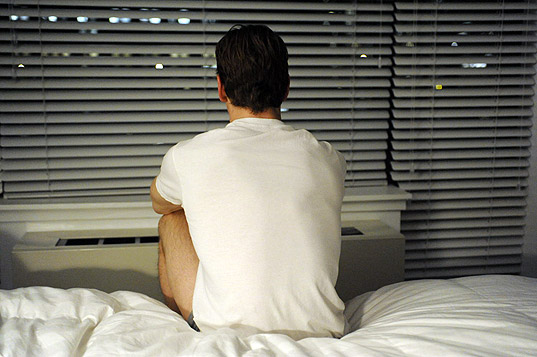
Composed of scenes that have seemingly rendered New York city as a 'sleepy' metropolis merely populated by few nightly nocturnes roaming the city's underground bar and sex club scenes, "Shame" is an intense character study of one man leading an all too isolated sexual life in an all too big a city with little to no care in the world. 

Living in a posh, minimalist apartment filled with boxes and boxes of pornographic materials and a steady income more than adequate for some nightly prostitutes, Brandon (Michael Fassbender), originally born in Ireland and has grown in New Jersey, is now living his own version of the American Dream. And where's better to consume it in excessively emotionless amounts than in the so-called center of the world that is New York City?

But then we can't accuse Brandon of not going after any emotional connections either. Trying his romantic luck with a co-worker named Marianne (Nicole Beharie), he forces himself towards love; an idea, along with marriage, that he was otherwise skeptic about. 

But like Travis Bickle's complete opposite, a character that's desperately in search for some genuine romantic attachment, Brandon's intended connection with Marianne might have been done just so he can tell to himself that at least he has tried this pesky little 'love' thing. And assuring himself with that fact, that he can't really exist within the context of genuine romantic affection (marked by his inability to have proper sex with her), he once again wills himself back to his empty pleasures.

For Brandon, his is a life worthy of envy, but not until his quite unstable sister Sissy (Carey Mulligan) unexpectedly comes to visit. With too simple a story, also written by its director Steve McQueen, we are given an unforgettable tale of obsession and sexual descent. But given that those themes have been tackled in many films before, "Shame" separates itself by highlighting another: the painful, guilt-ridden emotions the morning after. 

There's this powerful scene in the film that shows Brandon, after spending a night of sexual experimentation, in a complete emotional breakdown. Twisting his body in a semi-fetal position and gnashing his teeth, with fists closed, he implodes in a controlled and inhibited rage not towards the prostitutes and the sexual materials that have been the instruments of his sexual excesses, but towards himself.

Michael Fassbender, in probably the most overlooked but also maybe the best performance of 2011, has painted and embodied a painfully complex character in the form of Brandon. By conveying a very convincing and an almost frightening character transformation, from a silent and laid back young professional into a sex-chasing desperation-incarnate to a poor sap trapped within his own compulsions, not to mention Brandon's intimate yet hostile relationship with his sister, Fassbender has brilliantly portrayed a modern man's conflict between extreme hedonism and familial affection. 

What would he choose more? a path of sexual self-destruction or his dysfunctional relationship with his sister? The fine line has already been blurred, and maybe, just maybe, Brandon can handle them both, but not without any absolute consequences, and with a hand 'shamefully' covering a side of his face. 

"Shame", one of my most anticipated films of 2011, has equated my hype towards it and has introduced unto me a major collaborative force in the form of Michael Fassbender and Steve McQueen. Fassbender, who has portrayed a revolutionary psychiatrist in "A Dangerous Method", has now played here in "Shame" a man who might be in dire need of one.

FINAL RATING
Photobucket

Sunday, August 28, 2011

Annie Hall (Woody Allen)

Annie and Alvy, Diane and Woody; it's either way.

A second viewing.

Looking at the gallery of the previous Oscar winners for best picture, "Annie Hall" is definitely one of the most unorthodox and unglazed of all the films that have won the coveted prize. No majestic scope, no larger-than-life characters and no unreachable emotional core, but only an accessibly psychoanalytical and pop-intellectual presence of Woody Allen and his one-liners. Oh, and there's also the impeccable Diane Keaton as the titular character (whose real name is, well you've guessed it: Diane 'Annie' Hall) whose unassumingly fluctuating romance with Allen's character Alvy Singer founds the film's distinct postmodernist approach to the uber-complicated thing we all call 'love'.

Opening scenes meter what we can expect from a particular film's wholeness, be it an initial action scene or a non-linear middle scene pushed right into the beginning. We are introduced into "Annie Hall" with a monologue by Woody Allen, to which I'm not sure if he's uttering his entry comic speech as him being Alvy Singer, the other way around or a random combination of both. Either way, it's a subtle delivery that may not give the immediate feel of the film but definitely serves unto us the fragile wholeness of our neurotic main character. Why is he even talking to us in the first place? Is he really that lonely in his own reality of 'death' and isolated 'mental masturbation' that he wills himself to break the fourth wall?

Unlike other 'love' stories that preceded "Annie Hall" which starts with impossible chance encounters and ends with reconciliations, this film started somewhere where Alvy and Annie's romantic complications are at an all-time high but their emotional excitement for each other at an all-time low. Then like an unsure blend of fantasy and reality, the film then traces the pieces of how this 'nervous romance' came to be, or at least something like that. But with the tone of the film, which I believe can go on for days and days (the movie itself) even without an audience (this Woody Allen fellow really talks a lot), it's apt to say that the film really couldn't care less.

The ability to enact both a pessimistic existential viewpoint (according to Alvy, the 'horrible' and the 'miserable' are the only dividends of life) and an indifferent humor throughout yet hints on an underlying warmth beneath its 'foreskin'. This is one of the unique aspects of the film which certainly gave it the prestigious Oscar award. Right now, the said award is nothing but history, and although I think that "Annie Hall" hasn't aged that well, its portrayal of the distorted nuances of 'love' and 'contemporary existence' never did.

Written and directed by Woody Allen himself, I know that it's not quite right, chronologically and qualitatively speaking, that I was introduced into Allen's works (not counting "Vicky Cristina Barcelona") via "Annie Hall", a film that is widely considered to be the artistic zenith of his film career.

Now on the other hand, although I loved every moment of how Woody Allen and Diane Keaton's effortless chemistry pervades the screen through and through, their dialogue exchanges that seem like trivial conversations between two not-so-special souls and their consummate embraces and kisses amidst a backdrop of a surprisingly subdued New York City (photography by Gordon Willis), I really can't see myself as Alvy Singer.

Reckon how other 'love story' heroes mirror us one way or another? This is Woody Allen's difference. He can look as plain, thin and 'balding' as he is, but at least, his Alvy Singer is never completely us. A character that is molded more out of clumsy ubiquity (based on his sometimes alienating but seemingly all-knowing one-bit opinions and whatnot) than crazy human simplicity.

Granted, "Annie Hall" is a complex film of romantic proportions, but its heart lies within two key jokes uttered by Alvy himself: the humorous 'elderly women' analogy and the 'chicken brother' joke. Unnoticed as it may seem, these jokes weren't just meant to give a start and end transition for the whole film but a perceptive change for Alvy Singer himself. And like the autobiographical stage play that he has created near the end of the film, after all his musings about the futility of life and the importance of death, he simply wants his romance warm and eternalized, just like everyone else.

FINAL RATING
Photobucket

Wednesday, January 19, 2011

The Age of Innocence (Martin Scorsese)

two people consuming the fruits of forbidden love.

Film Review Archive (date seen: January 4, 2011)

Once again, Scorsese leads us through places almost bound with secrecy, wrapped in customs, littered with hidden scandals, and the people that inhabits them whose mastery of conversations, socialization, and even dining were too great in its artificiality that they almost looked like performance acts. No, it's not the Italian-flavored crimeland we're talking about here, but 19th century New York where high society dwells on everything material and excessive, where moral righteousness is not a code to follow but more of a trend to fashionably don.

At first, I had doubts if Scorsese's known visual compositions really belong to such a type of film set in an era of restraint and conservatism. But with his combination of attention to details and an inclined exploratory viewpoint of the social class' amoral gutters amidst its elegant vanity, he used a distinct style (at times, darkening everything on screen but a smooth-edged circle to contain the main subjects, or even letting a character face the camera and speak of a potentially saddening letter with great joy and eagerness) to really fit the film's grasp of irony. Those who accuse Daniel Day-Lewis as a scenery-chewing hack will be utterly disproved in his performance in this film, using the fine attitudes of an obligatory gentleman to depict the numbered movements of an 1870's society male while maintaining his attachment with controlled subtlety. With this type of acting approach, Day-Lewis has able to internalize and show on screen his character Newland Archer's episodic implosions about his clamor for freeing himself from the bondage of his class' norms about love.

Though "The Age of Innocence" had its moments of beautifying high society's excessive lifestyles, Martin Scorsese and Edith Wharton's novel (from which the film was adapted) have successfully portrayed an escapist love surrounded by eyes of the self-righteous ones, the impossibility of its fruition, and the beauty of its acceptance. Living the life of grandeur may be like lying in a bed of roses, but the occasional thorns sure do hurt.

FINAL RATING
Photobucket

1001 Movies You Must See Before You Die

Ivan6655321's iCheckMovies.com Schneider 1001 movies widget