Showing posts with label remake. Show all posts

Tuesday, May 15, 2012

Dark Shadows (Tim Burton)

Barnabas Collins.

If ever their continuous trio efforts have thought Johnny Depp, Tim Burton and Helena Bonham Carter anything, then maybe it is the reality that film collaborations can only last so much, quality-wise, if every new film they create won't end up to be more disappointing than the previous one. With the exception of the very good "Sweeney Todd: The Demon Barber of Fleet Street", the triumvirate has but recycled their seemingly manufactured comic sensibilities and staple gothic cum fantastical imagery to suit up and take on one project after another. Their previous film, the disappointing "Alice in Wonderland" proved that they are slowly running out of steam, and now, here in "Dark Shadows", a cinematic retelling of a classic '60s/early '70's TV series, they have presented quite an alarming fact that they just may need to take some time off and part artistic ways. Well, temporarily, at least.

Tim Burton, one of the most reliable filmmakers of our time in terms of gothic storytelling, especially with some added bits of deadpan humor that he can only call his own, is slowly becoming a passively commercial one. Although I have to say that there are still hints of faded greatness in "Dark Shadows", especially on how the film has introduced itself, it lacks emotion, a sense of purpose, and a pure narrative, with the latter being the thing that I question most about the film.

Yes, it's quite interesting to see how Tim Burton would interpret a TV series that has been aged by time, but then there's the thing we call a 'smoothly-told story', an aspect which, as we all know, is a staple Burton strength but has strangely gone AWOL here in "Dark Shadows". With a beautiful cinematography and set designs that have perfectly captured the atmosphere of the 70's which reminds me a lot of Hitchcock's "The Birds" (I know, it's a 1963 film, but still), all we need that can really put this film's engines into a creative high is a story that will be compelling and, at least, involving enough for 120 minutes or so.

Mentioning the introduction again, as we see Barnabas Collins (Johnny Depp) slowly transform from a mild-mannered heir to the Collins family business and fortune to a blood-thirsty vampire as a result of a curse, "Dark Shadows" has finely highlighted the classic elements of a great Burton film: A timeless and emotionally-charged gothic tale, some quirkily strange characters and a twisted take on history.

But as it proceeds to the narrative proper, which suddenly brings Barnabas and an old (and evil) flame in the guise of the beautiful Angelique Bouchard (Eva Green), both of whom have lived their mortal lives in the 18th century, into the 1970s, its middle part has somehow begun to dwell on nothing really important or integral to the story at hand. Some pointlessly brief 'blink or you'll miss it' comedic scenes from Depp's character, various beating around the bushes here, some '70s musical references there, and an awkwardly aggressive sex scene. It's as if the film's introduction and climax (specifically the last 5 minutes or so) are the only ones that are worthy of Burton while the whole segment in the middle are nothing but bitter-tasting nails that have sealed shut any traces of potential. Well, why bother to feed us frustratingly rusty nails when it could have been more than gracious, umm, cinematic pastries (or any, say, figuratively scrumptious cinematic delicacies. Well this is getting awkward) of some specific kind that "Dark Shadows" could have offered.

Also, what's with the whole fish-canning business rivalry that Barnabas and Angelique have ignited in the 1970s timeline? Maybe it's a thing of faithfulness to the original TV series, maybe it has worked before in the small screens because TV shows have better chances for stretched-out narratives, but for a film that can only tell a story within a limited time frame, it's just so hard to buy.

So, as what the film has suggested, if your cursed ex-darling has suddenly returned within your reach, a man which you have both despised and so passionately loved at the same time, the first thing you are going to offer him is a mutual business concession? Wait, isn't this supposed to be a fine semi-comic film about immortality, blood-drenched vendetta and vampires? And where are the emotions that have supported the film's opening scenes very well?

"Dark Shadows", instead of carrying the cult TV series in its shoulders to bring it into the high heavens of the big screens, has sadly succumbed to a lazy story and deficient character development. Great example: just look at how poorly handled the revelation about Chloe Moretz's character was?

While directing "Dark Shadows", Tim Burton should have retained within his line of thinking that what they're doing is a 2-hour film, not a long-running, 30-minute a week, boob tube show that can certainly afford a bush-beating or two; could have saved the story. But then again, maybe he did, and it's really the screenwriting department that is particularly at fault here.

The performances, however good they are, particularly those by Eva Green, Michelle Pfeiffer and even Jackie Earle Haley have been rendered quite pointless because of the film's strained storytelling. While Johnny Depp, well, what would you expect? Depp is his typical self here, which is not a bad thing, but perhaps a bit too 'typical' and a bit too 'himself'.

Started up like "Sweeney Todd: The Demon Barber of Fleet Street" and ended like "Edward Scissorhands", both of which are Tim Burton and Johnny Depp's prime works as creative collaborators, "Dark Shadows" ended up as a cluttered proof of what may appear as an artistic exhaustion on their part as far as actor-director partnerships are concerned. Add up Helena Bonham Carter in the mix and you got a panting little film begging for its creators to have some break.

FINAL RATING
Photobucket

Thursday, September 15, 2011

The Departed (Martin Scorsese)

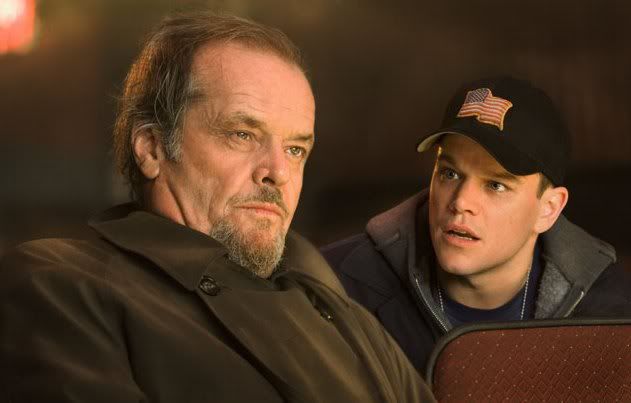
Sullivan's travails.

Stripped off of all the cinematic gloss and melodrama of "Infernal Affairs", "The Departed" is much more raw and pulsating in its delivery compared to the said Hong Kong original, and also more entertaining in its step-by-step revelation and thrills. Headlined by an all-star cast, particularly by Matt Damon and Leonardo DiCaprio (evidently showing how a Hollywood pretty boy before can convincingly pull off a hardened and at the same time conflicted character) and with the film itself fully enhanced with a much extensively realistic and sometimes spontaneously comic screenplay, it's a Best Picture Oscar well-deserved. And don't get me started about Martin Scorsese's best director win merely being an overdue honor for his legendary film career and not for his individual merit for this film. It sickens me, really.

"The Departed", above all, is the crowning jewel of his post-De Niro 'crime' film resume. Unlike "Infernal Affairs", which presents a deep articulation about choice, identity and destiny, "The Departed" ignored those flowery things and instead replaced them with sharp-edged machismo, rough visual texture and a hint of madness. This time, it's not much about the double lives of two moles pitted against each other and their subtle connection but more of an acute generalization of the violent nature of gangsterism itself.

And Jack Nicholson, as caricature-like as he can be, still displayed a thoroughly commanding and menacing presence as Frank Costello, whose knack for unpredictably pungent humor puts a slight comic antidote to refresh and balance the film's dark tone. An overly serious villain for a gravely-toned film is too much a chore to watch, so having someone like Mr. Nicholson to grace the screen with a conspicuously unique persona is, although I know how violently ragged "The Departed" can often times be, a thing akin to beauty.

But that does not mean that Nicholson owned and breathes fire and life unto the film. Damon and DiCaprio, the dual center of the film, didn't give in to Nicholson's larger-than-life screen occupancy. Matt Damon, with films such as "The Talented Mr. Ripley", "Good Will Hunting" and the more recent "The Informant!" as evidences to his stellar acting range, shows how he can be as increasingly heroic as Jason Bourne but can be equally despicable as a con man, scam artist, a nervous liar or as a man who runs a life of cyclic performance art. His Colin Sullivan, a mole planted by Nicholson's Costello in the police ranks, belongs fully to the last, but is a combination of all that were mentioned. That's how tricky and quite complex Damon's role really was.

Again, unlike "Infernal Affairs", who treated its Sullivan equivalent as a redemptive anti-hero, Scorsese (and screenwriter William Monahan) molded Colin Sullivan from pure lies, self-advantage and pure-bred 'pretty face' villainy and manipulation. Maybe it's just me, but I can't see one likable factor regarding Sullivan, except for the fact that him being constantly pushed around by more righteous bullies like Mark Wahlberg's Staff Sergeant Dignam (who would have thought that he's the same guy who played Dirk Diggler?) and, of course, Leonardo DiCaprio's Billy Costigan is surely a pitiful view. And after seeing the film for about four times, I believe that Damon's character is much harder to pull off than DiCaprio's, although both performed with equal energy and considerable dimension.

Some scenes were taken contextually verbatim from "Infernal Affairs", such as the wrongly-spelled word in the envelope and the pre-climactic final unraveling of the film's integral secret via the scene between Sullivan and Costigan inside the police headquarters. But what takes me in as to why "The Departed" is the better film overall, quality-wise, is the fact that everything seems to belong, and not a single thing felt forced.

Granted, the Hong Kong original is much more exquisite in its moody cinematography and perfect choice of seedy locations, but there's this pure spontaneity encapsulating "The Departed's" wholeness, enabling all its aspects, from its gallery of characters to the endlessly profane sputtering, to attain a specific level of believability.

Martin Scorsese, after creating opuses after opuses in his directorial heydays, seems to have been merely sitting tight and effortless while directing "The Departed". But that does not suggest any negative connotations. 'Sitting tight', meaning that he's been through so much cinematic gems (It's just not easy to choose just one 'best' film from his resume) that directing another masterpiece such as this one is, for him, not even a walk in the park, but like a leisurely sit in some prairie.

"Could you double-check the envelope?" Martin Scorsese uttered while finally taking hold of his first ever Oscar statuette. Don't worry, sir, that may just be a sole award, but with all the films that you've made that have waited and truly deserved that little golden man, the one that you've just received is much denser in its meaning.

And besides, you've transcended the AMPAS a long time ago, and a masterwork such as "The Departed" is just a mere reminder that you certainly still have 'it' and your burning artistry won't go out anytime soon, on this life or the next. It's (the film) also a clear-cut benchmark of how one must do a contemporary gangster neo-noir: with rough intensity, abundance of grit, and a penetrating moral undertone.

FINAL RATING
Photobucket

Wednesday, September 14, 2011

The Fly (David Cronenberg)

Metamorphosis.

Before anything else, even now, I still can't believe that I have bought a copy of "The Fly" from a legitimate store for a whopping 25 pesos (that's around 50 cents in American currency), while countless copies of Asylum-produced films like "Transmorphers" and "The Day the Earth Stopped" (Really, they thought someone would fall for that?) are there in the same store sitting comfortably in their overly expensive asses. Oh wait, a film called "Fargo" also sits in the lonely 25 bucks rack. Damn, really.

Now, moving on, I think it's quite refreshingly sardonic for director David Cronenberg and screenwriter Charles Edward Pogue (who adapted his screenplay from the 1958 original and also from the George Langelaan short story) to use an irrelevant insect to shockingly introduce us to the narrative's true frightening pulse. The film could have also worked on a much lighter level if its anomaly would have rooted out from the simple idea of the teleportation device itself, but the film took this common science fiction nugget into the real extremes, not just for the sake of it, but to offer something more.

Now we see the downside of intellectual grandeur not just by how it portrays the toll it gives to a man who has one mentally and socially (living in isolation, a lousy hair, Einstein references and the like), but also physically. The film of course focused more on the very last. But that focus that may seem, at first glance, too shallow a center point for a film, was emotionally balanced by enough doses of drama and "Frankenstein"-ish goth romance. What differentiates "The Fly" from Mary Shelley's literary classic, though, is how the first specifically merged both the 'fiend' and Victor Frankenstein in one wholeness, in the form of Jeff Goldblum's Seth Brundle character.

How he turned into that ghastly, slimy and monstrous creature, that is where the story's Olympian god-like intervention and alteration of the characters' motives and actions take full command of the film. Like the fly inside the teleporter plot mischief, Seth Brundle's motive as to why he carelessly attempted (and technically succeeded) to teleport himself was for one simple reason. No, not those complex internal conflicts regarding a self-debate of how he can change the world and himself by way of molecularly transporting himself through electricity and wires and stuff, but for the simple fact that he was crazy drunk (with a baboon as sole company) during the time.

Like the Coen brothers that seem to laugh at their protagonist's (especially in their neo-noirs) own misdemeanors and faux pas as they go helplessly and hay-wire insane from one situation to another, Cronenberg brilliantly manifests this unconscious natural albeit peculiar flow of existence that purely enunciates that sometimes, things, particularly the crazy ones, just happen. But from this initial, almost comic-like hammering of nails to seal Brundle's 'unfortunate fate', "The Fly", after being initially founded by an uneasy but evidently passionate romance between scientist Seth and journalist Veronica (played by Geena Davis, who later became more renowned as Thelma in "Thelma and Louise"), is emotionally intensified not mainly by its visual horror but by the sheer idea of love.

Through this way, the film became more or less a much relentless horror. A horror of choice. The film instantly became more concerned not about who kills who or who goes where or who decapitates which body part, but what it really takes to give up something. Would you relish love all the same even when the one you continuously love is a physical manifestation of hate and disgust? "The Fly", surprisingly, answered immediately with a not-so-subtle shotgun blast, then a fade to black. Not seeing what happens next is an extreme rarity among science fiction horrors. Not even the most recent "Splice" denied us a peak of an uncertain epilogue.

This is the thing that will surely be a constant reminder as to why I 'll always place "The Fly" on a separate field of existence, far from other films of its kind. It is this brave adamant stance to refuse us the answer to the question "What happened next?" that took me into "The Fly's" almost hypnotic spell of fright, bodily fluids and mad love.

It is this film's shining ability to just live in the moment, the beginning, middle, end and all, and forget about any prolonged post-carnage drama that convinced me of its audacious greatness. Fast-forwarding through the film in weary anticipation of a surprise post-credits sequence and subsequently finding out that there's none, there's this slight sigh of relief. Post-carnage drama? I believe Veronica's brief but infinitely tragic weeping is enough. I was moved, alright.

FINAL RATING
Photobucket

Sunday, July 10, 2011

Temptation Island (Chris Martinez)

A tributary notion.

Well, alright, I raised my rating to two full stars partly as a tribute to the original cult classic which this film has almost remade shot-by-shot and word-for-word. But remaking a film made in the 80's and completely retaining almost all of the dialogues that made the original so fascinating and endlessly intoxicating in its ability to capture, time capsule-style, the verbal pretenses of the bourgeoisie class (especially represented by the character Joshua in the original film) of the said era, I believe, is completely wrong.

Dialogues such as 'poor, proletariat, indigent people' should have stayed in the original and in it alone because as I hear it being uttered by John Lapus (who played Joshua in this remake), I can't help but feel the uneasiness of how comically oblique and strange the delivery is, especially coming from a supposedly homosexual character who dwells in the postmodern world of fashion where every terms and jargon are with added flash, sociopolitical words like 'communist' are the last things you may hear.

But despite of that, in a time where our local showbiz industry's range of gay performers are from undeserved hosts to stand-up comedians, John Lapus delivered the needed sense of villainy, vanity and lunacy, but he really never inherited the brash deadpan performance by Jonas Sebastian as Joshua in the original. But judging from John Lapus' gurgling, smoker voice, and his regular stint in television where he's regularly thrown in the air by a myriad of dancers while dancing off-sync with the music, you really can't expect subtlety from him.

For the bulk female cast, there really is nothing special going on except Marian Rivera, for the simple reason of her being the typical noisy comic actress that she is, Rufa Mae Quinto, whose stereotyped verbal tone is almost always effective, and Lovi Poe, mainly because her character is the most interesting of all. Solenn Heussaff (a real eye-candy, by the way) and Heart Evangelista, on the other hand, are all too unremarkable in their roles.

While the male roles, filled in with the typical 'pretty boys', suffered because of a crucial casting mistake (or a cast list typo?). Aljur Abrenica, who plays the role that Alfie Anido has played in the 1980 film, is characteristically far out of proportion and capacity with the character he plays (which is supposed to be a smart lad, me thinks). Newcomer Tom Rodriguez, who plays a lowly waiter in the film, should have scuffled for Mr. Abrenica's role and the latter should have been demoted in the waiter's shoes. Aljur's acting chops are just too 'wooden' ("Machete" pun, ha!) to show even a hint of involvement in the whole film.

Personally, I think director Chris Martinez should have fully heeded the nuances and true essence of the word 'remake' first before making this one. Aside from a screenplay fully devoted to the original's satirically composed dialogues (which I think, although how rich the source material is, does not give this remake any rightful merits) that is a delightful thing of the past, this "Temptation Island" remake is, overall, a very messy film, editing wise. Scenes jump from one to the other without a sense of adhesion, while relationships develop without a sense of emotional rhythm. And that final, post-island scenes are just too overlong in a very cliched and unnecessary kind of way.

And those 'food' hallucination scenes, which made the original even crazier and cheesier, are recreated not for the sake of eliciting the penetrating idea of 'hunger', but for the sake of the chief actresses to showcase their modeling prowess once more.

Compared to Martinez's earlier film "Here Comes the Bride", "Temptation Island" is an empty, absurd load of cinematic tosh (Maybe it's its campy intent, but it just doesn't translate that well). And who would have known? John Lapus' bodily parts produce finely grilled pork chops. Nice.

As the end credits roll, scenes from both the original film and this remake show up in succession. And for what? For comparison. Dialogues overlapping with one another, sometimes one trailing the other. I can't see the necessity of this remake. For comparison? If both are fueled with the same script and virtually with the same line deliveries, who needs that? If one needs a biting satire regarding the not so glitzy side of contemporary fashion, beauty contests and the world of social climbers and nausea-inducing extreme elitism, then local films such as "Pinay Pie" and "Bikini Open" are much more potent representations. Not this one.

(By the way, except for the dialogues, I did not like the original "Temptation Island" film that much either. So there.)

FINAL RATING
Photobucket

Sunday, January 16, 2011

The Crazies (Breck Eisner)

'Excuse me. I really need a ride into town'.

Film Review Archive (date seen: October 24, 2010)

One of those well-made horror-thriller remakes considered superior to the original (the others I can think of were "The Hills Have Eyes" and "The Last House on the Left"). Though I thought a sheriff as a protagonist (played by Timothy Olyphant) was an obvious, immediate choice to fill in the shoes of the central character, it was performed well by Olyphant, and though his physical stature may easily belong to that of a larger-than-life hero (remember, he played "Agent 47"), he has added a considerable amount of vulnerability, giving the "edge-of-your-seat" factor a notch higher than the usual.

Its title "The Crazies" is more or less an eponym of the film's abhorring, almost mutant-like killers, but may also pertain to the military itself, playing god with science, only unleashing hell afterwards.

The original "The Crazies" was made way back in 1973, but when you look at it, although how extreme the treatment of the film has been, it's also a sharp, fear-inducing social satire much relevant today as it was 37 years ago. Think about it. "Biological Weapon". "Genocide". Much, much more, isn't it?

FINAL RATING
Photobucket

1001 Movies You Must See Before You Die

Ivan6655321's iCheckMovies.com Schneider 1001 movies widget