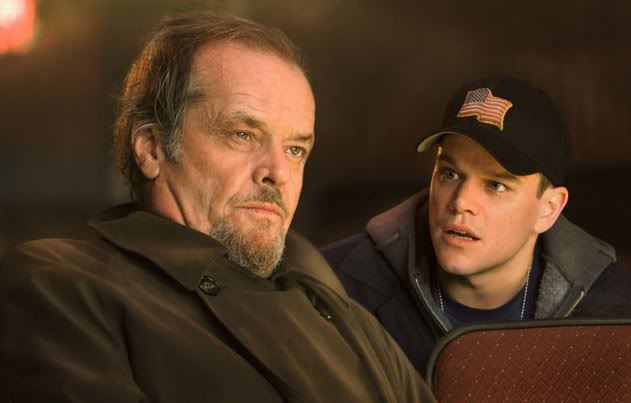
 Sullivan's travails.
Stripped off of all the cinematic gloss and melodrama of "Infernal Affairs", "The Departed" is much more raw and pulsating in its delivery compared to the said Hong Kong original, and also more entertaining in its step-by-step revelation and thrills. Headlined by an all-star cast, particularly by Matt Damon and Leonardo DiCaprio (evidently showing how a Hollywood pretty boy before can convincingly pull off a hardened and at the same time conflicted character) and with the film itself fully enhanced with a much extensively realistic and sometimes spontaneously comic screenplay, it's a Best Picture Oscar well-deserved. And don't get me started about Martin Scorsese's best director win merely being an overdue honor for his legendary film career and not for his individual merit for this film. It sickens me, really.
"The Departed", above all, is the crowning jewel of his post-De Niro 'crime' film resume. Unlike "Infernal Affairs", which presents a deep articulation about choice, identity and destiny, "The Departed" ignored those flowery things and instead replaced them with sharp-edged machismo, rough visual texture and a hint of madness. This time, it's not much about the double lives of two moles pitted against each other and their subtle connection but more of an acute generalization of the violent nature of gangsterism itself.
And Jack Nicholson, as caricature-like as he can be, still displayed a thoroughly commanding and menacing presence as Frank Costello, whose knack for unpredictably pungent humor puts a slight comic antidote to refresh and balance the film's dark tone. An overly serious villain for a gravely-toned film is too much a chore to watch, so having someone like Mr. Nicholson to grace the screen with a conspicuously unique persona is, although I know how violently ragged "The Departed" can often times be, a thing akin to beauty.
But that does not mean that Nicholson owned and breathes fire and life unto the film. Damon and DiCaprio, the dual center of the film, didn't give in to Nicholson's larger-than-life screen occupancy. Matt Damon, with films such as "The Talented Mr. Ripley", "Good Will Hunting" and the more recent "The Informant!" as evidences to his stellar acting range, shows how he can be as increasingly heroic as Jason Bourne but can be equally despicable as a con man, scam artist, a nervous liar or as a man who runs a life of cyclic performance art. His Colin Sullivan, a mole planted by Nicholson's Costello in the police ranks, belongs fully to the last, but is a combination of all that were mentioned. That's how tricky and quite complex Damon's role really was.
Again, unlike "Infernal Affairs", who treated its Sullivan equivalent as a redemptive anti-hero, Scorsese (and screenwriter William Monahan) molded Colin Sullivan from pure lies, self-advantage and pure-bred 'pretty face' villainy and manipulation. Maybe it's just me, but I can't see one likable factor regarding Sullivan, except for the fact that him being constantly pushed around by more righteous bullies like Mark Wahlberg's Staff Sergeant Dignam (who would have thought that he's the same guy who played Dirk Diggler?) and, of course, Leonardo DiCaprio's Billy Costigan is surely a pitiful view. And after seeing the film for about four times, I believe that Damon's character is much harder to pull off than DiCaprio's, although both performed with equal energy and considerable dimension.
Some scenes were taken contextually verbatim from "Infernal Affairs", such as the wrongly-spelled word in the envelope and the pre-climactic final unraveling of the film's integral secret via the scene between Sullivan and Costigan inside the police headquarters. But what takes me in as to why "The Departed" is the better film overall, quality-wise, is the fact that everything seems to belong, and not a single thing felt forced.
Granted, the Hong Kong original is much more exquisite in its moody cinematography and perfect choice of seedy locations, but there's this pure spontaneity encapsulating "The Departed's" wholeness, enabling all its aspects, from its gallery of characters to the endlessly profane sputtering, to attain a specific level of believability.
Martin Scorsese, after creating opuses after opuses in his directorial heydays, seems to have been merely sitting tight and effortless while directing "The Departed". But that does not suggest any negative connotations. 'Sitting tight', meaning that he's been through so much cinematic gems (It's just not easy to choose just one 'best' film from his resume) that directing another masterpiece such as this one is, for him, not even a walk in the park, but like a leisurely sit in some prairie.
"Could you double-check the envelope?" Martin Scorsese uttered while finally taking hold of his first ever Oscar statuette. Don't worry, sir, that may just be a sole award, but with all the films that you've made that have waited and truly deserved that little golden man, the one that you've just received is much denser in its meaning.
And besides, you've transcended the AMPAS a long time ago, and a masterwork such as "The Departed" is just a mere reminder that you certainly still have 'it' and your burning artistry won't go out anytime soon, on this life or the next. It's (the film) also a clear-cut benchmark of how one must do a contemporary gangster neo-noir: with rough intensity, abundance of grit, and a penetrating moral undertone.
FINAL RATING