Showing posts with label Bruce Willis. Show all posts

Monday, October 22, 2012

Looper (Rian Johnson)

Looper Joe.

Considered as one of the most highly original science fiction films in recent memory, I personally think that "Looper" is more of a great example of a cinematic pastiche done right. Think of a hundred times more vulnerable T-800 randomly meeting up with a more dead serious Doc Brown inside a dilapidated Xavier Institute and you have "Lopper". 
     
Starring Joseph Gordon-Levitt and frequent time-traveler "Bruce Willis" (remember "12 Monkeys"?), "Looper" is a relatively bleak film with a beating heart. In a haze of modern sci-fi films that are more concerned with the extravagance of CGI rather than the beauty of human emotions, "Looper" is a commendable exception because it stimulates both the heart and the mind at the same breath. 
     
Set in the year 2044 where hitmen (called 'loopers') are paid to kill for the gangsters of the future (the invention of time travel in 2074 has made it possible to zap people back in time), the film is about a looper named Joe and his surprising encounter with his older self. 
     
Though not as action-oriented as "Inception" or "The Matrix", "Looper" has this visual appeal that makes me want to hug director Rian Johnson in great appreciation. Instead of relying to the wonders that computer-generated effects can do to action sequences, Rian Johnson's treatment of the film's scenes of action and violence is sort of a throwback to the olden (and maybe also golden) age of action films reigned by the likes of Paul Verhoeven and John McTiernan. This is "RoboCop" violence right here. 
     
Given the fact that everything in the film seems to be borrowed from other pre-existing creations, director Rian Johnson has handled it all very well. As what French New Wave champion Jean-Luc Godard has said: "It's not where you take things from – it's where you take them to." 
     
Though not necessarily a great film, "Looper" is still a fresh science fiction creation worthy of praise. But of course, it is not without its share of flaws. One of my main issues with the film is how the younger and older versions of Joe (the former being Joseph Gordon-Levitt and the latter being Bruce Willis) were not given enough time to truly interact. Perhaps the urgency of their situation calls for them not to, but their friction as two extreme states of mind, despite of them being one and the same, was not properly explored either. In that aspect, I was short-changed. 
     
I also was not overly impressed by the whole 'Rainmaker' concept. In case you still haven't watched the film, 'The Rainmaker' is a futuristic and telekinetic Hitler, plain and simple. Because of his unmatched power, he has single-handedly taken over the future and is now closing all the loops. By the way, to close a loop means that a looper's future self is to be sent back in time so that it can be killed by none other than his younger self. 
     
For me, just the very idea of a present and future self freely interacting with each other and the dangers of doing so is enough to form one thematically weighty film. But wait, the film's creators thought that that would not properly suffice so they have integrated the overly ambitious idea of a Book of Revelations-esque figure like 'The 'Rainmaker' to complexify (yeah, give me that red underline, MS Word) things even more. I sure do love cinematic complexity when I sense one, but what I do not want is thematic overload, which this film is a great example of. 
     
But on the other hand, I did enjoy the performances. Joseph Gordon-Levitt is quietly intense as the younger Joe. Though his narrations may be quite spoon-feeding at times, his on-screen performance is comparably lesser (yet effective) in exposition. His face may display the same constipated look throughout the course of the film but you can constantly sense the escalating conflict brewing within him. Here in "Looper", Joseph Gordon-Levitt has just proved that the less showy characters are always the hardest ones to portray because it's a make or break kind of thing. As an actor taking on such a role, it's either you'll be accused of lazy acting or praised for your powerful subtlety. In his performance's case, it's definitely the latter. 
     
Now perhaps I'm quite biased on this one because I have always been a big fan of his, but I really think that it was Bruce Willis who has exuded the better presence in the film. In his portrayal of the older Joe, there's this certain air of 'nothing to lose' desperation and melancholy that really makes his character so sympathetic yet frightening; echoes of his performance in "12 Monkeys" persists. 
     
As for the rest of the cast, I think that two other actors have really stood out. The first one is the beautiful Emily Blunt, whose turn as a desensitized, no-nonsense Southern woman named Sara is very convincing. The second one is Pierce Gagnon, whose terrific juvenile performance as Sara's mysterious son has elevated the film to a whole new level. Now this might be a bit of an exaggeration, but not since Catinca Untaru in Tarsem Singh's "The Fall" have I seen a better child performance. 
     
All in all, I was very impressed by "Looper", especially in how it has preferred silence and dialogue over cheap plot twists and slam-bang action. But from where I can see it, I think that the film is ultimately a victim of its own ideas. Torn between time travel, telekinesis and dystopia, what resulted is a finely-executed yet fairly confused film. Perhaps some thematic trimming is what the film needs.

FINAL RATING
Photobucket

Wednesday, October 10, 2012

Moonrise Kingdom (Wes Anderson)

The eloping lovers.

I have always been fond of Wes Anderson's works but, strangely, was never entirely awed by any of them. Personally, I find his works more to be testaments in great character handling rather than pieces that truly exemplify great storytelling. Perhaps it's just a matter of taste. 

I commenced watching "Moonrise Kingdom" with zero expectations. Yes, although many reviewers are already branding it (and maybe quite prematurely at that) as one of the true best films of the year, I have veered myself away from that perspective simply because I do not want to be disappointed. But hell, them reviewers were right; "Moonrise Kingdom" is indeed something really, really special and, to some extent, even quite spectacular. I have never really thought that I would ever describe a Wes Anderson as something that oozes 'spectacle' but there you go. Wes, the truest hipster filmmaker out there, has just upped his ante, and it's something that's worthy of some genuine celebration. 

On one side, there's Bruce Willis, Edward Norton and Bill Murray (as always). On the other, there's Frances McDormand, Tilda Swinton and some surprising bits of Harvey Keitel. Though Wes Anderson is really not known for casting unknown actors to play his ever-quirky characters, "Moonrise Kingdom's" ensemble cast is just awe-inspiring. 

The story concerns the emotional misadventures of two troubled pre-adolescents (Jared Gilman and Kara Hayward), their budding romance, and their subsequent decision to run away from their parents in the name of whatever their concept of love is. For a film that's focused mainly on two young, peculiar lovers' awkward elopement, the film's cast is amazingly heavyweight. But "Moonrise Kingdom's" screenplay (penned by Roman Coppola and Wes Anderson himself), although not as articulately weird as some of Anderson's previous efforts, is very strong and emotionally direct that it has rendered the supporting adult characters to be as essential (sometimes even more so) as the two young ones. In hindsight, with the film's patented tableau-like sequences and a musical score that sarcastically serenades the abundance of dry wit and dark humor in it, "Moonrise Kingdom" seems to be treading the usual path towards a very typical Wes Anderson film, which may also result on a slight frustration on my part as a viewer. 

But with every film, Wes Anderson seems to be bent on constantly topping himself by taking on a more ambitious, visionary and expansive palette than the last. From India ("The Darjeeling Limited") to the woods ("The Fantastic Mr. Fox"), he is capable enough to create his creatively personal and quasi-fantastical versions of these environments. In "Moonrise Kingdom's case, he has successfully outdone himself even more. Aside from the fact that he has conjured up the fictional island of New Penzance out of thin air, he has also creatively integrated a detailed description of its terrains by way of the narrator (played by Bob Balaban), a short, gray-bearded man who enters and exits scenes for no apparent pattern and reason. 

Serving as the arena for the two young lovers' mutual, albeit strange affection, New Penzance, as the story progresses, also seems to take on a character of its own. Aside from the populating characters whose offbeat demeanors paint the whole island with faded hues, the island has its own air of life that's quite reminiscent of some far away fairy tale lands. This is the kind of place where fantasy and reality has once figuratively met, made love and subsequently separated in bitter, contemptuous tears. New Penzance, despite of its visual serenity, is a place of colorful anomaly. It is an island of bittersweet desperation and tender angst. It is a haven of regret and love both at its faintest whisper and most thunderous cry. 

Without much pretense in dialogue and eccentricity in characters (the characters in this film are, by far, the most conventional of all Wes Anderson films), Wes Anderson was finally able to subtly connect with me by just letting his visuals and his sweet tale of naïve love utter the things that are otherwise unspeakable by the tongue. To some extent, "Moonrise Kingdom" has even reawakened the quiet poet and the adventurous camper within me. Finally, I have found the Wes Anderson film that I am looking for. On second thought, maybe it's the one that has found me.

FINAL RATING
Photobucket

Saturday, September 17, 2011

Pulp Fiction (Quentin Tarantino)

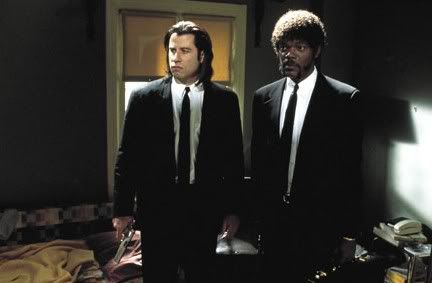
Vincent, Jules and the divine intervention.

Oh, how "Pulp Fiction" exemplifies the very meaning of the phrase 'it gets better after every viewing'. One can watch this film any way he/she wants to. If you're in a mood for a pretty slick, densely-written comedy of characters and choices, then there's nowhere to look further than this film. If you're in for some pop culture-laden crime film, then "Pulp Fiction" it still is.

Now, if you may initially think that this film is nothing but a shallowly self-indulgent farce that extracts its energy and ideas from worn-out B-movie references and obscure music, then simply look at it through Jules Winnfield's (the immortalized Samuel L. Jackson) desensitized eyes. It will immediately turn into a film of staggering, multi-layered power, and a rough-edged ode towards spiritual redemption and hard-bound honor, which is what the film is really all about, at least in my view.

But do not get me wrong about that 'selective exposure'-type subjective viewing that I have recommended. I mean, it can still be enjoyed in its immediate layer of violence and involving dialogues. But "Pulp Fiction", unlike any other films not just of its kind but of any films in general, gets better every time you dig a little bit deeper. There's little to no doubt why critics have endlessly analyzed the film ranging from its theological relevance to its devilish undercurrents (Did Marsellus Wallace's really sold his soul to the devil?). Many people have since relished all that's been there, surface-wise. Now it's time to further the appreciation.

There have been countless deconstructions, theorizing and analogizing (I'm not even counting how many speculations have been formulated regarding the content of Marsellus Wallace's briefcase) that have occurred and transpired ever since this film claimed one of the uppermost pedestals of postmodern cinema so that it can rightfully stand side-by side with the seminal works of Jean-Luc Godard.

"Pulp Fiction" has also created a colorful, albeit violence-laden, alternate reality where gangsters may kill in cold blood and talk about foot massages and cheeseburgers and rejected TV pilots at the same breath. A parallel but infinitely peculiar netherworld where normal-looking fellows can ably run pawn shops the same way they can also be dangerous homosexual perverts.

But the film, a masterful merging of spontaneous articulacy and empirical pop culture knowledge by Quentin Tarantino, Quentin Tarantino (I just have to mention him twice) and Roger Avary (who both deservedly won an Oscar for the film's unique screenplay), ceased to be just a cynical exploration of the wholeness of crime.

For a film that consists of sex, drugs and violence that blur the boundaries that separate it from the thematic commonalities of a typical B-grade fare, Tarantino and Avary infused their subtly hopeful sides into it to provoke, balance, and substantiate the transgressive nature that they have visually depicted all throughout the film. "Pulp Fiction", with its ironic mixture of cruelty and humanity, displays an unorthodox poise that makes it even more special and, to a certain extent, quite illuminating.

There's not much to say regarding its top-notch all-star cast, with Sam Jackson, John Travolta (as Vincent Vega) and Uma Thurman (as Mia Wallace) delivering the highlight performances, and with Bruce Willis as prizefighter Butch Coolidge serving as our rare glimpse of heroism that may either be self-serving, unconditional or both.

But what really served as the film's transition point from darkness to light is Jules' powerful dual delivery of the "Ezekiel 25:17" Bible verse. Notice his initial delivery that seems to be an oratorical expression of superficial, god-like anger. Then compare it to his enlightened utterance of the said verse in the film's final scenes. For people who may say that "Pulp Fiction" is nothing but a pretentious, overwritten mess that has an almost 3-hour running time but does not even have anything concrete to say at all, take a look at the tonal difference between the two line deliveries and how Jules, in the latter enunciation, stresses the line about how he tries real hard to be a shepherd with glittering conviction. It's just stunning.

Sometimes, it's not mainly the narrative that hands out change, but the characters themselves. Consider Winston Wolf's (Harvey Keitel) unforgettable remark: "Just because you are a character doesn't mean that you have character." Fortunately, Jules surely is and certainly has.

FINAL RATING
Photobucket

Tuesday, January 18, 2011

Unbreakable (M. Night Shyamalan)

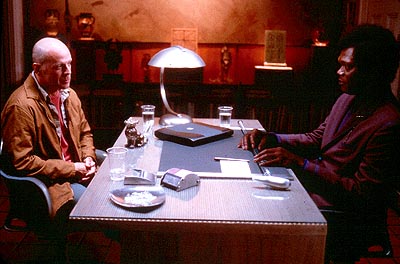
Bruce Willis and Samuel L. Jackson: Third time around.

Film Review Archive (date seen: December 18, 2010)

Before M. Night "The Happening" Shyamalan became the laughing stock of cinephiles everywhere that he is today (enhanced courtesy of his live-action adaptation of the Avatar animation series), he was quite a capable filmmaker that has the uncommon touch of conveying emotional power.

Though his earlier film "The Sixth Sense" was the most renowned of all his works, for me, "Unbreakable" is the better film. Not only because it's a well-weaved tale of self-discovery, but also because it has brought the superhero mythos and all its undertones into a different territory. No, not into familiar grounds that consist of flying musclemen and villainous megalomaniacs, but into a complex observation of its ideas, its translation into an environment more grounded in reality, and its application to the two main characters' (played by Bruce Willis and Samuel Jackson in their third film together) individualism and their search for existential meaning.

Yes, that may sound a tad too deep considering the conventionally immediate visualization (protagonists
wearing colorful tights and leotards) of the film's main theme. But director Shyamalan completely deconstructed those basic ideas, left important concepts into the film (such as the idea of a hero, a villain and the complexity of choice), and able to conceive a film that may look really familiar based on its initial elements, but a whole new exploration in its entirety.

"Unbreakable" is not about heroism nor villainy; it's a film about motives and decisions within that ultimately define who we really are.


FINAL RATING
Photobucket

1001 Movies You Must See Before You Die

Ivan6655321's iCheckMovies.com Schneider 1001 movies widget