Friday, June 29, 2012

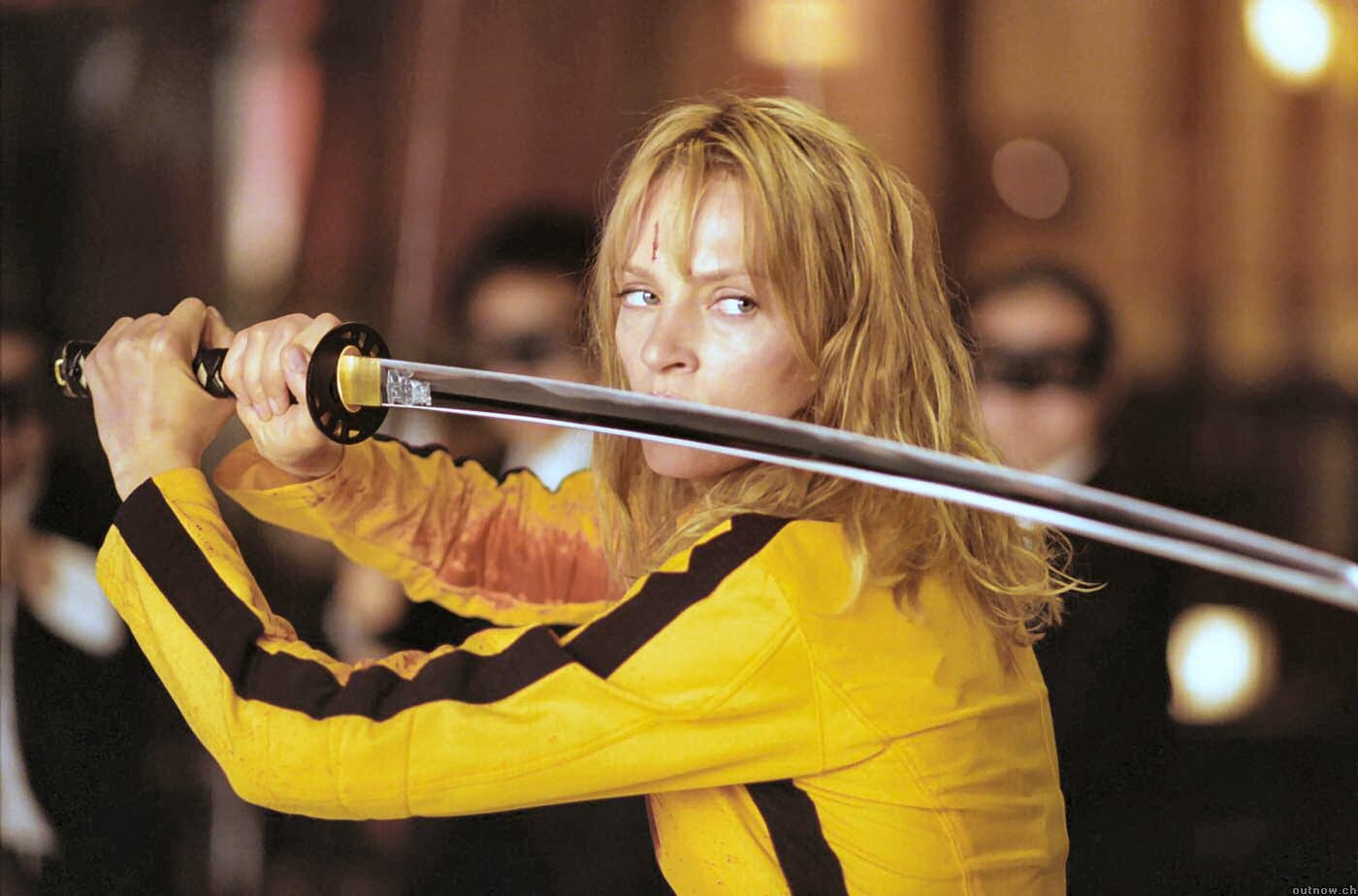
Kill Bill: Vol. 1 (Quentin Tarantino)

The showdown.

Always the master of cinematic homages, Quentin Tarantino now offers us a martial arts genre-inspired, revenge-themed film that's best served cold. It's a film that highlights, in bright crimson red, the stupendously over-the-top craziness of martial arts films and how it has captured the imagination of many people who were lucky enough to have seen such pictures. But aside from being an ode to the martial arts genre, "Kill Bill: Vol. 1" is also a fiery introduction to what may be one of the most resonant revenge tales of recent memory.

In a world inhabited by code-bound katana makers (like Sonny Chiba as Hattori Hanzo here) and evil martial arts masters, it would have been out of place to put a frail blonde woman in the middle of it all. But Tarantino, now a filmmaker that has already reached his utmost potential for gender maturity, just did, and the result is truly rewarding. Quite ironic, really, for a director whose first film, the neo-gangster classic "Reservoir Dogs" doesn't even contain a single female character.

And with that, "Kill Bill: Vol. 1" has succeeded in showcasing Tarantino's directorial flair and sheer passion for, this time, everything martial arts. It simulates, as it renders a bygone era of martial arts films in a reinvigorated light, what it's like to be witnessing an old-fashioned film glazed with the language of the fist and the code of the sword once again.

Heightened by Uma Thurman's great performance as the vengeful bride on an unmercifully violent path of revenge who will stop at nothing until, well, he can finally kill the titular Bill, the film's effectiveness is not much because of the plot but because of how this seemingly tired story of blood-soaked revenge has trickily found its way into the screen looking completely different and strangely beautiful once again.

Some playfulness with non-linear narrative on one side, some animation here (one of the most striking features of the film) and a subtly powerful use of 'chapters' there; the clever amalgamation of these aspects has not just made the film something that's truly riveting to watch at surface level but also an intensely unforgettable portrait of what wonders a truly passionate cinephile of a filmmaker like Tarantino can do for a genre that's seemingly buried by time.

Going back to the very narrative, we can simply say that it's a story of a woman's revenge against a former flame that has attempted to kill her, but didn't. So what? What then? What's new? We are repeatedly being fed with films drenched in fearlessly bloodletting vendettas such as this one, with one being crueler yet less fascinating than the previous one. So, again, what's with all the fuss?

Well, the answers for all of those lie within the very film itself. The film, for a lack of a better persuasion coming from yours truly, needs to be seen to be believed. To be seen as a highly stylish action film. To be believed as a truly unique cinematic experience.

"Kill Bill: Vol. 1" may not possess the complexity or depth of "Pulp Fiction", but at the end of the day, its distinction as a great Tarantino film by its own right lies not within the plot or the characters themselves but within the courage of pulling off such a film and how it was done in the most brilliant of ways and the most outlandishly exceptional of styles.

In a time where movies wallow on old ideas that pretend to be something new, it's invigorating to watch a film that's humble enough to embrace old ideas but ingenious enough to render it familiar yet fresh all at the same breath. This film may not necessarily be the 'one' that will immortalize the martial arts genre, but it sure has put the seemingly forgotten genre into prominence once more, and dare declared the greatness of its peculiar aesthetics.

FINAL RATING
Photobucket

Sunday, June 17, 2012

RoboCop (Paul Verhoeven)

Murphy.

Films like "RoboCop" are the prime reasons why the action scene of the '80s is truly the best there is. In a time where highly-paid action stars are being manufactured for the sake of non-stop, shallow-minded feast of blood, guns and guts, "RoboCop" stands tall as that rare work that mixes delicious satire, brutality and inspired originality in one action-packed entirety. 

It stars Peter Weller as Alex Murphy, an honest, hard-working Detroit police officer that was violently murdered in action by a ruthless gang led by the notorious Clarence Boddicker (Kurtwood Smith). But because of revolutionary technology, he was resurrected back to the land of the living hardly as a man anymore but as a law-upholding, well, as what the title suggests, robot. 

But wait, there's a catch right there: his memory box is not fully wiped out. So guess what? He wants revenge. Motown is in for a ride. 

Paul Verhoeven, a truly visionary action and science fiction filmmaker, is arguably at his definitive best here. Possessing a unique vision for action that certainly can't be surpassed even by today's standards, Verhoeven paints every action scene with an attention for the explosive and the absurd. His action sequences are those that are inclined to shock, to excite and even to put a sardonic smile in a viewer's face all in one stride. For instance, if some action films utilize blood squibs for the sake of enhancing the effect of a gunshot wound, "RoboCop" uses it in a more ironic fashion. The said prop has instead been used to enforce a more cartoonish depiction of violence, which is greatly significant for the film's prevailing satirical tone and its distinct comic book feel. 

So with that being said, what is it that "RoboCop" is satirizing then? Very much like Frank Miller's "The Dark Knight Returns", "RoboCop", finely written by Edward Neumeier and Michael Miner, ingeniously pokes fun at what news programs may look like in an unstable future: A short running time, a couple of all-smiling anchors and an overly feel-good atmosphere ironic to the news at hand. Oh, and did I mention that this film is also a slight attack towards capitalism and consumerism?

As seen in the film's numerous faux TV commercials, there's this unforgettable TV ad in "RoboCop" that shows the fictitious 6000 SUX (a new car model) immensely dwarfing a dinosaur (which, I don't know, may symbolize the olden, more innocent times of simpleton living). Such image proves that "RoboCop" isn't just an action vehicle that caters to audiences' need for some adrenaline rush but also a timely commentary to our declining discernment between need and want. 

In a few years' time, we may just as well buy everything that the television tells us to. The film capitalizes in this sort of pessimistic view of capitalism and misuse of the media and made quite an unforgettably satirical impression out of it. 

But aside from conceptual originality and an iconic RoboCop design (by Rob Bottin), which are the primary reasons why this film is highly successful and was even able to attain a cult following, another potent reason as to why "RoboCop" is truly special is because of the performances. 

Led by Peter Weller's restrained approach to the Alex Murphy character, the cast is simply terrific. Although the performances were in no way deep or complex, they were uncannily energetic enough for the film to maintain its entertainment level even without the high-powered action sequences. 

Take Miguel Ferrer as a great example. He plays the ambitious and bureaucratic Bob Morton who, despite of being a cold-blooded douche, made Murphy's transformation as RoboCop possible. Ferrer, in all of the scenes in which he is in, is armed with a great sense of timing and articulate unorthodoxy that it's entertainingly exhausting to watch him perform. 

Same goes for Kurtwood Smith as the villainous Clarence Boddicker, who is so good in playing a major villain here in "RoboCop" that he was offered an equally despicable role again in "Total Recall" (also directed by Verhoeven), only to turn it down. While Ronny Cox, playing Richard 'Dick' Jones, the vice president of the film's fictitious corporation named Omni Consumer Products (OCP), is the stereotypical image of a purely manipulative corporate villain. Although contained within the limitations of a generic character, Cox was able to squeeze out something special and distinctive from the role. As for Nancy Allen, she plays Murphy's partner on duty with pristine calm. She is the image of sanity in the film. 

For jaded viewers, it's difficult to distinguish the gold from the dung in a genre (in this case, action) that is more inhabited by the latter. For me, watching "RoboCop" renders this viewing cynicism as untrue. Even from afar, it's easy to see this film's golden makings as a true action masterpiece even if you put it in a damn septic tank. And despite of the occasional garbage that may surround it, its greatness shines forth through the heap. 

"RoboCop" is one of the best action films of all time, and unlike other action pictures of the same kind that were made solely for the specific era to which they belong, this film transcends time. It has aged supremely well, and its entertainment and shock factor are just as potent as they were almost 30 years ago. This is one for the books.

FINAL RATING
Photobucket

Saturday, June 16, 2012

Mad Max (George Miller)

Max is...quite mad.

It has been widely believed that ever since "Mad Max" was released, action films have never been the same again. It has introduced a more frenetically-paced action style and also a purer form of utter machismo and brutality that has since been the staple themes of almost all of the action pictures that have followed after it. In a way, the whole '80s to mid '90s action film scene is highly indebted to "Mad Max" because without it, there wouldn't be a need for such red-blooded films. And also, without this seminal George Miller classic, the world of bullet-spraying, revenge-driven heroes inhabited by the likes of Arnold Schwarzenegger and Sylvester Stallone would be devoid of another equally important action icon: Mel Gibson. 

But then more importantly, this film has significantly done something that can be compared to what "Jaws" has done to the beaches or what "A Nightmare on Elm Street" has done to dreams: "Mad Max" has made us fear the open highways. 

Judging from its narrative, "Mad Max" has nothing remotely surprising going on. It also does not help that the film has some irritating side characters and a lazy dubbing. With that, "Mad Max" is nothing more than a B-grade little film that, despite of its overly rough edges, has managed to unconsciously revolutionize a whole genre. 

Made in 1979, the film has aged quite badly both in editing, sounds and script. Even the performances are quite cheesy and cartoonish. The plot, for the lack of a better word, is almost non-existent. The car chases are quite new at the time but are nowhere near of being unique and truly fresh. 

But then, after all of these overbearing cons, there's "Mad Max's" universe. Making it appear as if the empty expanse of the speedways are the final frontiers of an apocalyptic Australia, the film's imaginative vision of a world gone way, way awry is a thing of peculiar beauty and originality. 

Oh, and there's an attempt of being prophetic too. Labeling "Mad Max's" time frame as 'few years from now', the film is also quite successful in creating an illusion of plausibility that I can surmise is quite alarming and frightening at the time of its release.

With an intention to create an insane, 'anything goes' world devoid of swift justice, George Miller and company have created a surrealistic neo-western world with an atmosphere reminiscent of "High Noon". Only this time, Frank Miller and company are now mentally unstable bikers and Gary Cooper's Will Kane is now in the guise of a gutsy highway patrol officer named Max Rockatansky (Mel Gibson).

"Mad Max", amid the immensity of its negative aspects, is a finely realized hybrid of a film that's armed with whatever's left of the cinematic sensibilities of the western genre yet heightened by a newer, more energetic style of action. 

Watching "Mad Max", after all these years of seeing action films with the same revenge-driven story, is like watching something new set in a more than familiar narrative landscape. Rooted in the film's use of clichéd storytelling, an aspect that has been one of the main reasons why action movie-goers has since been transformed into jaded ones, the film seem to render the plot secondary and the visuals as the main priority. And with that, I believe the film has succeeded not as a truly compelling action film but as a highly kinetic action fare fueled mainly by the spectacle and not the story. 

What resulted is an action-packed tale of revenge and justice that has given birth to a new breed of action films, and also to edgier protagonists bent not just on setting things right but also on pure, red-blooded retribution. 

Watching "Mad Max" today, I can confidently say that I've seen better action films. "Mad Max" is the Wright Brothers' prototype plane to Arnold Schwarzenegger, Sylvester Stallone and Bruce Willis' Boeing 747. The films by the latter action stars may be bigger in terms of scope, budget and larger than life characters, but nothing beats classic novelty. An interesting look back to where it all started.

FINAL RATING
Photobucket

Tuesday, June 12, 2012

Under the Hood (Eric Matthies)


Now, on with Hollis Mason's tell-all interview, along with many other recognizable characters, here in "Under the Hood". 

A short film that evokes the magazine-like news features of the '80s, "Under the Hood" is an effective secondary sweetener that gives your viewing experience of "Watchmen" a more intimate feel. Headlined by an aging Hollis Mason aka Nite-Owl in a sobering interview that tackles the story of his life, from his childhood years up to his days with the "Minutemen" and his subsequent retirement from masked vigilantism, "Under the Hood" is truly insightful both as a pseudo-documentary and as a precursor to much grander things in a parallel world teetering on the edge of chaos and oblivion. 

Of course, for some who have already read the graphic novel, this supplemental short film is nothing new. But as one of those who were slightly disappointed by Zack Snyder's "Watchmen" adaptation, it's still quite refreshing and commendable for Snyder and company to have conceived "Under the Hood" for the sake of enriching and extending their cinematic translation of "Watchmen" while also exemplifying an almost unsurpassed dedication to the source material. 

Now, what I liked most about "Under the Hood", aside from the sincere performances by Stephen McHattie (as Hollis Mason) and company, is the very genuine '80s feel of the whole short film that seemingly suggests media tranquility days or weeks before the world of "Watchmen" ironically heads into an imminent nuclear destruction. The fun little commercials also helped in heightening this sense of calm as products such as the very resonant 'Nostalgia' perfume populate the screen with a laid-back and feel-good advertising atmosphere. 

But this calm exterior slowly subsides, though almost unrecognizably, once the characters' opinionated insights come to play. Like a quiet bomb awaiting its own implosion, words uttered by the likes of Hollis Mason, Sally Jupiter aka Silk Spectre I (Carla Gugino is also great in this one) and even a very Woody Allen-like Wally Weaver have underlined the anxious fate that awaits both the remaining members of the Watchmen and the world itself. 

"We've been replaced". Hollis Mason sadly stated as he pertains to Dr. Manhattan's god-like status that, for him, replaces not just the costumed heroes of a bygone era like him but also humanity as a whole. But on the other hand, when asked about Dr. Manhattan, a street smart news vendor named Bernard (that's also one of the more significant bit characters in the graphic novel) highlighted Dr. Manhattan's great contribution by answering that America would not have won in Vietnam without him (of course, in "Watchmen's parallel universe, U.S. did won). Different people with different opinions that has since shaped the world of "Watchmen"; it surely is a joy both to hear and to watch.

Once started as an autobiographical interview cum advertising ploy for Hollis Mason's book "Under the Hood", the short slowly turns into a full-formed mosaic of opinions (by way of separate interviews) regarding issues prevalent in the "Watchmen" universe as given by different individuals ranging from flawed masked crime fighters of the past to ordinary bar owners and psychoanalysts. 

"Under the Hood", unlike "The Tales of the Black Freighter", is a film that cannot stand alone. Snyder's "Watchmen" must still be watched first (or the other way around). Speaking in terms of "World of Warcraft", "Under the Hood" is the "Frozen Throne" to "Watchmen's" "Reign of Chaos". A potent companion piece, "Under the Hood" is an effective "Watchmen" short that boldly underscores the world of "Watchmen's" proverbial calm before the storm.

FINAL RATING
Photobucket

Tales of the Black Freighter (Daniel DelPurgatorio, Mike Smith)


"Tales of the Black Freighter" is a wonderful adaptation of the pirate story of the same title embedded within the already complex narrative of "Watchmen" and is also a great reminder of how powerful this parallel story really is wherever you may look at it and whatever medium one may use to tell it. The hellish tale, about the captain/lone survivor of a destroyed sea vessel and his nightmarish odyssey to return back home, can be merely seen as a side story that may or may not add to the overall effect of "Watchmen's" story. But thanks to Zack Snyder's utter dedication of giving just cinematic life to the "Watchmen" universe through his great attention to detail (which resulted in this animated feature and the "Under the Hood" short),"The Tales of the Black Freighter's" sustaining power as a stand-alone narrative that seemingly evokes Joseph Conrad's like-minded take on madness and futility (see "Heart of Darkness") was shown in all its power and doomed glory.

Inserting the DVD into my player to view it in a very 'watch it just for the sake of completion and a hint of curiosity' kind of way, I was immensely surprised as to how well "The Tales of the Black Freighter's" story has flowed while also retaining Alan Moore and Dave Gibbon's surreal combination of doomed yet poetic narrative and otherworldly illustrations. 

On the other hand, some technical deficiencies include the slight out of synch between the dubbing and how the characters on-screen open their mouths and maybe some subtlety missing in Gerard Butler's voice performance (just a little bit). But all in all, those meager cons are still overshadowed by the immense vision that was contained and perfectly captured within this fine animation short. 

At the end of the day, I'm still quite critical about Zack Snyder and company's choice of changing the plot twist in the film adaptation of "Watchmen", which, in my opinion, pales in comparison to the one that was shockingly revealed in the source graphic novel. But still, though I must say that Alan Moore has a completely valid and understandable point on preferring complete high-brow apathy towards Snyder's "Watchmen" or any other cinematic adaptations of his works for that matter, I think he needs to check out "The Tales of the Black Freighter" for the simple artistic reason that it did channel his hypnotic and nightmarish vision of tragedy, despair and, ultimately, fatalistic madness, with great conviction and considerable justice.

FINAL RATING
Photobucket

Sunday, June 10, 2012

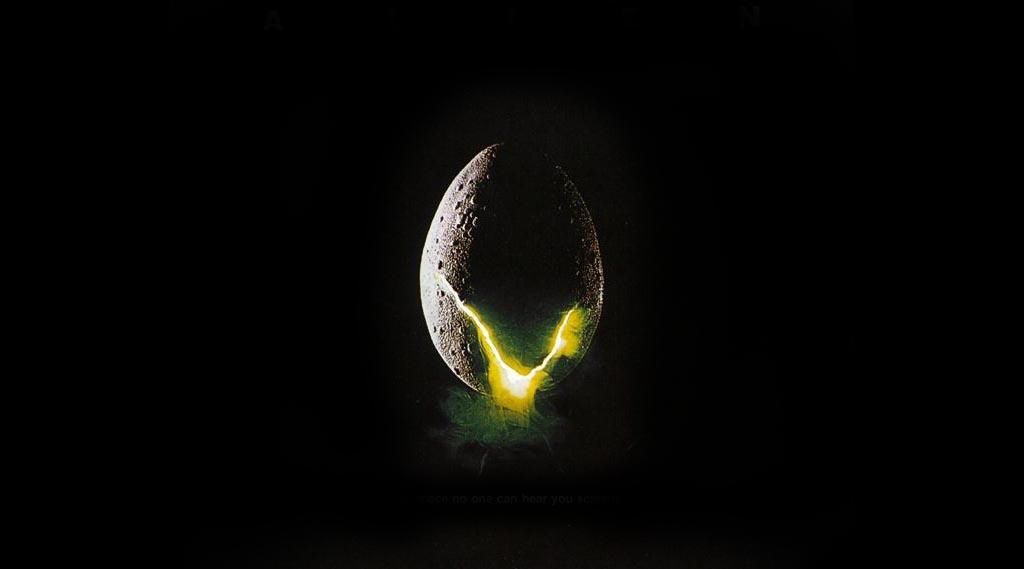
Alien (Ridley Scott)

Egg.

Not that I was truly compelled to rewatch "Alien" solely because of "Prometheus'" release, as viewing the former once more was already in the back of my mind even before the latter was even green lit. And watching it after more than 5 years, it was as if I'm seeing something new altogether. 

Perhaps my slight cluelessness brought about by the years of not watching this film is, in a way, a thing of envy for die-hard "Alien" fans and even a fantasy realized for most movie watchers. As a long-time film lover, I know that there's this ever-recurring yet far-fetched idea among compulsive cinephiles of being able to wipe their memories clean so that they can enjoy all of their favorite films once more without knowing what's going to happen next. 

I, for one, would love to watch "Predator" again without any 'action hero' bias towards Arnold Schwarzenegger so it will once again be a genuinely thrilling experience. 'Who will die next?' A simple question that is indeed one of the guilty pleasures in all of cinema and one of the meager delights of an avid suspense fan. Perhaps that's what I have felt while watching "Alien" once more, and it was indeed a wonderful high. 

Of course, one can't deny how well-made this film really is and how its simple premise has brought it to its legendary status that we all know of today, but I have never remembered it, more than half a decade ago, to have contained such exceptional performances. Sigourney Weaver's performance for instance, after watching it again, has been enhanced to a certain extent and was even more believable than I last remember it to be. 

Her transformation as Ellen Ripley, from a dead serious female crew of the Nostromo to a brave heroine by circumstance, is such a powerful slow-burner that her intense metamorphosis is still being repeatedly used as the model character arc for sole survivors in many films of the same kind even to this very day.

But although this 'zero to hero' arc has been used a year before "Alien" was released in the form of Jamie Lee Curties as Laurie Strode in "Halloween", Ellen Ripley is a hundred times more chilling in how she has responded to her situation mainly because the survival rate in space, paired with a murderously invulnerable Xenomorph, is relatively low compared to a suburban neighborhood hunted by a slow-ass, Captain Kirk mask-wearing Boogeyman. And also because, let's admit it, playing this little survival game in space is infinitely more intensely terrifying to behold. 

But the "Alien" experience, as we all know, wouldn't be that unforgettable if not for Ridley Scott's exquisite direction, Dan O'Bannon's (rest in peace) simple but effective writing and H.R. Giger's iconic creature design. Taking one out of those three will surely render "Alien" quite deficient and lacking so it's fortunate that they have created a film so good that it has bred an expansive franchise and even cross-over films, much, of course, to the delight of fans who wanted more of it.

And then there's the rest of the cast, which consists of Harry Dean Stanton, Tom Skerritt, John Hurt, Ian Holm, Veronica Cartwright and Yaphet Kotto. If I am to look upon that particular line-up of actors without a further knowledge that this is indeed a science fiction film about a murderous alien in a spaceship, I would have mistaken this to be an elegant ensemble drama. 

Indeed the talent of "Alien's" cast has made O'Bannon's writing more natural on-screen, as they have truly provided it with human spontaneity that an otherworldly and literally alienating film like "Alien" crucially needs. Their performances were not legendary by any means, but their chemistry exudes a certain relational authenticity that it has been the strong, primary highlight of the film just second to the very arrival of the extraterrestrial slaughterer itself. 

Now, look at it again: The Nostromo's crew sitting around a white, futuristic table, eating futuristic foods while taking about home. Aside from the creature itself, isn't that what you'll remember most about "Alien"? 

But after all, what has really made "Alien" a legendary classic? Well, if you look at it, the story is too simple to even qualify as such, which plainly concerns the crew of a commercial spaceship named "Nostromo" and their unlucky encounter with a not so accommodating creature that serves as the antithesis of Spielberg's "E.T.". "Alien" does not even possess "2001: A Space Oddyssey's" mystical ambiguity or even "Planet of the Apes'" revolutionary utilization of a twist ending.

So what, then, has made "Alien" so special? I believe it is how the film exemplifies the greatness of having just the right amount of everything. It's a science fiction film that does not bite more than it can chew, it's a suspense movie without the usual overkill and it's a monster movie without the visual excesses. The performances do not dominate and even the creature lurks in the blackest darkness, teasing you with the terror that it entails rather than scaring you with its physical wholeness and its tails (Why? I want to make a rhyme, damn it!). "Alien" is a film that wants you to look at the vast emptiness of space not as a purely meditative speculator asking the 'whys', 'wheres' and 'hows' but as a cautious spectator asking the most perverse 'what ifs'. 

"In space, no one can hear you scream". Just reading that tagline alone is enough to send genuine shivers down your spine. Watching the film is even a taller order for your nerves to handle. Beware of its scares but be compelled by its greatness.

FINAL RATING
Photobucket

Wednesday, June 6, 2012

Prometheus (Ridley Scott)

The monolith head.

It's not a highly intelligent science fiction film or a purely imaginative Ridley Scott creation. But what makes "Prometheus" a picture that is worthy of all the hype that it has amassed throughout its promotional phase is one word that Ridley Scott was able to strongly uphold: audacity. 

Even now, I can't say if "Prometheus" is really necessary because however original this companion piece may be, the first "Alien" film will always stand on its own strong feet as an untouchable and seminal science fiction work that dared the darker mysteries of outer space like never before and, probably, never again. 

Being announced as an indirect prelude to the events in "Alien", it's given that "Prometheus" will hand out some answers to things that the said sci-fi horror classic have left quite ambiguous for so many years. And with its trailers leaving an impression that this will certainly be a film of significant magnitude, it's also given that this will also expand the "Alien" universe even more. 

The result is certainly not the greatest prequel or Ridley Scott film that we'll ever see, but it is, nonetheless, a brave piece of filmmaking that clarifies as much as it raises new questions and is also a science fiction film that balances the scares with some far-reaching concepts of human creation. 

It stars Noomi Rapace of the "The Girl with the Dragon Tattoo" fame as the perfect actress to channel Sigourney Weaver's intense portrayal of bravery and claustrophobic fear in the "Alien" films as Ellen Ripley. Here, Rapace plays Elizabeth Shaw, an archeologist who, along with a ragtag crew with the same intent for discovery, was commissioned by the mysterious Weyland Corporation (look for a geriatric Guy Pearce) to brave the far reaches of the outer space and land on a distant planet to unearth a key that may or may not hold the answer to our deepest inquiries about the origin of the human race, or its annihilation. 

Aided by a humanoid named David (Michael Fassbender), who's greatly fascinated with Peter O'Toole's turn as T.E. Lawrence in "Lawrence of Arabia", and watched upon by an antagonistic Weyland Corporation representative named Meredith Vickers (Charlize Theron), the team set on to do what they were tasked to do, but not without some magnified mishaps or two. 

For a science fiction film dealing with the typical 'mission gone wrong', 'not knowing what we're dealing with here' theme, "Prometheus" is strictly a standard venture. But despite of that, it's still a high concept film that may surely be flawed at some point, but is nevertheless thought-provoking both as a prequel and as a stand-alone film. 

Opening with a highly unusual scene of a muscular, Dr. Manhattan-like creature that looks more like a character taken from a 'sword and sorcery' film rather than from the world of hard science fiction, "Prometheus" introduces itself as a tall cinematic mythology. And with this type of prologue of sorts, Ridley Scott is evidently on to something here that's bigger in conceptual scope compared to the first "Alien" film. 

But with such expansive ambition is a most critical issue of whether or not it can really deliver the promised goods. Like 2011's sleeper hit "Rise of the Planet of the Apes", "Prometheus" is a film that is burdened with the pressure of conveying a very interesting story that can hold its own ground but can also pull off a great feat of patching up questions of origin. 

For some veteran directors armed with such films as "Alien" and "Blade Runner" in their resumes, it's not that unusual at this point in their lives to be highly contented with what they have contributed to the film industry. Look at George Lucas and his countless re-releases of "Star Wars" and you'll know what I'm talking about. However, for Mr. Scott, it seems as if he's veering away from what Mr. Lucas, right now, is doing. 

Instead of squeezing dry a highly lucrative franchise like "Alien", and with that I mean desperately pitting an aged Sigourney Weaver once more with the wretched Xenomorph in a most ill-advised "Alien 5", Ridley Scott, nearing the twilight of his career, is brave and still confident enough not to do that but has instead created something that merely revisits the franchise but whose main intent is to refresh it. 

The result may be imperfect, but what I adore most about "Prometheus" is not much about the very execution itself, although it has great merits of its own (particularly the strong performances by Rapace, Theron and Fassbender), but the sheer bravery of touching and expanding "Alien's" cinematic universe while also maintaining the integrity of narrative originality.

Surely, fans may be infuriated by how, in some ways, "Prometheus" has ruined the simplistic mystery and horror of 1979's "Alien" by way of its exposition. Though that can surely be a case in point, I admire how the film took a more mythological approach to counter "Alien's" style of silent, straightforward terror. 

"Prometheus", as a prequel, gave enough answers regarding how one of the most despised movie creatures of all time came to be. But with that, the film has also left fresh new questions to ponder about. Not since "Blade Runner" have I ever been more satisfied with how Ridley Scott has left some things open.

FINAL RATING
Photobucket

1001 Movies You Must See Before You Die

Ivan6655321's iCheckMovies.com Schneider 1001 movies widget