Showing posts with label Irene Jacob. Show all posts

Wednesday, August 1, 2012

The Double Life of Véronique (Krzysztof Kieslowski)

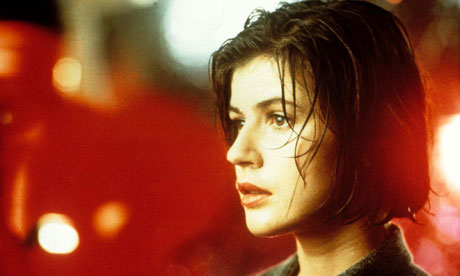
Irene Jacob as Weronika and Véronique.

Fresh from a blockbuster overload after watching “The Dark Knight Rises” a couple of times (and “The Amazing Spider-Man” before that), it’s a bit off for me to immediately jump back to my more esoteric inclinations. Now, here’s Krzysztof Kieslowski’s enigmatic “The Double Life of Veronique”, a film that, like the movements of the marionettes shown in the film, unveils its story with a certain hypnotic vibe. Honestly, I’m not quite sure if what I have seen is really something deeply meditative or merely a pretentious piece, but it is nonetheless an artful ride. 
     
Just like a typical Kieslowski film, “The Double Life of Veronique” appears as if little to nothing is going to happen and as if the main characters’ feelings are operating within the confines of an emotional plane alien to ordinary viewers like us. But with the Kieslowki’s usual sleight-of-hand at play here, and with that I mean his penchant for integrating deeply affecting concepts about love and identity within the visual limitations of a subtle drama film, “The Double Life of Veronique” is quite successful in a handful of levels. 
     
First, it is a well-crafted cinematic amalgamation of music and imagery (thanks to Kieslowski’s frequent collaborators Zbigniew Preisner and Slawomir Idziak). Second, it is a film particularly memorable because of Irene Jacob’s natural, iridescent charm and quietly devastating performance. And third, well, this is where the more ambiguous things come in. As an abstract film both in emotions and meaning, it is meritorious in just letting its own visual and auditory mood take over the reins of telling the film’s story (or the reins of justifying the lack thereof). But unlike your usually plotless art film, “The Double Life of Veronique” has an involving narrative working to its own advantage. 
     
Well, the story is quite simplistic. It concerns two women who look very much alike: Weronika, who lives in Poland, and Veronique, who lives in Paris. Both characters are played by Irene Jacob. From the hair to their dressing preference, they are the spitting images of one another. Hell, they’re not even related. 
     
Not aware of each other’s existence, the film’s metaphysical powers are slowly creating a bridge; slowly, we are seeing the connection between them. But Kieslowski, arguably at his subtlest, won’t let his film be tarnished by some clichéd chance encounters or life-affirming vis a vis between the two. Instead, Kieslowski has spatially set both characters apart from each other to first let their independent stories be told. Weronika, a considerably free-spirited young woman, is just inches away from attaining success in the world of opera singing. Veronique, on the other hand, is a music teacher in search of a meaningful love. From these simple stories of existence, the film is quite surprising in how it slowly widens its conceptual plane as it progresses. From simply being a drama film about two look-alikes, “The Double Life of Veronique” slowly turns into a meditation about distant duality and the spiritual and emotional connection between two people created in the same physical mould.
     
So, maybe this is where God enters this little humanist circus. Does Kieslowski perceive God as a playful master creator? An omniscient being that brings dead ringers into existence, intentionally integrates them into the stream of life and then watch the sparks fly? Is there some sort of energy that these two share that when one of them dies, the other gets weaker and emptier inside? Kieslowski’s vision for this picture is just too far-reaching and, at the same time, so wonderfully ambiguous that its idea just won’t end where this film already has. Take “Another Earth” as an ideal example. I believe that the said film is “The Double Life of Veronique” all over again. 
     
Adding a sci-fi element by incorporating a ‘mirror’ earth that is said to be inhabited by parallel versions of ourselves, “Another Earth” just took this film’s whole concept and made it a notch more complicated but a notch less fascinating. But do not get me wrong, I think that “Another Earth”, as a film, has its own merits. But at the end of the day, I very much prefer Kieslowski’s masterly stroke of using nothing as his ultimate explanation to everything. Though this might be considered as a pretentious cop-out on his part, leaving everything unanswered has made the film even more compelling and reflective than it should have been. Although we all have different takes on it, we do not hold the key to what it’s really all about. Perhaps life itself does, and we just aren’t looking closely.

FINAL RATING
Photobucket

Monday, January 23, 2012

Three Colors: Red (Krzysztof Kieslowski)

Destiny.

With its beautifully multi-layered drama and its great sense of closure, "Three Colors: Red" is quite easily the best film in Krzysztof Kieslowski's "Three Colors" trilogy. It stars the beautiful Irene Jacob as Valentine, an easy-going fashion model, and Jean-Louis Trintignant ("The Conformist") as an enigmatic retired judge who eavesdrops on his neighbors' private lives by way of wire-tapping their telephones and successively playing them in his speakers as if a series of radio shows. Although the relationship between Valentine and the judge is peppered with psychosexual tension, which my more cynical mind, to a certain extent, reminds me a lot of the relationship between Clarice Starling and Hannibal Lecter, the film, albeit the enveloping intrigue and mystery that surrounds the whole film's premise, is a hopeful exercise in love and human warmth.

Out of the three films, I think that "Three Colors: Red" is the most immediately relatable but at the same time also the most cryptic (the questionable actions of the retired judge). We can relate with the adventurous Valentine because, unconsciously, we are also her because by any chance our car may ran over a dog and find out that the wounded animal has a name tag with an address in it, we will immediately return it to the owner, which in this case is the judge. This is how Valentine and the mysterious judge met, therefore forming a bond forged out of curiosity and developed out of the immediacy of human connection.

For some filmmakers, with this kind of characters, a twenty-something girl and a sixty-something man, it's enough grounds to create a relatively pretentious romance. But Kieslowski, himself about to reach sixty years of existence himself (which he never did when he suddenly died in 1996) by the time this film, his last one, was released, knows better by instead playing this type of character relationship with dramatic assurance, wisdom and lots of heart. Of course, it's not without a hint of tragedy and a sense of isolation, which both "Three Colors: Blue" and "Three Colors: White" has finely established in different perspectives.

But aside from this filmic relationship, Kieslowski also has something much trickier to pull off: how to coherently tie up the three films while also giving his current characters enough breathing space to wrap up their own situation.

On one side, we have the budding emotional involvement between Valentine and the privacy-invading judge. On the other, there's also a young judge named Auguste (Jean-Pierre Lorit), whose life, in many ways, closely mirrors that of the judge's and who's currently involved in a run-of-the-mill romance with a personal weather reporter.

At surface viewing, "Three Colors: Red" may look like your typical film by way of how it tackles love and existence at different viewpoints, sometimes in bliss, sometimes in pain. But Kieslowski has created his characters to fit an urgent inevitability to unconsciously interconnect. In this idea of intertwining of fates, Kieslowski has already gave us a tease by mistakenly letting Julie (from "Three Colors: Blue") enter the courtroom where the divorce trial between Karol and Dominique is taking place in the beginning of "Three Colors: White". There's also the hunched old lady (who appeared in all three films) immersed in a mundane difficulty: The camera and the characters always catch her laboriously trying to put an empty bottle inside a trash bin; a prominent figure in the whole trilogy that has been, in a way, the barometer of the protagonists' characters. (Julie merely looked at her in puzzled sadness while Karol minutely smirked at her predicament. Only Valentine has the basic courtesy to help her put the bottle in the bin).

In this film, it has truly, as they say, come in full circle.

But not in the way how a generic ensemble film may. Sure, the film may have discoursed about the general outlook of love by way of those two (bliss and pain) extremes, but the film is a minuscule observation of love and life at the same time as it is a far-reaching, 'what if' meditation on time. In the end, "Three Colors: Red" relies on the singular choices and plans of its characters instead of giving the responsibility to an invisibly omniscient hand to move the likes of Valentine and the judge as if indifferent chess pieces. And for that, the film was uniquely pragmatic.

After 'liberty' and 'equality' were tackled through individualistic perspectives by way of Julie and Karol in the two previous films, "Three Colors: Red" was able to brilliantly put these stories, stories of people striving through all too human flaws, in a holistic harmony even in the midst of a tragedy. This may very well be the significance of 'fraternity' in the whole film, but "Three Colors: Red" is also quite aware of another infinitely more transcendent thing: destiny. Again, with its fascinating visionary depth and articulate human drama, "Three Colors: Red" is the best film in the trilogy, and is also a fitting swan song for Krzysztof Kieslowski, who sadly passed away far too soon.

FINAL RATING
Photobucket

1001 Movies You Must See Before You Die

Ivan6655321's iCheckMovies.com Schneider 1001 movies widget