Showing posts with label 70's. Show all posts

Thursday, October 20, 2011

Tinimbang Ka Ngunit Kulang (Lino Brocka)

Anguish.

Living in the modern Filipino film culture, one can't easily delve oneself deeper into it without even hearing about the film "Tinimbang Ka Ngunit Kulang" and marvel about how heavily metaphoric the title really is. And then, with an unconscious compulsion, you then become curious. What is the film really all about? I, for one, initially thought that this film, although undoubtedly one of the finer Filipino films, isn't clearly one of the all-time greats. That's me and my unflinching idiocy. I then rewatched it with the aforementioned question rerunning in my mind, and then some. And just like that, I was in utter awe.

"Tinimbang Ka Ngunit Kulang" may widely be considered as Lino Brocka's seminal masterpiece, but somewhere within the corners of my mind where "Maynila: Sa Mga Kuko ng Liwanag", "Bona" and this film are on a continual struggle for subjective supremacy, it might just be his best work.

Contrary to Brocka's trademark ambient sounds-enhanced, raw visuals-enforced neorealisitic approach to contemporary Filipino squalor that has been ever prevalent in his later films such as "Insiang", "Tinimbang Ka Ngunit Kulang" boasts of a powerful human drama set within the hypocritical social and religious milieu of a seemingly quiet rural town.

Part coming-of-age film and part cinematic indignation of inhuman judgments, the film succeeded to disturb, touch and shake viewers all at the same time with its potent ability to deliver both an encompassing social commentary and an observant exploration of an adolescent's moral journey from debilitating indifference to something mirroring righteous courage and humanity.

The teenager, named Junior, played by then-rookie actor Christopher De Leon (who won a FAMAS for his performance in the film) who surprisingly handled the role like a seasoned veteran, is caught at an early crossroad; in this existential standstill, he can't seem to find his own path. Should he follow his father's successful yet women's perfume-laden path (a serial womanizer, that is)? Must he pursue a romantic, but ultimately hollow and immature commitment, or does he have the fiber to embrace the lives of two sideshow social outcasts whose deeply felt relationship overpowers their physical and mental shortcomings?

In some ways, just as how Brocka applied it to his later film "Jaguar", "Tinimbang Ka Ngunit Kulang" is a film that deals with crucial choices. Even with the dream-like opening sequence alone which, in a very hallucinatory way, portrayed the emotional nightmare of an abortion, both in its procedure, the aftermath (this powerful scene prophetically answers some of the questions that were raised in the 1985 film "Hinugot sa Langit) and the psychological effect once the choice regarding it was finally made, though in the film's case, a one-sided one at that (Lolita Rodriguez's Kuala seems unwilling).

Today, mentioning the name Lolita Rodriguez is like unveiling a dignified marble statue of a true Filipino cinematic icon, and for that kind of automatic pop culture thinking, suffice it to say that it was duly in part of her legendary performance in this film as the town lunatic, Kuala. It's one of the best performances in all of Filipino cinema, and her detailed conveyance of staggering facial expressions and uncanny gestures brilliantly merged and crisscrossed both the overly animated movements of a dirty mental case and the uncommon emotional depths of a woman who just suffered too much and is begging, by way of her soul creeping silently through her eyes, for all of it to end.

Mario O'Hara's role as Berto the leper is just as tricky to pull off. Listening to some of his lines, the character may easily drift into one-dimensional nobility, but O'Hara kept it all together quite consistently and has able to display the visceral goodness of a man who has nothing left to lose but just enough time to love. Eddie Garcia also shined in his role as Junior's father, Cesar, a role he so conveniently and effortlessly played that the very polygamous core of the said character has since been iterated quite heftily in his action film roles (the 'Manoy' persona).

One of Brocka's real, unequaled strengths is his great execution of endings. The one here in "Tinimbang Ka Ngunit Kulang" is a great example. Playing with the facial expressions of both the extras and the chief actors while still maintaining the emotional strain of the ending's dramatic center, the film, although can easily be branded as a communal tragedy, is still hopeful despite of its wounded premises. And as Junior emerges from Kuala and Berto's hut, carrying a symbolic purity that is a product of two individuals that were subjected to inhumanity, there's a feeling of solitary safety, and at last an emphasis, as Junior looks upon the people's guilty faces, of what was really weighed and found terribly wanting: the town itself.

FINAL RATING
Photobucket

Saturday, October 8, 2011

Taxi Driver (Martin Scorsese)

The immortal mirror scene.

My film review/analysis of what may be the best film ever made:

With its main target being to portray the extremely acute post-Vietnam War angst and disillusionment, director Martin Scorsese focused his lenses and vision to a lone cab driver cruising through the filthy streets of New York that almost alludes to a contemporary 'hell', and subtly articulates about the ambiguous nature of insanity. And the result is, well, not just his masterpiece, but one of the finest films American cinema has to offer. It stars Robert De Niro in a heavily complex (and one of the screen's greatest) performance as Travis Bickle, exhibiting both his mastery of subtle acting and his ever-escalating intensity.

But his Travis Bickle is never just a character. He is a representation. A social mirror of how depression and loneliness exist in a subjugated psychological fragment of society where existence is just for the sake of it, and the meaning of the word 'interaction' a fading afterthought. There are those who do not want to meet any new people save for some of his/her few acquaintances. There are those who do not know people much but is striving to meet some. And then there is Travis.

One of the film's timeless aspects is its disturbing, angry, but ultimately sad narration by Bickle himself. Here's a man who transforms his solitude into an anger-laden vigilantism against the so-called 'filth' of the streets. Here's a man who has nothing but his own breathing body and his own deteriorating psychological health. But at least, here is a man who stood up. But to look at Travis Bickle as a flawed hero is far from what "Taxi Driver" is all about. To look at him as a man with a goal and and a concrete initiative is far from the film's nightmarish view of what Travis Bickle is and what he's in for.

If we'll go into a direct assumption that him saving a young prostitute is a heroic deed, then why haven't they just made "Taxi Driver" into a dramatically redemptive little action movie? The answer is this: the whole 'saving the prostitute' mission he had is, like his existence, just for the sake of it. Looking at Travis's motivational pattern, all of his actions root out from him being rejected by the beautiful campaign worker Betsy (played by Cybill Shepherd).

With him having nowhere to go from there, he went on for a plan to assassinate presidential candidate Charles Palantine, not just to horribly capture the imagination of countless people regarding the fact of how terribly 'far-out' a man can be to do such a thing (John Hinckley Jr. and Mark David Chapman already captured ours in real life) and also to take hold of Betsy's attention. This is where ambiguity regarding his actions really starts to go haywire.

Some would say that his plan to kill Palantine is a condemning act to blame the said candidate for not being able to clean up the city's filth. But take note of their scene inside Travis' cab earlier in the film. Their conversation, although a bit distant in nature, is an honest exchange between two men craving for change. See how Travis' eyes went from being patronizingly phony into deeply-set ones as he stated how he wants someone to just flush all the city's scum down the toilet.

In all fairness, Travis do want some change, but relating this sentiment with his act to kill Palantine for not being able to do so (to do something with the city, that is) is foolish. Just like a common psychologically disturbed fellow resulting from extreme social isolation, Travis dreams of 'grandeur'. He wants to be 'that' man that has purposely killed the presidential candidate, and the people will remember him for it. The same applies to his final ditch effort to save the young prostitute Iris (Jodie Foster in a performance that earned her an early Oscar nomination) from his manipulative pimp (played by the great Harvey Keitel).

Because he failed in his previous plan, and also maybe because he has thought that killing a high-profile political figure may put him into the psychotic row of the history pages, Travis decided to enter the territories of folk heroism and masqueraded himself as an obscure social crusader, albeit an extreme one. Take note of the film's tagline: "On every street in every city, there's a nobody who dreams of being a somebody." Travis Bickle may have achieved cult status as an ideal cinematic anti-hero, but I view him more as nothing but a confused and heavily disillusioned fellow who wants to prove something within himself and to everyone, even if it takes a casualty or two to do it. But although I do not see him as a hero, I see him as a truly sympathetic figure, and a truly saddening one at that.

Scorsese (along with Paul Schrader's masterful screenplay), with his ethereal but deeply unsettling depiction of 70's New York City, enhanced by Bernard Hermann's misleadingly seductive yet menacing musical score, symbolically pushes Travis Bickle into a lonesome spotlight in the middle of a show, only to subsequently find out that audiences are filing out of the venue even before he had the chance to step into the stage. "Taxi Driver" is the manifestation of how he may have hypothetically felt at that moment, and the result is a film of unequaled greatness. Please do watch this film, and let the brilliance of what 'true' cinema is all about pervade within your soul.

FINAL RATING
Photobucket

Monday, May 16, 2011

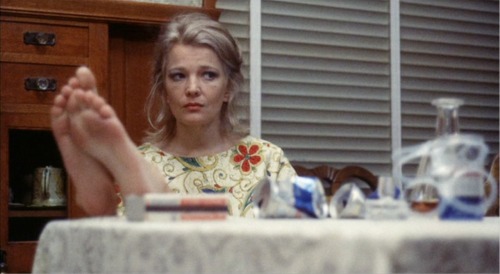
A Woman Under the Influence (John Cassavetes)

Gena Rowlands as Mabel Longhetti.

Great films like "Sunset Blvd." and "Psycho". They have both shown 'madness' in a way both disturbing and doomed, uncontrollably fatal and in brutal askew. Both pictures solidified the fact, with utter exclamatory conviction, that being in such a mental state is synonymous with being 'done for' and you can't really do anything but inhabit its very delirious core. And although the latter statement was still further raised by "A Woman Under the Influence", this film, directed with raw attention to the essence of the story and characters rather than the overall aesthetics by John Cassavetes, is a revolutionary break-out party (a bit hyperbolic, I must admit) to the hidden side of this seemingly over-used cinematic theme of psychosis: That madness can also serve as a familial balance.

Peter Falk, which I have first seen playing himself in "Wings of Desire", delivered an unforgettable, emotionally powerful and quite underrated performance as the husband Nick. The character is a blue-collar worker striving to keep his family together, and by the sight of his sublimely pleading eyes, he means good for everyone. He immensely loves Mabel (Gena Rowlands), his wife, and his children even more so. But he is quite weary of Mabel and her slow drift into a self-losing basket case.

His weariness is quite valid, after all, and with the help of the shaky camera utilized by Cassevetes that sometimes even goes out of focus, he has established Mabel's initial sequence as she, panting, exaggerated, and worried, assists her children as they go with their grandmother into her car to go to her house. "I shouldn't have let 'em go", uttered by Mabel. This sequence, although it shows her unusual redundancy, does not really highlight her insanity but shows her neurotic tendencies. As we see her repeat instructions, mostly about her children's well-being and safety, and fast talk her way to her mother's attention, Gena Rowlands depicts Mabel's personality with a slight slant of ambiguity: Does she really mean every word?

"A Woman Under the Influence" is infused with such incredible sequences after another, mostly dominated by Ms. Rowlands' weird, pathetically disorienting glib of tongue. She wants to entertain Nick's friends. She immerses into childhood persona just to make children laugh. But ultimately, she is marked by sadness. Yes, she is mentally unstable, but did she ever wanted to be in such a condition?

Then, in a tolling decision lifted by frustration and exhaustion on Nick's part, he sent her to a mental institution. He then tries to care for his children himself. But as shown by the significant sequence in the beach, shot within a considerable distance and with a point of view not leveled to an adequate position, the film showed Nick's incompetence as an affecting parent. Of course, he loves his children more than anything else, but with things that needs tenderness and detailed caring, he is gravely lacking.

Through this sequence, not only was it suggested that Nick really misses his wife with her free-willing interaction with their kids, John Cassavetes, with his great characterization of Mabel, also made us audience miss her. Despite the deterioration of her mental health, as she left their house and was committed to an institution, she also left a hole in her family. For once we see, after her erratic mental episodes, her encompassing influence to Nick and their children. Her utility. Her vitality.

After watching "A Woman Under the Influence", I thought that the film is really much more about the essential presence of a mother in a family rather than it is about the complexity of madness. Yes, beneath its sheer depiction of deafening attempts to control an insanity-inflicted individual and its uneasy portrayal of mental instability, it's centered in the significance of a caring matriarch. Mabel may be raving mad, she may shout senseless phrases and dance in the tune of the "Swan Lake" atop a couch, but her importance echoes throughout the four corners of their house all the same.

And as suggestively shown in the final scene approached with a sense of suburban calm, Nick and Mabel will always stride to strive. And as they make their bed and close the curtains, they, after all that have transpired, are still in one piece. That is until something else do them part.

FINAL RATING
Photobucket

Friday, May 13, 2011

The Rocky Horror Picture Show (Jim Sharman)

Dr. Frank-N-Furter and his minions.

"Didn't we pass a castle back down the road a few miles? Maybe they have a telephone I could use." Said Brad Majors, a hero. A very cliched line from hundreds of horror films to fundamentally begin a complication. And from that so begins the crazy night in Frank-N-Furter's gothic castle and the fun of "The Rocky Horror Picture Show" as a whole, filled with hilarity, horror and sexual innuendos that is also an out-of-this world ode to the cheesy greatness of B-movies.

'Frankly' (He. He. He he.) speaking, 'cult' films, like this one, are really very hard to scrutinize based on pros and cons as they aren't merely just films alone. Like "Star Wars", "The Rocky Horror Picture Show" is an unsurpassed phenomenon that blurs the borders between 'cinema' and pop culture. Through the years, it ceased to be just a film but also an embodiment of the numerous taboos of the 70's and at the same time, the era's uncontrolled, raging energy. To look at the film's (based on a stage play) ideas, characters, and set designs, it's hard to imagine all of it being created by sane minds. A distant galaxy called Transylvania and a planet named Transsexual? A cross-dressing scientist? Lots of eccentric grotesques? Coming from a perverted disposal, more like.

But from these seemingly outrageous thematic excesses and far-fetched conceptual liberties arises a balanced treatment of the musically ordered and the characteristically absurd. With Tim Curry's amazing, awe-inspiring depiction of a free-willing transsexual scientist who creates his ultimate hedonistic object that is 'Rocky Horror' (played by Peter Hinwood) and Susan Sarandon and Barry Bostwick's portrayal of a gullible, naive and repressed young couple, the film, directed by Jim Sharman, has achieved to pit two opposites.

We may be abhorred, disgusted and repelled by Frank-N-Furter's unorthodox sexuality and all, but it is perfectly contrasted by the straight-laced couple. We may see weird dance numbers amid surrealistic backdrops but they were viewed through the considerably unknowing eyes of Sarandon and Bostwick's characters. Decadence and innocence. Both contained in a colorful, gothic and occasionally shocking musical bizarre fest. Oh, how it delivered immensely.

Sure, the whole film is pure outlandishness just for the sake of it, but with Charles Gray's (by the way, he has played both an ally and a villain in the James Bond franchise) semi-profound statements, mostly told in intervals, about the emotional capacity of human beings only meagerly connected to the quick peripherals of persuasion (which Frank-N-Furter took advantage of), the film has also tread something other than music and choreography.

Sure, these can be nothing but cynic cliches commonly heard from many films dealing with pessimistic outlooks about human existence, but it sure fired away to fully complement the immoral undercurrents of the film. We may succumb to LSS, singing "Whatever Happened to Saturday Night?" and "Sweet Transvestite" at the back of our minds, but the film, as a cinematic entirety, exposes the emotional and sexual repression prevalent on many people dealing with the same situational predicament as in the film.

Tragic, fun, mischievous, even weirdly sexy, "The Rocky Horror Picture Show" is, after all these years, still a refreshing cinematic experience partly because of it's aghast-inspiring perspective about the futility of human control caught in the middle of an enticing prospect for dissipation. But also, quite simply, because the film is just so much fun to behold.

FINAL RATING
Photobucket

Saturday, March 26, 2011

I Spit on Your Grave (a.k.a. Day of the Woman) (Meir Zarchi)

Left for dead.

Sometimes, there are pieces of provocative filmmaking that although tackle sensitive, graphic and taboo themes, can still pass as art. This may be a personal bias, but I do regard the likes of "Irreversible" as a daring cinematic art. The original "The Texas Chainsaw Massacre" had its artistic merits amidst its exploitative slaughterhouse feel. Hell, even Clive Barker's "Hellraiser" can be considered as a masterful exercise of gothic storytelling. And then there's "I Spit on Your Grave".

This is where the pretense of unorthodox cinematic art really exhausts reasons and justifications. A revenge-themed independent production that actually climaxed in the gruesome and harrowing series of rape scenes. It is a film that can never find its place in a positive consensus. It is a deeply offensive display of feminine violation on celluloid. It is a highly nauseating exploitation picture that is tailor-made for that little, almost neglected 'fast-forward' button on your DVD remote control. Yet it sparked endless curiosities, garnered an underground cult following and even inspired a remake. Why? In one of my rare (cough, cough) instances as a film watcher and reviewer, I honestly do not know why.

"I Spit on Your Grave" is, above its surface of violence, murder, and physical and emotional torture, is primarily founded by two negative extremities fighting for hegemonic balance: misandry and misogyny. After all, as I question myself as how the 'momentary' capturing wonder of the video camera ever reached such a pathetic low point, the film is surprisingly, although unconsciously, split into two parts: The first being 'women' through the viewpoint of sexually shallow men and the second being the literal physical deconstruction (and dismemberment) of the idea of advantageous masculinity as the tables are finally turned.

Actually, I never thought that I will ever have the chance to see this film; but in a cruel twist of fate, I finally did, and although I really wish I hadn't, it gave me genuine firsthand reasons why.

This is disturbing stuff, and yes, even in today's standards, "I Spit on Your Grave" is still extremely disquieting. Just one tip for men, if ever you are planning to watch a horror film with your girlfriend, please do prefer Freddy and Jason's campy exploits more; this piece of questionable cinema doesn't belong in the 'horror' genre or does it even qualify as a film. It is a revenge-fueled assault to the senses completely devoid of any moral sanctions, nor traces of narrative cohesion, nor characters with common sense.

FINAL RATING
Photobucket

1001 Movies You Must See Before You Die

Ivan6655321's iCheckMovies.com Schneider 1001 movies widget