Showing posts with label revenge. Show all posts

Friday, June 29, 2012

Kill Bill: Vol. 2 (Quentin Tarantino)

The training.

At last, we've reached the epic conclusion of Quentin Tarantino's "Kill Bill" saga (Okay, let's just pretend that this is the first time that I have seen it), and unlike what many have expected it to be, "Kill Bill: Vol. 2" is surprisingly more patient, mature and emotionally articulate compared to its predecessor. 

If "Kill Bill: Vol. 1" is, as what Roger Ebert has stated in his review of the film, "all about storytelling and no story", this film, in comparison, is a perfect amalgamation of style and substance, which Quentin Tarantino has perfected in blending over the years. 

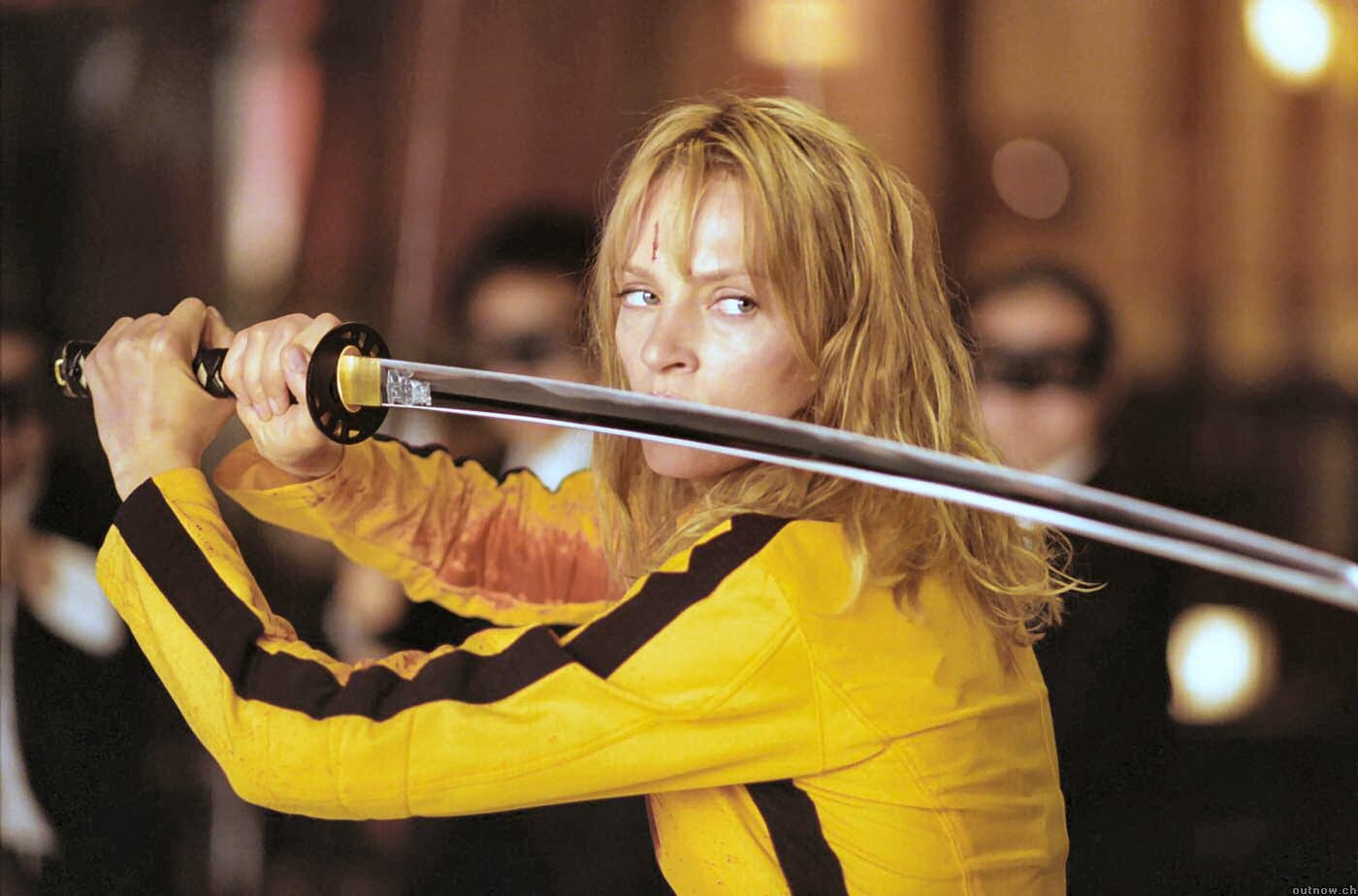
This time, we don't have any gargantuan swordfights between Uma Thurman's "The Bride" and 80 other men, but what we surely have in this picture is genuine drama and a hint of heart. But that does not necessarily mean that "Kill Bill: Vol. 2" does not have any time left for some genuinely pleasurable ass-kicking courtesy of our vengeful bride. It sure does, of course. It's only that the fight sequences and moments of cruelty are far more compelling and emotionally involving this time around. 

As much as I love the showdown at the House of Blue Leaves between the bride and O-Ren Ishii's (played by Lucy Liu in "Kill Bill: Vol. 1") "Crazy 88" in "Kill Bill: Vol.1", there's honestly little to no emotional connection between me and the very essence of the blood-drenched sword ballet whatsoever. But here in this film, we are now more drawn and more empathetic towards the bride's self-imposed task of exacting revenge against those who literally gunned her down. Damn, we know that she can survive the House of Blue Leaves showdown in the first volume. But now, with "Kill Bill: Vol. 2" taking on a more grounded approach, can she still handle it all? 

In the first film, we are quite affectionate towards the bride's revenge but we are just too awed with the visual stylishness on display that we take her path of destructive revenge in the first film merely as a showcase of Tarantino's auteur flamboyance. But with "Kill Bill: Vol. 2" now preferring a slower pace, evidently shown in the film's opening scene of the bride's serene wedding dress rehearsal minutes before Bill and company blow her and her loved ones away, we are now more acquainted with the bride not just as a character that simply represents Tarantino's patented cinematic style but as a living, breathing character with a highly justifiable motive behind her every slicing of limbs and poking out of eyeballs. 

We are also introduced more to Elle Driver (Daryl Hannah), the eye-patched femme fatale who's the most painful thorn within the bride's throat next to Bill himself, and Bud (Michael Madsen), Bill's slacker of a brother who also had a hand in the infamous pre-wedding massacre. Oh and then there's also Pai Mei, played by Gordon Liu (who has already played the "Crazy 88" leader in "Kill Bill: Vol. 1"), a kung-fu master that's obviously Quentin Tarantino's great ode to the stereotypical 'martial arts master' character in countless genre films of the past with his overlong white mustache and exaggeratedly thick and contoured white eyebrows. 

And finally, there's Bill, played by David Carradine in what may be his most memorable character next only to Caine in "Kung Fu". Possessing the looks of a murderously ragged old man yet armed with the gentle demeanor of an old-fashioned lover, Carradine has perfectly captured the essence of Bill. For the record, I believe that Bill is not a villain as per what the word's typical meaning denotes. For that, Tarantino is truly commendable in how he has handled this particular character perfectly. 

There's a moment in the film where Bill, now face to face with the bride herself, explains himself as to why he has done the murderous deed. As if stating that his violent nature is imprinted deep within his soul and cannot be erased, he simply stated that he's a downright murderous bastard and he just acted based on his immediate compulsions when he found out that the bride, his former flame, is now about to be married to someone else. Though it cannot be denied that Bill is the monstrous incarnation of aggressive masculinity (he can't take romantic defeat), Quentin Tarantino is emotionally aware enough to depict Bill as a villain that's capable of explaining himself. 

For some, "Kill Bill: Vol. 2's" climax is highly anti-climactic because it has not exceeded the bar that the first film has set in terms of confrontational swordfights and bone-crashing fisticuffs. But seeing the dramatic potential of such a tale of revenge, Tarantino chose to be more calmly elegiac with it rather than being shallowly aggressive. It may not have ended with both barrels blazing (or 'both katanas shining' if you want to remain consistent with the martial arts analogy) in terms of action-packed physicality, but the film is still highly satisfying not because of its physical pay-off but because of its ultimate emotional confrontation between the vengeful woman and the man who has made this feeling possible within her. 

"Revenge is a dish best served cold" is the film's opening quote. For the bride, she served it straight from the freezer, but still, tears were shed. Revenge is a sad venture, and the film is fully aware of that fact.

FINAL RATING
Photobucket

Kill Bill: Vol. 1 (Quentin Tarantino)

The showdown.

Always the master of cinematic homages, Quentin Tarantino now offers us a martial arts genre-inspired, revenge-themed film that's best served cold. It's a film that highlights, in bright crimson red, the stupendously over-the-top craziness of martial arts films and how it has captured the imagination of many people who were lucky enough to have seen such pictures. But aside from being an ode to the martial arts genre, "Kill Bill: Vol. 1" is also a fiery introduction to what may be one of the most resonant revenge tales of recent memory.

In a world inhabited by code-bound katana makers (like Sonny Chiba as Hattori Hanzo here) and evil martial arts masters, it would have been out of place to put a frail blonde woman in the middle of it all. But Tarantino, now a filmmaker that has already reached his utmost potential for gender maturity, just did, and the result is truly rewarding. Quite ironic, really, for a director whose first film, the neo-gangster classic "Reservoir Dogs" doesn't even contain a single female character.

And with that, "Kill Bill: Vol. 1" has succeeded in showcasing Tarantino's directorial flair and sheer passion for, this time, everything martial arts. It simulates, as it renders a bygone era of martial arts films in a reinvigorated light, what it's like to be witnessing an old-fashioned film glazed with the language of the fist and the code of the sword once again.

Heightened by Uma Thurman's great performance as the vengeful bride on an unmercifully violent path of revenge who will stop at nothing until, well, he can finally kill the titular Bill, the film's effectiveness is not much because of the plot but because of how this seemingly tired story of blood-soaked revenge has trickily found its way into the screen looking completely different and strangely beautiful once again.

Some playfulness with non-linear narrative on one side, some animation here (one of the most striking features of the film) and a subtly powerful use of 'chapters' there; the clever amalgamation of these aspects has not just made the film something that's truly riveting to watch at surface level but also an intensely unforgettable portrait of what wonders a truly passionate cinephile of a filmmaker like Tarantino can do for a genre that's seemingly buried by time.

Going back to the very narrative, we can simply say that it's a story of a woman's revenge against a former flame that has attempted to kill her, but didn't. So what? What then? What's new? We are repeatedly being fed with films drenched in fearlessly bloodletting vendettas such as this one, with one being crueler yet less fascinating than the previous one. So, again, what's with all the fuss?

Well, the answers for all of those lie within the very film itself. The film, for a lack of a better persuasion coming from yours truly, needs to be seen to be believed. To be seen as a highly stylish action film. To be believed as a truly unique cinematic experience.

"Kill Bill: Vol. 1" may not possess the complexity or depth of "Pulp Fiction", but at the end of the day, its distinction as a great Tarantino film by its own right lies not within the plot or the characters themselves but within the courage of pulling off such a film and how it was done in the most brilliant of ways and the most outlandishly exceptional of styles.

In a time where movies wallow on old ideas that pretend to be something new, it's invigorating to watch a film that's humble enough to embrace old ideas but ingenious enough to render it familiar yet fresh all at the same breath. This film may not necessarily be the 'one' that will immortalize the martial arts genre, but it sure has put the seemingly forgotten genre into prominence once more, and dare declared the greatness of its peculiar aesthetics.

FINAL RATING
Photobucket

Saturday, June 16, 2012

Mad Max (George Miller)

Max is...quite mad.

It has been widely believed that ever since "Mad Max" was released, action films have never been the same again. It has introduced a more frenetically-paced action style and also a purer form of utter machismo and brutality that has since been the staple themes of almost all of the action pictures that have followed after it. In a way, the whole '80s to mid '90s action film scene is highly indebted to "Mad Max" because without it, there wouldn't be a need for such red-blooded films. And also, without this seminal George Miller classic, the world of bullet-spraying, revenge-driven heroes inhabited by the likes of Arnold Schwarzenegger and Sylvester Stallone would be devoid of another equally important action icon: Mel Gibson. 

But then more importantly, this film has significantly done something that can be compared to what "Jaws" has done to the beaches or what "A Nightmare on Elm Street" has done to dreams: "Mad Max" has made us fear the open highways. 

Judging from its narrative, "Mad Max" has nothing remotely surprising going on. It also does not help that the film has some irritating side characters and a lazy dubbing. With that, "Mad Max" is nothing more than a B-grade little film that, despite of its overly rough edges, has managed to unconsciously revolutionize a whole genre. 

Made in 1979, the film has aged quite badly both in editing, sounds and script. Even the performances are quite cheesy and cartoonish. The plot, for the lack of a better word, is almost non-existent. The car chases are quite new at the time but are nowhere near of being unique and truly fresh. 

But then, after all of these overbearing cons, there's "Mad Max's" universe. Making it appear as if the empty expanse of the speedways are the final frontiers of an apocalyptic Australia, the film's imaginative vision of a world gone way, way awry is a thing of peculiar beauty and originality. 

Oh, and there's an attempt of being prophetic too. Labeling "Mad Max's" time frame as 'few years from now', the film is also quite successful in creating an illusion of plausibility that I can surmise is quite alarming and frightening at the time of its release.

With an intention to create an insane, 'anything goes' world devoid of swift justice, George Miller and company have created a surrealistic neo-western world with an atmosphere reminiscent of "High Noon". Only this time, Frank Miller and company are now mentally unstable bikers and Gary Cooper's Will Kane is now in the guise of a gutsy highway patrol officer named Max Rockatansky (Mel Gibson).

"Mad Max", amid the immensity of its negative aspects, is a finely realized hybrid of a film that's armed with whatever's left of the cinematic sensibilities of the western genre yet heightened by a newer, more energetic style of action. 

Watching "Mad Max", after all these years of seeing action films with the same revenge-driven story, is like watching something new set in a more than familiar narrative landscape. Rooted in the film's use of clichéd storytelling, an aspect that has been one of the main reasons why action movie-goers has since been transformed into jaded ones, the film seem to render the plot secondary and the visuals as the main priority. And with that, I believe the film has succeeded not as a truly compelling action film but as a highly kinetic action fare fueled mainly by the spectacle and not the story. 

What resulted is an action-packed tale of revenge and justice that has given birth to a new breed of action films, and also to edgier protagonists bent not just on setting things right but also on pure, red-blooded retribution. 

Watching "Mad Max" today, I can confidently say that I've seen better action films. "Mad Max" is the Wright Brothers' prototype plane to Arnold Schwarzenegger, Sylvester Stallone and Bruce Willis' Boeing 747. The films by the latter action stars may be bigger in terms of scope, budget and larger than life characters, but nothing beats classic novelty. An interesting look back to where it all started.

FINAL RATING
Photobucket

Monday, January 23, 2012

Three Colors: White (Krzysztof Kieslowski)

The secret in his eyes.

A slight departure from "Three Colors: Blue's" transcendent and melancholic tone, Krzysztof Kieslowski's "Three Colors: White", representing the middle color in the French flag which symbolizes the virtue of equality, is humorous in its study of sexual weakness and subsequent redemption. The film opens with a trial scene involving Karol Karol (Zbiegniew Zabachowski), a hairdresser who has, ever since his marriage with his wife Dominque (Julie Delpy), failed to sexually consummate their love.

With his numerous insecurities and sexual inferiority plaguing their marriage and also are the things that are responsible for putting him on the pitiful end of a divorce, just like Julie's isolation in "Three Colors: Blue", he has withdrawn himself from the main stream of existence. But this time, this isolation is never a strengthened choice. Pushed into the streets with a frozen bank account and only a large, almost empty suitcase to live with, he is a definitive image not of emotional bravery (unlike Julie) but of defeat.

But as fate permits it, he meets Mikolaj (Janusz Gajos), initially a mysterious Polish lad who has soon became his friend. Unlike the previous film which broods about loneliness and repeatedly hints on isolated sadness, our protagonist here in "Three Colors: White" is also a lonely little chap but with a trusted pal. Although of course inserted by Kieslowski more importantly as an initial plot device (this film is, after all, the most plot-reliant of the trilogy), the Mikolaj character slowly transforms from being a hazy character with questionable intents into a surprisingly upbeat light that has been most instrumental for Karol's new lease on life, which is the same equivalent of what Karol is to Mikolaj. And in this friendship that was built in a time of utter tribulation, there's the cause of it all: Dominique.

Julie Delpy, who I have first seen in "Before Sunrise" as the intelligently vibrant and sweet Celine, is unbelievably cold and indifferent as Dominque. At times she even looks and feels like a femme fatale. But Kieslowski, veering away from the shallow dimensions of character stereotypes, treated Dominique not as the aggravator of the situation but also as a victim of circumstances. Just like every wife, Dominique only wants sexual and emotional fulfillment in her marriage. But Karol, ever the shy sexual weakling, never properly took on the role of an accommodating husband.

From what I've noticed, "Three Colors: White" was very well-known as a revenge film as much as it is recognized internationally as the only comedy film in the trilogy, albeit a dark one. For many, this certain 'revenge', planned by Karol to give Dominique her deserved comeuppance (the catalyst being the time when he has heard her pleasurably moaning on the phone, presumably while having sex with another man), is the poetic justice that the film is looking for on Karol's part for him to attain the signified 'equality' that the color 'white' is representing. But as I look more into it, the less I give a damn about Karol's so-called vengeance scheme.

Sure, it was, for a moment, very enlightening and emotionally purging for us because we have rooted for Karol in the film's entirety. Yes, we are supposed to, but we're not compelled by Kieslowski to overly do so because he has never overlooked to give dear Dominique her own share of a beating heart.

In the end, as I subconsciously decipher the pure significance of 'equality' in the whole film and as Karol gradually changes from a vulnerable sap into a relatively powerful businessman and a confident male, the more I think that it's not Karol's quest for revenge that is the real point of the film in terms of aligning itself with the color white's 'equality' symbolism but more significantly about how Dominique, being a good wife and all (the film shows how genuinely happy she is during their wedding), gets what she deserves: a Karol who's sure of himself, is sexually assertive, and knows what he wants.

In a way, I even think that when Dominique finally found out about Karol's vengeful scheme, sure she was shocked, but she's also silently elated. With the way how her husband has handled and cleverly played the situation to manipulate the situation to his advantage and set it against her, she has realized ever so unconsciously that Karol, at that very moment, has finally become a man, the one that she's waiting to love. This therefore creates equality between the ever- loving feminine (Dominique) and the now transformed masculine (Karol), making their marriage worth all the emotional pitfalls, the agony of sexual misgivings, and the pain of relational apathy.

So surprisingly, "Three Colors: White" is not just a one-sided tale of revenge but is also an exploration of the essential role masculinity plays in strengthening a marriage. Absurdist as the film may sometimes seems to be, Kieslowski still has offered a fresh take on the thorns and roses that populates not just the spacious boundaries of love, but also the bumbling and stumbling confines of life.

FINAL RATING
Photobucket

Sunday, July 31, 2011

Memento (Christopher Nolan)

Lenny and AMD.

After a 4th viewing, I finally came into terms on how great a psycho noir film "Memento" really is. Its lonely and constantly manipulated protagonist Leonard Shelby (played by the very underrated Guy Pearce), who is out there in the open searching for the man who raped and murdered his wife, isn't the only one that goes with the wave of the film's conflicted theme of revenge, deceit and selective thinking, but also us. 'This' character helps Leonard and 'that' character aids him, but can they really be trusted? "Memento" is indeed a film that gives its ultimate revelation in the end (which is also supposedly the chronological beginning of the film's colored sequences) just like any other mystery films, but what elevates the film above other movies of its kind is its unique view of its characters' reliability. Do they really speak of the truth?

The film plays like a crooked little jigsaw puzzle game and we, the audience and Leonard, are the clueless arrangers. Or is it like a tight-strung political conspiracy and we are the Woodwards and Bernsteins? "Memento" is truly successful in its layered exploration of the barren landscapes of a short term memory disorder-inflicted mind that visually simulates this through the film's reverse chronology. Christopher Nolan, who directed the film with both the limitless consciousness of a daring independent director and the depth of a human dramatist, fragments the film with subtle linkages that makes the film all the more urgent in its presentation. It's purely involving yet it never spoon-feeds plot devices and narrative necessities.

"Memento" merely plays like a confused sleuth who constantly goes around places until its confusion turns into a foggy clarity. As evident in its pattern alone, it stands as a film that was never really created to answer its own teetering questions. It probes into the deepest and treads the slightest yet the next thing you may know, it unravels on its own. Here is an exceptional mystery film that is more concerned with its protagonist's internal catharsis than the audience's plot satisfaction.

Here we do not have a hero but a mere vengeful soul. He wants answers but so do we. "Memento" hands out its clever twists and turns just like any other cinematic exercises in doing so but does not have the courtesy to give a parenthetical period. It's a fourth wall cerebral involvement and I'm more than happy to join in.

I hate films which open up a lot of doors yet don't have enough capacity to close them afterwards. "Memento" is different. It's meticulously written to the point that I have even imagined Christopher Nolan and his brother Jonathan drawing out diagrams for the film's numerous probabilities. We're very much aware of their skillful ability to answer the film's many questions with stoic narrative certainties, but they chose not to.

Like people with Anterograde Amnesia ourselves, Nolan is our few-worded storyteller that tells us an unforgettable tale of desire and the search for human closure but does not consider the necessity to leave us a pen so that we wouldn't forget. But as I like to call it, it's 'living in the moment and in it alone'.

Aside from a rich, 'blink and you'll miss it'-type of story, the film is also filled with splendid performances by former "Matrix" colleagues Carrie-Anne Moss and Joe Pantoliano. He (Pantoliano) embodies our common view of an unreliable handler of truth. Do the words he says comfort or distort?

"Memento" grabs us audience in its engrossing clutches but then leads us astray to each our own as the film ends. Some may find Teddy as a legitimate guide, some may consider Sammy Jankis nothing but a tarnished flashback, but again, to each our own. "Memento" surely polarizes in-depth views and what-if analyses among its viewers, but as a film that brilliantly shows the mystery of motives and the flaws of human relationships, it concentrates its audience into a common agreement that it is indeed one of the first great films of the new millennium.

First viewing, I thought it was confusing as hell. Second, I thought it was good but still confusing as all hell. Third, I thought it's not as confusing as how I initially thought it was but still wasn't as great as how everyone thinks it is. This is my fourth viewing and the rating speaks for itself. It's not 'confusion' that bothers me anymore but its characters' (particularly Teddy's) 'reliability' and the liability of Leonard's tattered memories; two doors worth finding the keys for.

FINAL RATING
Photobucket

Saturday, March 26, 2011

I Spit on Your Grave (a.k.a. Day of the Woman) (Meir Zarchi)

Left for dead.

Sometimes, there are pieces of provocative filmmaking that although tackle sensitive, graphic and taboo themes, can still pass as art. This may be a personal bias, but I do regard the likes of "Irreversible" as a daring cinematic art. The original "The Texas Chainsaw Massacre" had its artistic merits amidst its exploitative slaughterhouse feel. Hell, even Clive Barker's "Hellraiser" can be considered as a masterful exercise of gothic storytelling. And then there's "I Spit on Your Grave".

This is where the pretense of unorthodox cinematic art really exhausts reasons and justifications. A revenge-themed independent production that actually climaxed in the gruesome and harrowing series of rape scenes. It is a film that can never find its place in a positive consensus. It is a deeply offensive display of feminine violation on celluloid. It is a highly nauseating exploitation picture that is tailor-made for that little, almost neglected 'fast-forward' button on your DVD remote control. Yet it sparked endless curiosities, garnered an underground cult following and even inspired a remake. Why? In one of my rare (cough, cough) instances as a film watcher and reviewer, I honestly do not know why.

"I Spit on Your Grave" is, above its surface of violence, murder, and physical and emotional torture, is primarily founded by two negative extremities fighting for hegemonic balance: misandry and misogyny. After all, as I question myself as how the 'momentary' capturing wonder of the video camera ever reached such a pathetic low point, the film is surprisingly, although unconsciously, split into two parts: The first being 'women' through the viewpoint of sexually shallow men and the second being the literal physical deconstruction (and dismemberment) of the idea of advantageous masculinity as the tables are finally turned.

Actually, I never thought that I will ever have the chance to see this film; but in a cruel twist of fate, I finally did, and although I really wish I hadn't, it gave me genuine firsthand reasons why.

This is disturbing stuff, and yes, even in today's standards, "I Spit on Your Grave" is still extremely disquieting. Just one tip for men, if ever you are planning to watch a horror film with your girlfriend, please do prefer Freddy and Jason's campy exploits more; this piece of questionable cinema doesn't belong in the 'horror' genre or does it even qualify as a film. It is a revenge-fueled assault to the senses completely devoid of any moral sanctions, nor traces of narrative cohesion, nor characters with common sense.

FINAL RATING
Photobucket

1001 Movies You Must See Before You Die

Ivan6655321's iCheckMovies.com Schneider 1001 movies widget