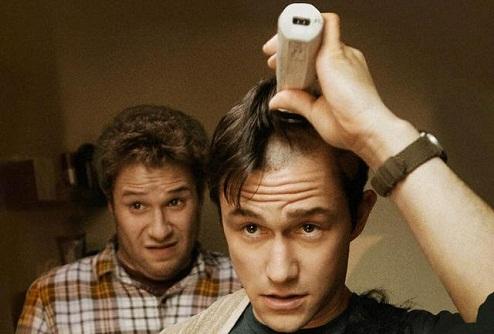
 The big shave.
Echoing its very title, which tells of the survival rate of people suffering from the spinal cancer that Joseph Gordon-Levitt's character has contracted in the film, "50/50", at the same breath, equally focuses both on despair and optimism as it pushes its way to highlight the often tackled issue of mortality.
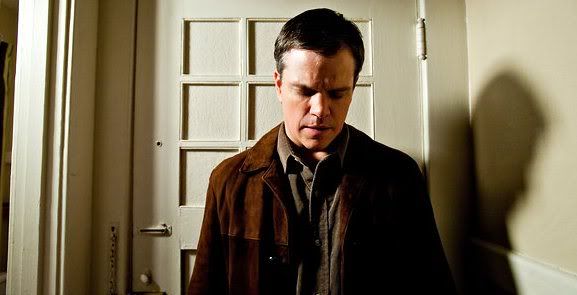
Almost single-handedly carried by Joseph Gordon-Levitt's simple yet very effective performance as the cancer-stricken Adam Lerner, the film, directed by Jonathan Levine and written by Will Reiser (which I found out to be Seth Rogen's real-life friend who was diagnosed with cancer in his early 20s), is a bittersweet eye-opener regarding the reality of cancer patients that stare death at its very eyes on an everyday basis, while making the often uttered and always superficially imposed phrase 'live like you're dying' literally a thing of urgency. But what's wonderful with this film is how it has gravely wrapped its narrative around the inescapable reality of being diagnosed with cancer yet never completely succumbed to what's bleak and hopeless.
"50/50", fully advertised as a buddy dramedy of sorts between Joseph Gordon-Levitt and Seth Rogen, surprisingly does not capitalize on the very mere idea of these two starring in a film. Hell, even the tagline teasingly said so ("It takes a pair to beat the odds"). While both of them had their share of poignant moments together, the film's emotional drive is not concentrated to just both of them but is instead finely rationed among its other characters, namely Adam's mother, played by Anjelica Huston, his rookie therapist, played by Anna Kendrick, and his artist girlfriend, played by Bryce Dallas Howard.
As I'm watching the film, I initially thought that Seth Rogen's character Kyle, Adam's best pal, was integrated into the film merely for some sideshow comedy and nothing more, which entails the fact that maybe, the chemistry between Gordon-Levitt and Rogen may end up humorously great but dramatically lacking.
But then I realized that having Rogen and his usual improvisational self in the film made him a potent antidote to counter the film's potential brushes with dramatic clichés. Making him all too serious and suddenly turn him all too teary-eyed at Gordon Levitt's pitiful character can be a bit awkward and is a complete departure from what made Seth Rogen popular in the first place. Fitting enough, Rogen's comic performance made the film more naturally dramatic and his character's relationship with the main character Adam feel more genuine.
Joseph Gordon-Levitt, a truly versatile actor who can play a lovestruck average Joe on one film, transform into a convincingly stern, gravity-defying action hero on another while still skillful enough to turn all psychotic and murderous on the next, embraced subtlety in this film, portraying the different psychological phases of a cancer patient, the various physical pains and the seemingly cold acceptance of the inevitable with a great display of bravery but also of an evident 'Why Me?' frustration.
Although "50/50" centers at the harsh reality of cancer, it has prevented itself to be completely overwhelmed by hodge-podge sentimentalism and preachy utterances about hope and survival that make films of this type all too fleeting. Instead, with this change of tone, it has given the film a cleaner and infinitely more honest emotional atmosphere.
"50/50" is relatively unique in its dramatic and comic effortlessness as it ironically tackles a laborious, life-threatening illness. And while we may all have immediately foreseen the sad inevitability of Adam Lerner's fate, there's still an unconsciously lingering thought, with the film successfully equalizing optimism and the otherwise, that it may just be a boulder-like obstacle that can certainly be endured.
'Keeping up with the battle' or 'dying without a fight'; 'family and faith' or 'to concede and surrender'. "50/50" takes these absolutes and laid it into the open. The film maintains the fact that the act of 'fighting' or 'giving-up' does not just apply to battling cancer, but also to life in general. And that cancer, although it has prematurely claimed countless lives, is not always an end but sometimes just a phase. "50/50" surely holds on to that claim for a reason.
Almost single-handedly carried by Joseph Gordon-Levitt's simple yet very effective performance as the cancer-stricken Adam Lerner, the film, directed by Jonathan Levine and written by Will Reiser (which I found out to be Seth Rogen's real-life friend who was diagnosed with cancer in his early 20s), is a bittersweet eye-opener regarding the reality of cancer patients that stare death at its very eyes on an everyday basis, while making the often uttered and always superficially imposed phrase 'live like you're dying' literally a thing of urgency. But what's wonderful with this film is how it has gravely wrapped its narrative around the inescapable reality of being diagnosed with cancer yet never completely succumbed to what's bleak and hopeless.
"50/50", fully advertised as a buddy dramedy of sorts between Joseph Gordon-Levitt and Seth Rogen, surprisingly does not capitalize on the very mere idea of these two starring in a film. Hell, even the tagline teasingly said so ("It takes a pair to beat the odds"). While both of them had their share of poignant moments together, the film's emotional drive is not concentrated to just both of them but is instead finely rationed among its other characters, namely Adam's mother, played by Anjelica Huston, his rookie therapist, played by Anna Kendrick, and his artist girlfriend, played by Bryce Dallas Howard.
As I'm watching the film, I initially thought that Seth Rogen's character Kyle, Adam's best pal, was integrated into the film merely for some sideshow comedy and nothing more, which entails the fact that maybe, the chemistry between Gordon-Levitt and Rogen may end up humorously great but dramatically lacking.
But then I realized that having Rogen and his usual improvisational self in the film made him a potent antidote to counter the film's potential brushes with dramatic clichés. Making him all too serious and suddenly turn him all too teary-eyed at Gordon Levitt's pitiful character can be a bit awkward and is a complete departure from what made Seth Rogen popular in the first place. Fitting enough, Rogen's comic performance made the film more naturally dramatic and his character's relationship with the main character Adam feel more genuine.
Joseph Gordon-Levitt, a truly versatile actor who can play a lovestruck average Joe on one film, transform into a convincingly stern, gravity-defying action hero on another while still skillful enough to turn all psychotic and murderous on the next, embraced subtlety in this film, portraying the different psychological phases of a cancer patient, the various physical pains and the seemingly cold acceptance of the inevitable with a great display of bravery but also of an evident 'Why Me?' frustration.
Although "50/50" centers at the harsh reality of cancer, it has prevented itself to be completely overwhelmed by hodge-podge sentimentalism and preachy utterances about hope and survival that make films of this type all too fleeting. Instead, with this change of tone, it has given the film a cleaner and infinitely more honest emotional atmosphere.
"50/50" is relatively unique in its dramatic and comic effortlessness as it ironically tackles a laborious, life-threatening illness. And while we may all have immediately foreseen the sad inevitability of Adam Lerner's fate, there's still an unconsciously lingering thought, with the film successfully equalizing optimism and the otherwise, that it may just be a boulder-like obstacle that can certainly be endured.
'Keeping up with the battle' or 'dying without a fight'; 'family and faith' or 'to concede and surrender'. "50/50" takes these absolutes and laid it into the open. The film maintains the fact that the act of 'fighting' or 'giving-up' does not just apply to battling cancer, but also to life in general. And that cancer, although it has prematurely claimed countless lives, is not always an end but sometimes just a phase. "50/50" surely holds on to that claim for a reason.
FINAL RATING